Proverbs 12:24: Build Your Wings

Diligent work will open opportunities for advancement but lack of direction means you will be forced to take jobs that only necessity provides.

Series: Proverbs for Business

“The hand of the diligent will rule,
while the slothful will be put to forced labor.”  Proverbs 12:24 (ESV)

Who controls your career path?

As I’ve written before, I don’t believe the Bible teaches that God has a specific plan mapped out for your life but expects you to make decisions that are moral and good. Since we don’t have to look for omens or vague feelings to guide our career choices, we need to use good judgment and strategic decision making. How much control do you have on your career path?

Internally-driven people realize that they have to look for or create opportunities and make decisions that advance their career growth. Externally-driven people are waiting for the company or their boss to give them a path and promote them  and that the market gives and takes away growth potential. Though you may not be a lazy worker, as in the proverb above, if you are not diligent about taking control of your career direction you will, like the forced laborer, only have what life circumstances force you to accept.

If you do not direct your business path, someone will do it for you. If you leave the direction to others you must remember that they are acting in their own interest and will only help you inasmuch as it helps them. No one will be as passionate or invested in your career success as you so don’t expect even the most benevolent boss to provide the best career guidance.

Your skills are your job security

I interviewed with a successful CEO and asked about job security should I switch to his company. He provided the most sage answer that has proved to be true: your skills are your job security. Learn new software, maintain knowledge of what is going on in the industry and where it is going, develop and enhance communication, productivity, and leadership skills and be a lifelong learner and your skills will remain current and useful no matter what happens with your current job. This requires sacrifice and diligence. This requires unpaid time away from the office reading industry and general business books, blogs, and magazines, attending industry association and general training, and developing business relationships outside of your company and industry. In developing these skills, you will provide more value to your company and be able to direct your career path instead of being forced to do whatever is available.


Class Book: Sing With Understanding

I wrote this class book to explore the Biblical principles behind the songs we sing. I love learning the stories behind the spiritual songs we sing in books such as*:

*Affiliate links

For some information on enriching your public singing in worship I’d suggest visiting the  Get Them Singing website.

This class book focuses on the major Bible themes of our songs allowing for discussion of both the Bible teaching and reading the words of popular hymns to explore the meaning described in poetic terms. I list suggested familiar hymns for each lesson and some questions reference particular hymns.

Sing With Understanding CoverIt is a 13 lesson series which fits well into most Bible class schedules. There is plenty material to discuss the topics in two class periods per week. I have often taught the Biblical principles in the Sunday class and explored the words of selected hymns in a mid-week Bible class. It would also be suitable for a small group study.

The book contains only questions which will require the teacher to develop the material to suit the class. I have taught it in adult and high school classes.

You may freely copy this book for your classes. It is 16 pages so it will not cost much to print. You may want to print the cover page separately then print pages 2-16 duplex to save paper.

Download Sing with Understanding.

Lesson Listing

  1. Introduction
  2. Eternal God Our Creator
  3. God Our Protector
  4. God Our Shepherd and Guide
  5. Resurrection and Judgment
  6. Crucifixion
  7. Grace and Salvation
  8. Battle Songs and Victory
  9. Kingdom of God
  10. Evangelism
  11. Brotherly Love and Unity
  12. Christian Living
  13. Heaven

How To Deliver a REAL Apology

Real apologyAccept responsibility for your failures

Think of the last time you did something wrong. Why did you do it?

  • “My brother (or friend) made me do it”
  • “Everyone else was doing it.”
  • “The Devil made me do it.”

When we do something wrong it is easy to blame someone else. When Adam and Eve ate the forbidden fruit in the Garden of Eden, Adam blamed Eve for his sin. He was also blaming God because he blamed the woman God gave him. Eve blamed the serpent (Genesis 3). In 1 Samuel 15, King Saul blamed the people for his sin. However, when we do something wrong, we can only blame ourselves.

Other people may urge you to do something wrong or tempt you to disobey your parents, if you are a young person, and God. But you—and only you—choose whether to obey or disobey. Someone might make it difficult to choose the right thing, or you may feel embarrassed to choose the right action, but you can make that tough choice.

I had a sign in my room in high school and college with a saying attributed to the British Foreign Office*:

“Never Excuse. Never Explain. Never Complain.”

When you complain and blame you are saying that other people have control over your life. Irresponsible people make excuses for why they couldn’t complete a task, do their chores, or fulfill the responsibilities expected of them. They have lengthy stories and explanations of what went wrong and why they couldn’t keep their word and fulfill their obligation. They complain about lack of resources, time, ability, or the impact of others on their life.

The sign was a reminder to the officials to do what was expected and keep their word because no one wants to hear their excuses, reasons for failure, or whining. That is why I posted it on my wall.

Be strong and accept the embarrassment and penalty for your wrong.

Irresponsible responses

The non-apology: “If I did anything wrong…” Either you did or you didn’t. Avoiding your obligation to apologize, blaming everyone else and not accepting responsibility, or making excuses instead of owning your behavior. We must accept responsibility for our actions and our response.

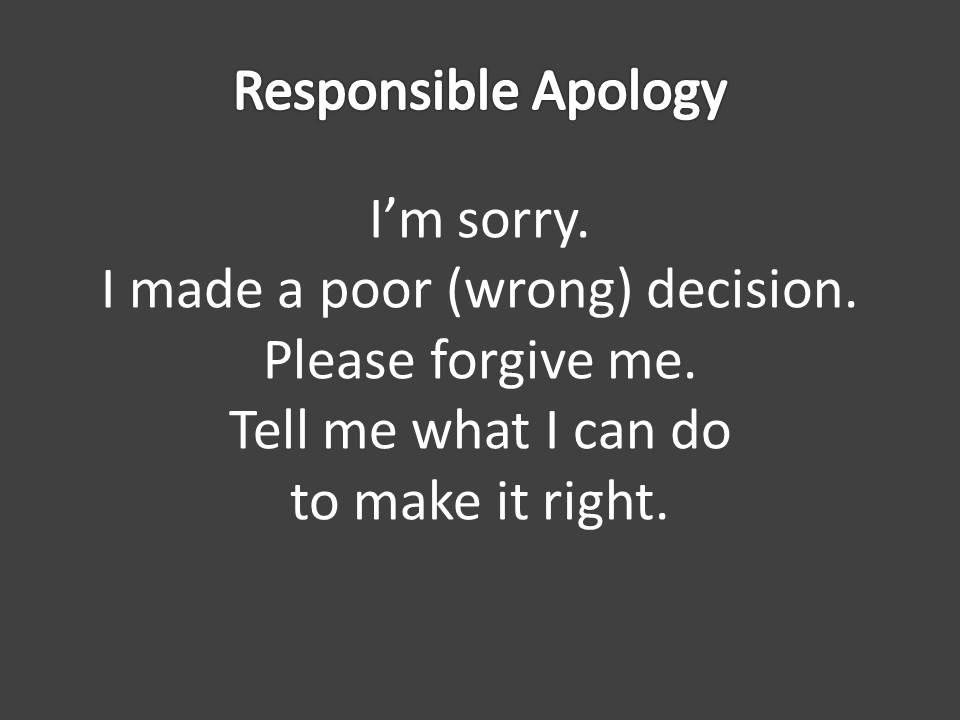
A responsible apology

“I’m sorry. I made a poor (wrong) decision. Please forgive me and tell me what I can do to make it right.”

  • You acknowledge that your choice has hurt or caused difficulty for another and for that you are sincerely sorry.
  • You take responsibility for your choice without offering excuses or explanations.
  • You ask for their forgiveness because you need it.
  • You ask what you can do to correct your poor choice. Maybe you can replace something, apologize to someone else, or maybe you can do nothing. But offer to do what you can to make it right and act quickly.

You will be proud of yourself, you will bring honor to yourself, you will be responsible, and you will glorify God.


*I’ve tried to verify it but have had little success confirming it. Any concrete attribution would be appreciated.

Own Your Life and Give Up Your Excuses

Kyle Maynard’s Story

Kyle Maynard wrestled in high school and in college for the Georgia Bulldogs. He set records in weightlifting, fought in mixed martial arts, and ascended to the summit of Mt. Kilimanjaro, the highest mountain in Africa. These would be amazing feats for anyone to achieve but they are more amazing when you consider Kyle Maynard’s physical condition: he was born with a condition known as congenital amputation. Most of his arms and legs were not there at birth.

According to his biography, his parents told him that the world would not be designed to meet his needs so he would have to find ways to adapt to how the world works. “With basically two elbows he can type up to fifty words per minute on a normal keyboard, eat and write without any adaptations, drive a vehicle that has little modification, and live on his own in a three-story townhouse in Atlanta, GA.” He can feed himself, shave, and otherwise take care of himself.kylemaynard

He had many challenges: he lost every wrestling match for most of the two years he competed but with an iron will and parents who supported him he won 36 varsity matches, defeated several state champions, and bench pressed 240 pounds 23 times and, with leather straps and chains, lifted 420 lbs. “In April of 2009, Kyle became the first quadruple amputee to step into the cage and compete as an amateur mixed martial arts fighter. Kyle’s focus is on grappling and ground fighting — he’s currently in his 7th year studying Brazilian Jiu-Jitsu and now training with Renzo Gracie black belt Paul Creighton.”

The reason that Kyle had such success is that he took responsibility for his life instead of giving up because of his physical condition.

Taking responsibility means giving up your excuses

In Matthew 25:14-30 Jesus told the Parable of the Talents. The master was going away and entrusted his servants with various sums of money and expected them to use that money to make more money for him. The master had different expectations for each man but expected all to prosper. He rewarded or punished the men based on how they used the talents. When the master returned, two of the servants had some success but one failed prosper. He thought he was playing it safe but the master was angry and punished him for being a wicked and useless servant.

This is a parable of judgment. The issue is not taking care of money but using what God has given us to His glory. God will judge us on how we use or waste our lives and the blessings He has given. Two men made a choice; one made an excuse.

So then each of us will give an account of himself to God, Romans 14:12

What is “responsibility”?

There are many definitions available. For our purposes, one could define responsibility as:

  1. The state or fact of having a duty to deal with something or of having control overs someone or something
  2. The state or fact of being accountable or to blame for something
  3. The opportunity or ability to act independently and make decisions without authorization

Responsibility means trust is placed in an individual with expectation that they will fulfill their obligations without being told or threatened, accepting the good and bad consequences of their actions, and running to responsibilities instead of hiding from them.

Accepting responsibility is the essence of being mature

God has given us free will – the right to choose our course of life. We are not robots who follow a predetermined program. He does not force us to do His will or refrain from sin. Like the servants in the parable of the talents, we are given great freedom in what we choose to do with what God has given us. We are stewards of the life God has given us and He will hold us accountable for our actions or failure to act. God has given us control over how we live our lives.

I remember when I got the keys to my first car. The keys meant I had the freedom to go where I wanted when I wanted. I didn’t have to depend on anyone for a ride and I could go on dates. I was also responsible for paying for gas to fuel my freedom. I had to wash and clean it if I wanted it to look nice: no one did it for me. I was also accountable for the safety of myself and my passengers. One night I almost killed myself and two girls by being stupid behind the wheel. When I was given the keys to the car I was given freedom, responsibility, and accountability.

God has given us the keys to our life and with them freedom, responsibility, and accountability for how we use our lives. Paul wrote in 2 Timothy 3:16 -17 that God’s word fully equips us for EVERY good work so we can’t blame God for not telling us what to do.

One of the most sobering passages of scripture is Romans 14:12: “So then each of us will give an account of himself to God.” We will have to answer to God for how we lived our life: the choices we made and the things that we failed to do. 2 Corinthians 5:10 – “For we must all appear before the judgment seat of Christ, so that each one may receive what is due for what he has done in the body, whether good or evil.” Our parents don’t answer for us. The preacher or elders don’t answer for us. We cannot blame or credit anyone else for how we have lived. We receive reward or punishment based on what we have done.

Some people fail to accept responsibility for their lives. Some churches filled with people who are spiritually weak and biblically ignorant having given no serious effort to their spiritual growth. Churches need spiritually strong Christians grounded in God’s word to live faithful holy lives and to serve God and others. In some churches a few are willing to step up and work and learn new responsibilities but they are surrounded by irresponsible people who are willing to let others work and do not challenge themselves to godly service.

Some people won’t grow up. Most kids know the story of Peter Pan, the boy who never wanted to grow up, only wanted to play, and escaped from the real world to keep up his immature life. Far from being discouraged in our society, our emphasis on professional play, entertainment, and sexual promiscuity encourage a long period of irresponsibility. Some boys and girls do not want to leave play time to transition into the society of responsible men and women. I shocked a person who wondered why video games are intense and had language and other mature characteristics when I told her that video games weren’t made for kids, the biggest users are young adult men. I’m not condemning the playing of games because alcohol, laziness, non-electronic hobbies, etc. can limit a young person’s growth or lead people to perpetual adolescence. Though talking about spiritual gifts, 1 Corinthians 13:11 tells us there is a time to put away the childish things and accept responsibility.

Instead of seeking responsibility, some are passively avoiding it. They let others do the work. They wait for others to direct them to work. We have a lot of boys running around in men’s bodies who will not do hard work, want others to do things for them instead of serving others, seek entertainment and comfort instead of embracing the mature satisfaction of rising to the challenges of life. Proverbs 10:5 reminds us “He who gathers in summer is a prudent son, but he who sleeps in harvest is a son who brings shame.”

Help others with their burden

Opportunity plus ability equals responsibilityThe Christian must rise to action to serve God, not hide or wait for others to work, but must seek opportunities to serve and rise to the task. John, in 1 John 3:16, describes a brother in need who requires an open heart and active hands to help him. Faced with this situation, the Christian should act if they can help. No one has to tell you to act: the situation calls you to action. When we encounter an opportunity to help, and we can help, then are responsible to act.

Be honest about your ability. You may not have the cash but can you use your time and energy to help the situation? Maybe the need isn’t financial, perhaps someone needs a friend, sympathetic ear, or word of encouragement.

Bear your own burden

We can help other people carry their burdens but everyone is responsible to carry their own burdens, Galatians 6:1-5. Some people will let you carry all of their burdens: do their work, make lots of demands on your time, etc. They might try to make you feel guilty for not doing more but remember they are responsible for their own lives.

Many years ago I spent several hours at the house of a husband and wife with marital problems AND problems raising their kids. I gave them some practical things to do to help in both situations. A couple of weeks later they called during the middle of some family time saying, “You need to come over here. We’re having problems.” I asked if they had followed the advice I gave earlier. They said “no.” I told them to discuss these things because I wasn’t going to come over repeat the advice they ignored. I didn’t feel guilty because they had ignored my help before. I would have sacrificed precious time with my family because these people were making poor decisions in their family and until they made different choices they would continue to have the bad consequences.

Conclusion

We have so many opportunities to let God’s light shine through us but we have to look for opportunities and act without being asked. Living this life will enrich your life and the lives of others and glorify your God.

What Price Will You Pay for A Good Time?

I met someone a few weeks ago that reminded me that when people choose to live time in sin, they not only waste that time of relationship with God and fellow Christians and good influence, He struggled with drug use and other immoral behaviors and was far behind his peers in career and life advancement because he is having to break from a terrible addiction. The consequences of his decisions are more than a damaged body. His dignity, self-respect, economic status, freedom, and relationships have been damaged. He is struggling to hold onto faith and rebuild his life.

A young man walks into the desolate desertSome are not addicted to drugs but become ensnared by immoral behavior. They start going to places they once avoided. They quit feeding on God’s word (if they ever ate deeply), occasionally snacking on devotional passages or positive verses while ignoring the call to holiness and righteousness demanded by the savior, and quit associating with Christian friends that will hold them accountable. Eventually they are drawn deeper into immorality, doing things they never thought they would do, and learning the emptiness of sin’s illusions.

IF they return to God (not guaranteed) they waste even more time trying to disengage from immoral behaviors and habits, emotionally wrestle with past sinful behavior, struggle to rebuild a relationship with God and those they have alienated, and rebuild their dignity and reputation. Sin leaves scars and the person will not be the same again. They can repent and strive to live a holy life and even accomplish some great things for God. Yet I have met some of the most active and enthusiastic Christians who mourn the decisions of an immoral past even though they know they are forgiven. There is an emotional price to sexual immorality and a relationship impact on future relationships. There is shame for actions taken and things said while intoxicated (Proverbs 23:29-35). More than this, there is the spiritual weakness while separated from God and His people and the loss of spiritual growth as one abandons serious personal Bible study, engaging in worship, and spiritual discussions with godly people. That time will never be recovered and the spiritual neglect will lead to a diseased soul.

It was sad seeing a guy who lost years to sin and more years to recovery because he wanted to enjoy the sinful life. It’s even sadder thinking of people I know who died during the time they wandered from God because they were with people doing ungodly things or never had time to return to God. I think also of some who became so involved in sin that they could not find their way back. Others felt they had done too much or really wanted to have that relationship with God they once had but felt but weren’t motivated enough to change. Sadly, their life is not better for having left the Lord. Jesus paid the ultimate cost to purchase their salvation but they crucified Him again to take the old life of sin from the cross and let it live again in them, Hebrews 6:4-8.

It reminds me of a friend’s wise, oft quoted, admonition: “Sin will take you farther than you wanted to go, keep you longer than you wanted to stay, and cost more than you wanted to pay.”

Though it is talking about adultery, read Proverbs 5:7-14 in the context of being seduced by sin, replacing the seductive message of the woman with the deceptive appeal of Satan, and ponder the price of a life alienated from God:

And now, O sons, listen to me,
and do not depart from the words of my mouth.
Keep your way far from her,
and do not go near the door of her house,
lest you give your honor to others
and your years to the merciless,
lest strangers take their fill of your strength,
and your labors go to the house of a foreigner,
and at the end of your life you groan,
when your flesh and body are consumed,
and you say, “How I hated discipline,
and my heart despised reproof!
I did not listen to the voice of my teachers
or incline my ear to my instructors.
I am at the brink of utter ruin
in the assembled congregation.” (ESV)