5 Ways to Use Social Media to Glorify God and Teach Others

Most teenagers have some type of social media account (Facebook, Twitter, Google+, Pinterest, Myspace) they use to exchange information and cat pictures with their friends and keep up with what is going on in their world. Some consider these networks to be the opening of a great world of information sharing while others  cite them as examples of the downfall of civilization. In truth, they are neither good nor evil but are simply tools that can be used and abused.

socmedia logos

Like anything in their lives, Christians must use social media properly to be bright lights in a dark world and reach out to those who have no relationship with Him. Because of the connecting nature of these tools, we have opportunity to use them to connect others with God. Here are five ways we can use social media to glorify God and teach others.their spiritual life instead of polluting their heart or distracting them from God’s service.

  1. Remember that the things that come out in social media are the things that are within your heart. Let your heart be filled with good things and let them be evident to others.Be a good example. Social media posts reflect the things that we want the world to see about us. They often reflect our interests, beliefs, principles, and loves (and too often our meals–whatever). Do the things we “like” reflect whatever is pure, lovely, commendable, and excellent? (Philippians 4:8)
    • What do the musical groups, television shows, movies, actors/actresses, etc. that we like say about what we put into our hearts?
    • Do the things that we share include profane or foul language?
    • In our pictures, are we dressed modestly?
  2. Edify others. The word “edify” means to “build up.” Do the things that we say encourage others or do we gossip about  r insult others? When we know that someone is going through a difficult time we can offer words of comfort or let them know that we are praying for them. As people discuss their needs, we can see opportunities to serve them. Perhaps we can ask our parents to help us prepare a meal for them if they need one or go over to their house to visit and pray with them. When things are going good we can rejoice with them (Romans 12:15).
  3. Invite them to teaching opportunities. Facebook is a great way to announce Bible studies and worship services to your friends. You can lead them to teachers of truth.
    • For example, you could post “We’re having this great study in our Teen Class on ___________. I have really been learning about ___________________ and it has helped me a lot! Our next class is this Sunday morning at [time]. We meet at [address] -or- give link to the church web site if you have it.”
    • You can also advertise special Bible classes, gospel meetings, or sermons directed towards visitors. Post the invitation several times over a  few days and especially the day before the event.
    • Reflect the excitement you have in how it helps you as you try to interest others in attending.
  4. Teaching others.  Facebook’s sharing features are a great tool for sharing articles (like these on GodlyYouth–hint), Bible verses, links to audio/video sermons, books. and other material useful for teaching others. When you read a good article that educates or encourages you, share it with others and note the things with which you agree or disagree or important points to consider with this resource. Some people share quotes, hymn lyrics, and Bible verses which can be a positive message on the Facebook wall. You can also take opportunity when someone is saying something wrong about what the Bible teaches, use the opportunity to correct them in a spirit of meekness (2 Timothy 2:23-26). When someone says they don’t understand something about the Bible or what’s going on in the world, offer to study with them privately online or in person.
  5. Be a peacemaker. Jesus blessed the peacemakers in the Sermon on the Mount, Matthew 5:9. Social media gives us opportunity to cause problems with others or be at peace with them. If our focus is on the salvation of souls, we will not have a spirit of bullying others or tearing them down online. We cannot control what others do but “as much as depends on us” we can live in peace with others, Romans 12:18. Don’t use social media to gang up with others on another person, to tear down or insult others, or senseless arguments. There may be times when you must disagree but can do so without being disagreeable. Be careful in your choice of words and the tone of your message so even if you speak things that are not acceptable to the recipient, your attitude will be honorable. Realize that you may still be misunderstood, reviled, and insulted, but don’t answer in kind. Respond in humility as Jesus did, 1 Peter 2:23-25.

Advice on Developing Sermons for New Preachers

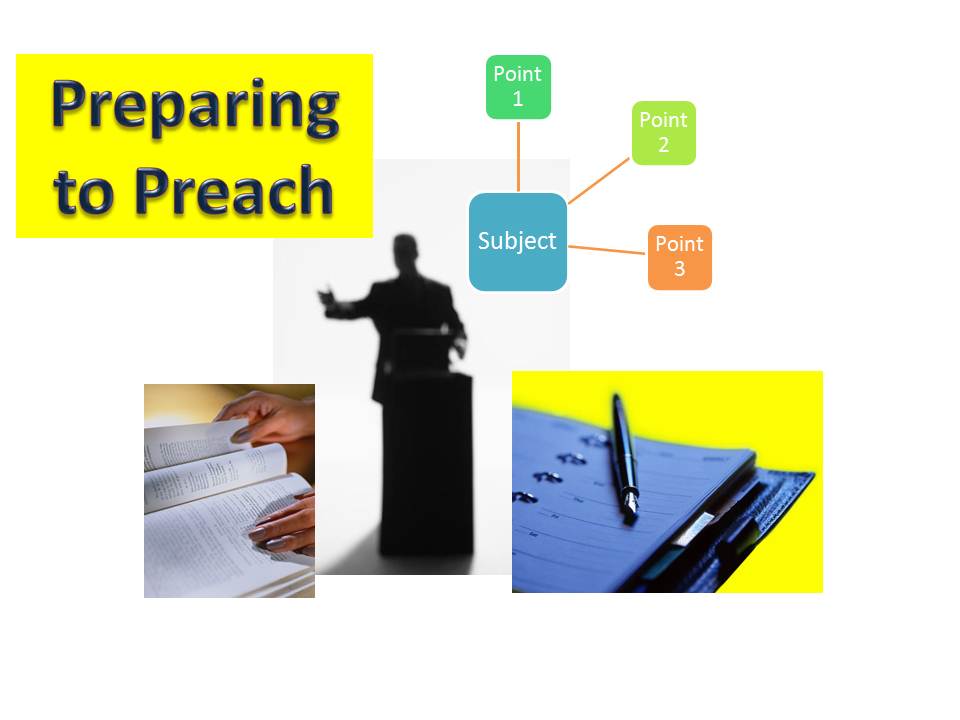
I have been asked several times in the past few weeks for advice on how to organize one’s work for preaching by people who were starting out as preachers seeking advice from other experienced preachers on how they do the work. The following are some observations I shared with these men based on my work and my experience. I emphasize this because each preacher probably has an approach and method that works perfectly for them that would not be as effective for another preacher. Although the work of the preacher is broad, this article focuses on how I approach sermon planning and development.Preparing to Preach

Planning

Every three to six months I review the list of lessons that I preached in the last 3 or 6 months and identify the topics/subject areas I need to preach on in the next 3-6 months (and even some topics to consider in the next review period that won’t fit into the next 3-6 months). As best as I can I set up a calendar with the topics that I want to preach on which dates. I do not make this so concrete that I cannot intersperse lessons that need to be preached on needs that arise during this period. Flexibility is extremely important.

This approach helps me balance the lessons that are more in-depth studies with ones that are more exhortation and not as mentally taxing. I would also look for other areas to keep balanced such as lessons focused on Old and New Testament topics. I keep a list of sermons I’ve preached by date and place and keep each year in a separate tab on a Google Docs spreadsheet (I share this with the man who posts the sermons online so he knows what title to use for the lesson). This helps me make sure that I cover a wide range of congregational learning needs, planning my personal study applicable to the sermons, avoiding the mind blank question, “What am I going to preach on Sunday?”, and prevent unnecessary redundancy in the topics on which I preached.

Time Management

When preaching full-time, I would usually schedule Friday and Saturday off (assuming no emergencies) but often needs arose to which I would be called. However, having this in mind saved me from having to work late on Saturday trying to get something ready for Sunday–a problem compounded if there was also an emergency on Saturday to which I would be called. I would start my sermon prep on Monday morning. My goal was to have both sermons and the Bible classes completed by Wednesday. Those three days would be focused on the study for the lessons, writing them out, and preparing the visuals. Some of the more in-depth lessons might be developed over the course of multiple weeks but that need would be identified in the planning process. This allowed me to have Thursday for in-depth study on a topic of personal interest that I wasn’t necessarily preaching or teaching on at the time. (of course, there were hospital visits, visits with members, studies with non-Christians and new converts, etc. interspersed during this time).

The best thing I did when preaching full-time was getting a calendar broken down in 15 minute increments (appointment calendar). I wrote down everything I did in the time slots (what I studied, who I called, which sermon/class I worked on, reading, visits, etc.). At the end of the week I calculated to make sure that I had at least 40 hours of legitimate preaching work (generally more than 40 hours but if a “4o hour week” is the minimum in the work world, how much more should one be working hard in his labor for the Lord’s kingdom). More importantly, as I reviewed each week I could identify ways to make my work more efficient or identify time intensive activities that might be better assigned to or shared with someone else. For example, there was a lot of time spent on folding bulletins–so I changed to a format that did not require folding or making sure everything was centered for the fold. There was also work that I was doing that made more sense for one of the deacons or interested members to do to allow me to focus more on the study and give that members something to do that contributed to the growth of the congregation. In fact, I found members who were eager to help with correspondence course mailings, etc.

Sermon Preparation

Since, based on planning, I know what I want to preach, I rough out some ideas that I want to cover–not an outline, just some main points and questions I want to answer from my study. The greatest focus of the preparation is immersing myself in the texts related to the lesson to first learn the message of the scriptures. Through the study, other points usually reveal themselves and occasionally eliminate some of the main points I was going to emphasize. This study is the bulk of the work as it should be. I then sketch a Mind Map to develop the order of the lesson (Mind Maps are great tools for planning and organizing thoughts). Working from the Mind Map I write the outline of the lesson. I then go back through and see what areas need illustration or further explanation.

After writing the outline, I do a sweep to see what I need to trim from the lesson. There is an important concept from the writing world: kill your darlings. Sometimes you have a point that you really like or an illustration that seems so good but, in all honesty, it detracts from the lesson or goes on a tangent. Have courage and remove it. Like I note in the next paragraph, you can make use of it in other ways but don’t fall in love with a point or illustration and let the rest of the lesson suffer as a result.

Don’t Do Anything Once

The most practical piece of advice I give to other preachers is don’t do anything once. Use the fruit of intensive study to develop a sermon (or three), write bulletin articles using the points used in the sermon(s) or information that you could not include in the sermon (the darlings you killed) for immediate publishing or to keep in a collection for when time is limited, and copy the bulletin articles as blog posts to share with a broader audience. Often you can use material developed through a deep study to write class material or handouts you can give to people for questions related to that topic. Both the blog articles and handouts allow you to answer common questions by giving prepared information instead of recreating the wheel when questions come up. Finally, keep your notes, articles, handouts, class material, sermon outlines, source material, and other information in a place where you can pull it for refresher study or as the building blocks for future projects. I have a premium subscription to Evernote (Microsoft OneNote can work as well) so I can store PDF and other file formats and access them from my laptop, other computers via the web, and my smartphone. It is a great tool for free and even better for the $45/year premium upgrade. Efficiency allows you to spend more time in the study and service that is important for the kingdom of God.

Difference in Sunday AM and PM Lessons?

Whether one approaches the type of sermon preached on Sunday morning and afternoon depends on the audience. The places I preached full-time, we usually had more visitors on Sunday morning than in the evening (we only have Sun morning services were I preach now) so I might not preach such in-depth lessons. Sunday morning was usually first principles, basics of Christian living, etc. Please consider that probably 95% of the average worship attendance is comprised of those who are already Christians so preaching a lot of lessons on how to become a Christian is, in my opinion, wasted teaching opportunities. Focus on how to live the Christian life, the virtue and blessings of such a life, scriptural answers to life challenges, holiness, and answering specific false teaching and leave most of the “how to become a Christian” to personal studies with the non-Christians and studies with the young people. On Sunday evenings I might do a more in-depth studies on something like millennialism,  Calvinism, etc. and training lessons such as evangelism and service.

Preaching a Series

I heard advice long ago to not announce you are preaching a series. If the series is not going well, you can quietly abandon it if you have not announced it. Announce it, and you feel obligated to it even if it doesn’t seem to be working. I think either approach you described could work. The advantage of spending each lesson on it (or Sun morning and evening) is that the linking info from other lessons is fresher. If the future lessons depends much on the prior lesson I would absolutely keep them close. If the lessons tend to stand on their own, the one or two each month would probably work fine.

Recommended Resources

There are some good resources for preaching available. If I had to recommend three they would be:

  1. 1 and 2 Timothy and Titus. Spend much time in these epistles for the instruction of the wise inspired apostle Paul to these preachers. They are a great source of encouragement, instruction, and exhortation.
  2. Common Sense Preaching by Dee Bowman is an excellent book written by an experienced preacher of the word.
  3. Letters to Young Preachers by various authors. If this book had only the letter by Sewell Hall it would be worth the price of the book. However, there are letters from many wise preachers on the work of preaching including teaching Bible classes and presenting sermons. I can’t recommend this too highly.

Most of all, approach all parts of planning, study, and preaching with liberal time in prayer to God. Never forget, your service is to His glory, not yours.


The Leading of the Holy Spirit

Mark Copeland wrote an extremely insightful and well explained description of what the Bible teaches about the leading of the Holy Spirit: http://executableoutlines.com/hs/hs_09.htm It describes the leading of the Spirit through the word and the implications of the Holy Spirit in the life of the Christian. In my life I have seen brethren who believe that the Holy Spirit speaks to them directly telling them what Bible passages mean, what job to take, where to live, etc. Though Francis Chan called the Holy Spirit “The Forgotten God”, He is also subject to the most misunderstanding and speculation. Scripture doesn’t give us many details of much of His work but that doesn’t stop people from attributing messages and direction to Him. (Great review of that book by Gardner Hall here: http://www.gardnerhall.com/articles/reviewForgottenGod.html note: Hall also talks about scriptural problems with Chan’s “Spirit leading” teaching).

The clear problem is that the Scriptures do not teach a direct leading of the Holy Spirit in the revelation of God’s will when we study or specific direction in our lives. There are no instructions for Christians on how to listen for the Spirit or how to discern between the message of a person’s spirit or the Holy Spirit after the period of spiritual gifts have ceased. There is no scripture addressing the consequences when we don’t move to the place or take the job as the Spirit directs (is it the same as breaking an explicit command of Scripture?–why not?). Furthermore, those who believe the Spirit speaks to them directly cannot explain how so many people who claim to be divinely led by the Spirit speak contradictory things when “God is not the author of confusion.” Where are the explicit miracles to accompany the revelation of God’s will as that which accompanied the revelation of God’s word in the Scriptures?

Many years ago I knew some people who first believed that the Spirit helped them understand God’s word and that He would set up “appointments” for them. Eventually, they became so “Spirit led” that they felt the Spirit was dictating what they should wear, where they should eat, and would give them words to say–essentially becoming puppets of the Spirit who no longer made decisions for themselves. This is a departure from the Bible description of lives transformed by the study and application of the Spirit-inspired scripture that become  spiritually discerning, kingdom focused, looking for opportunities to teach and edify, and making life choices (such as careers and where to live) in view of how the choice can glorify God.

7 Great Resources on Modest and Immodest Dress

The constant barrage of sensual images from the media have trained the modern eye to seek more and more visual stimulation. The fashion industry has responded by providing clothing that is revealing and provocative to allow men and women to display their bodies in ways that draw attention to the flesh instead of the person inside.
The Christian is challenged to train his eyes to focus on what is pure and to choose clothing that reflects an inward godliness (1 Timothy 2:9-10).  Like Job, we should train our eyes (Job 31:1) and follow the New Testament instructions to let our minds dwell on what is pure (Philippians 4:8). Jesus said that one who looks on a woman to lust commits adultery with her in his heart (Matthew 5:27-30) but women especially should be careful not to place obstacles in a man’s desire to think pure by wearing revealing clothing (Romans 14:13; 1 Corinthians 8:12).
Here are some resources to help men and women watch out for each others souls in this important matter (not listed in any particular order).
  1. Brent Hunter Sermon Series This includes web sites for modest clothing resellers in the Adobe Acrobat file for the second lesson in the series.
  2. Jonathan Perz Articles on Immodest Dress In this two part series, Jonathan discusses the Bible understanding of nakedness and the application of customs and modern standards to our understanding of this issue.
  3. Apologetics Press: Baby Dolls, Beauty Pageants, and the Sexualization of Children If the title doesn’t make you click, I don’t know what will. Discusses the disturbing socialization of sensuality among children.
  4. The Suddenly Uncomfortable Cheerleading Uniform Parents are disturbed after a man films cheerleaders at sporting events and compiles them into a sensual video. As bad as this was, parents need to reflect on what the girls were wearing in public as the man filmed routines they were performing in front of grandstands of hundreds.
  5. A Father’s Plea For Modesty Yes I wrote this article but, as the father of girls and boys I wanted to share some observations that I hoped would help parents and young people with this issue.
  6. “Whatever Happened to Modesty” by Michael Hyatt Great thoughts from a very popular blogger
  7. David Hartsell’s Alabama Winter Camp Class on Modesty Another great resource on the Godly Youth website. Be sure to look at the lesson on lasciviousness as it lays the groundwork for the lessons on modesty and lustful dancing.

I recently preached a sermon on Modesty and referenced many of these resources. Here is the audio. (February 15-17, 2013 series)

When Christians Think Their Nation Is Wasting Away

Whether you are a citizen of the United States or another nation of the world, at times you may look at the choices of your fellow citizens and feel that the nation is wasting within and interpret events such as election results and natural disasters as the punishment of God on the wicked. It could be, for who can know the mind of God. But it may be that other purposes are being accomplished.

As I’ve written before, I do believe God rules in the kingdoms of men.  However, I think that while one cannot rule out that a particular natural disaster may be God calling some to repentance, we also cannot rule out that it may just be the product of the natural laws that God put in place when He created this world. In a series on God and suffering, I addressed this (particularly in the second article)

A question from my young friend Dana about the trends towards wickedness in the United States prompted my thoughts on this subject. In particular, could God allow America (or any other country) to elect leaders who encourage ungodly practices?

Since we ultimately trust that God rules in the kingdoms of men one can interpret certain outcomes as punishment on a people, but those outcomes could also serve other functions.

  • A preacher friend suggested that if the US falls, perhaps it will demonstrate the foolishness of building a government on humanistic wisdom.  When a nation builds on a foundation that does not incorporate the principles of God’s word, it can be our Tower of Babel so to speak. Those who know me well understand that I love history and two periods in particular: ancient history and the establishment of America. It is easy to get me to watch a documentary on the American Revolution and I would be hard pressed to pass on an opportunity to visit a historical site from that period. Yet, for all the mentions of God and providence by the founding fathers, the revolution was also a product of Enlightenment humanism. And while I will not complain about the formation and principles of our government, when we seek to establish a nation whose citizenry embrace the works of the flesh more than the fruits of the Spirit and “put their trust in chariots and horses (Psalm 20:7),” we should not be surprised when it weakens from within. It may be the punishment of God but it can also be the consequences of wickedness that is part of God’s order (i.e., Proverbs 5:21-23).
  • If our nation becomes more immoral (not determined by an election but the choices of each citizen), perhaps it will provide opportunities for the gospel since people are often seeking the light when they have journeyed far into the darkness and realize they are lost. Remember in Luke 7:36-50, it was the immoral woman who realized her wickedness that sought Jesus with a sorrowful heart and washed His feet with her tears. Simon was just as lost yet he didn’t realize his perilous condition because his wickedness was not so obvious in his own eyes. Perhaps a nation is allowed to wander into wickedness for the salvation of souls.
  • Maybe another purpose accomplished is that Christians will realize that God’s purposes will not be achieved through worldly leaders and legislation but taking the gospel to their neighbors. There are many immoral practices that are legislated and approved by worldly governments. Though Christians do not have to participate in these ungodly behaviors and can speak out against them, they should not expect that governments will consistently legislate in ways that harmonize with God’s will. As mentioned before, even allowing citizens to participate in such behaviors may ultimately work out for the good when some realize that the behaviors do not provide peace or joy and seek God’s way.

Regardless of whether our nation wastes from within or repents in sackcloth and ashes, God’s people, citizens of that heavenly kingdom, can take courage that their kingdom shall stand forever.