Mark Copeland wrote an extremely insightful and well explained description of what the Bible teaches about the leading of the Holy Spirit: http://executableoutlines.com/hs/hs_09.htm It describes the leading of the Spirit through the word and the implications of the Holy Spirit in the life of the Christian. In my life I have seen brethren who believe that the Holy Spirit speaks to them directly telling them what Bible passages mean, what job to take, where to live, etc. Though Francis Chan called the Holy Spirit “The Forgotten God”, He is also subject to the most misunderstanding and speculation. Scripture doesn’t give us many details of much of His work but that doesn’t stop people from attributing messages and direction to Him. (Great review of that book by Gardner Hall here: http://www.gardnerhall.com/articles/reviewForgottenGod.html note: Hall also talks about scriptural problems with Chan’s “Spirit leading” teaching).
Category: Know the Bible
God Rules in the Kingdoms of Men
Nebuchadnezzar, king of the mighty Babylonian Empire, remembered the words of God but it was too late. Walking the roof of his palace, he boasted to himself “is not this great Babylon, which I have built by my mighty power as a royal residence and for the glory of my majesty?” (Daniel 4:30 ESV) He then remembered the prophet Daniel’s interpretation of a troubling dream foretelling the great king being humbled by God for a period of time until he recognized that “the Most High rules the kingdom of men and gives it to whom he will,” (Daniel 4:25 ESV). God raised Nebuchadnezzar to power for his own purposes and his great empire would fall at a time of God’s choosing.
God Raises and Destroys Kingdoms
This central thought, “God rules in the kingdoms of men,” fills the Bible. It is demonstrated in visions of Daniel foretelling the rise of the Persian, Greek, and Roman empires. Isaiah and Jeremiah contain many prophesies of the rise and fall of the Assyrians, Babylonians, Moabites, Ammonites, Ethiopians, Egyptians, and others. When God divided Israel into Israel and Judah, God determined what person would divide the kingdom, the proportion of tribal division, and the preservation of David’s family rule in Jerusalem, 1 Kings 11:30-36. God punished the northern tribes (Israel) by raising the Assyrian Empire to take them into captivity and later bringing the Babylonian Empire to power to subjugate Judah and punish other nations. Yet God was in control of the situation and determined the time of Judean captivity (70 years) and raised Cyrus to power to allow the Jews to return to their homeland (Jeremiah 29:4, 10-14; Isaiah 44:28-45:7). God brings kingdoms into power. Romans 13:1 and 1 Peter 2:13-14 tell us that the authorities exist because of God and they are sent by Him for His purposes.
Some Kingdoms are Oppressive to the Faithful
Even though authorities exist because of God, this does does not mean that it will always be peaceful and calm for the Christian. The Christians in the first few centuries were persecuted by local and national leaders because of their faith. Jesus was delivered to political powers to be crucified. Presented before Pilate to be crucified, Jesus reminded Pilate that the power to condemn or release was given to him by God, John 19:7-11. Jesus warned his apostles that they would be brought before kings and political leaders and persecuted.
Why Would God Allow Oppressive or Wicked Kingdoms?
- Opportunity for the gospel: In his warning to the apostles, Jesus said that they would have opportunity to share the gospel with the kings and rulers, Luke 21:10-19. Paul stood before many leaders and proclaimed the message to those with whom he might never have had an audience with otherwise (Acts 22-26). Through his “oppression” Paul was able to teach the whole palace guard (Philippians 1:12-13) and there were believers in Caesar’s household (Philippians 4:22). The persecution of the church in the early chapters of Acts scattered Christians who went everywhere preaching the word, Acts 8:4.
- Magnify the wickedness of mankind: When people will not retain God in their knowledge, their hearts become darkened and they become oppressive and fleshly (Romans 1). Some of the most wicked nations, like Nazi Germany, remind us what can happen when a nation bows down to the idols of power, oppression, eugenics, and hatred. There have been evil political movements carried out in the name of God, such as the Inquisition and the “holy” wars of the Middle Ages, but the focus was on political power and struggle with a facade of, or misapplication of, a godly cause. Jesus said that His kingdom was not like these earthly kingdoms and its power did not reside in the armaments of men, Matthew 20:25-28; John 18:26. Evil kingdoms remind us how bad mankind can be and the importance of vanquishing evil in our hearts and the world’s need for the gospel.
The Christian Role in Earthly Kingdoms
When the Herodians challenged Jesus on service to the government, He told them to render to Caesar the things that are Caesar’s and to God what belongs to Him, Mark 12:13-17. Peter echoed this obligation in 1 Peter 2:13-17 in the exhortation to render obedience and honor to the government for God’s glory. Even though the Caesar occupied the highest religious office in the idolatry of Rome, the Christians still had to honor and respect him and obey the laws. Paul equated resisting the government to resisting God, Romans 13:1-7. Obedience and respect is not based on whether we agree with the laws the ruling party, but in obedience to God. Acknowledging God’s overarching rule, we obey those who are his ministers below.
The only exception to obedience to the government is when “Caesar demands what is God’s.” When the political power requires the Christian to act in a way that disobeys God, the Christian must obey God. The Jewish leaders forbade Peter and John to preach the gospel but Jesus gave the great commission to take the gospel to the world. Therefore, when confronted by the Sanhedrin, Peter and John said, “we must obey God rather than men,” Acts 5:27-29. When the Caesar’s demanded Christians sacrifice and worship them, the Christians had to resist even through they would faithfully obey other laws that were not in conflict.
How we respect and obey the government is an example to non-believers! The world will observe our respect for authority in our obedience to laws we consider inconvenient or disagreeable. They will observe when we pay our taxes and fulfill other obligations to glorify God, not out of fear of the government’s “sword.” They will also observe whether we are respectful of our leaders (“Honor the king”) or spew hateful personal venom towards those with whom we disagree. They will observe if we are respectful of those with whom we disagree. Ultimately, they will see whether the fruits of the Spirit permeate our life as citizens of an earthly kingdom.
Our Greatest Citizenship is in Heaven
As much as we may love our homeland, we must remember that the greatest citizenship is heavenly, Philippians 3:20-21; Hebrews 11:13-16; and Ephesians 2:19-22. We live as pilgrims, exiles, and aliens in this world and that includes worldly citizenship. The nations of this earth will rise and fall but the kingdom of heaven remains forever. Let your greatest loyalty and service be for the banner of the King of Kings and Lord of Lords. Be more concerned with advancing the gospel into the hearts of men than an earthly agenda in an ever changing political climate. I do not believe it is wrong to be involved in the earthly political system, but do not let it be your god and do not expect it to accomplish the work of moral change that is inherent in the gospel’s power.
Related Post: 5 Reasons I Don’t Get Freaked Out During an Election Year
Bible Class Books Can Be A Waste of the Lord’s Money
I have attended many church business meetings considering purchases for furnishings, the outdoors, classroom supplies, material for edification, gospel meetings or special services (with associated advertising efforts), and a host of worthy matters. Inevitably some decision arises where members express the concern that it is a waste of the Lord’s money (money contributed to the local church on the first day of the week). I contend that Bible Class books are a waste of this money that is to be used for benevolence, edification, and evangelism.

Looking at an online bookstore I found some very educational material by Robert Harkrider for about $6.95 per book. Bob and Sandra Waldron published excellent books on the history and geography of the Bible that will take you on an insightful journey through the Bible for about $9.95-14.95 per book. These books reflect extensive study, organization, and writing by true Bible scholars. Even question books at the low cost of $3-4 per book would still fall into this category of wasted money.
Why is this a waste of the Lord’s Money?
Growing up, my mom’s greatest frustration was when we would “throw our money away.” Buying candy and playing coin-operated video games seemed like a wise investment of funds to my ten year-old mind but fell into her “thrown away money” category along with unnecessary fees for late library books or movies, gas used on wasted trips, and food purchased but not eaten. As a father I have adopted her view. We hate to see hard earned money wasted. It is frustrating to see Christians contribute hard earned funds and see it wasted. But you say Bible class books are useful material and provide direction for the class, how could it be a waste of the Lord’s money?
Lost Books: Few things frustrate me more than students–adults and kids–losing their class books by the second or third class period. By the middle and end of the quarter some are using replacement books or the visitor copy. The average class quarter is three months! Some students are costing $15-30 per quarter (serial offenders then are wasting $45-120 per year). Anyone who is responsible for ordering class material has known the frustration of counting the members and adding copies for visitors then reordering books after the first month because some brethren need a book. It is especially frustrating for those who have to copy, collate, and assemble class books (a boring job) to hear a teacher say “we need you to print some more books for our class.” Several years ago I spent hours making a class book (not counting the many hours writing it) and told the class that I would email them an Adobe Acrobat or Microsoft Word copy of the material if they lost their book and they could reprint copies to their heart’s desire. Some chose to share a book with their neighbor instead.
Unused Books: The often unspoken disappointment of teachers (and I am speaking it here) is walking around an empty classroom or auditorium seeing Bibles and class books left behind for retrieval at the next class period. You know that lesson will not be read and those questions will not be answered in preparation for the next class. Once I asked an adult class to turn to the question page, close their eyes, and hold their pages up and out so that only I could see them. Sadly, a large percentage of the lessons were blank. I wonder if their children had completed lessons?
If many in the congregation will leave their class books in the church building or car or lose them quickly, then it is wasteful for the church to continue to spend money purchasing the material. If 90 class books are ordered (for members, visitors, and replacement copies) and 60% will be unused or lost, then $540 will be wasted that quarter, $2,160 for the year.
Fantasy Solutions
I have some fantasy solutions to address the problem. They are fantasy solutions because I doubt anyone would actually do it; but a man can dream.
Solution 1: At the end of the last class for the quarter announce the topic for the next quarter and direct the students to a bookstore to purchase the material. After the shock and silent outrage sets in, tell the class that if they will bring a completed class book to the teacher immediately after class, the church will purchase the next quarter class book for them. After students purchase at least one quarter of material themselves to turn in (completed) at the end of the quarter, they might realize the cost involved and the educational value of completing the material.
Solution 2: There are two classrooms. Someone is posted at the door to the first classroom and those who show a completed lesson (or are visiting) are allowed to enter. Those who have lost books or have not completed their lessons go to the second classroom. In the first classroom the students have an engaging class on the topic because they know the material and perhaps have brought questions developed in the preparation of the lesson. The teacher doesn’t have to teach what was supposed to be prepared ahead of time so the class can get into the material at a greater depth. In the second classroom there is no teacher but a facilitator and the class can discuss whatever jumps in their head. Brother “I Think”, Sister “Preacher So-and-So used to say”, and Brother Internet, who does a quick commentary reference and concordance search and spouts off what the search returned, can opine to their hearts content. It won’t really matter what they discuss since there is no prepared material to know whether the discussion is on track or not, or even scriptural for that matter. It will be full of discussion though, and that can’t be a bad thing!
How Bible Class Books Can Be A Wise Purchase
Keep them: Bible class books are not cheap either in finished product cost or the labor of someone to print and assemble. Keep up with your class book. Kids in public school are given several books and are expected to keep them for a whole school year–nine months! Generally we just have to keep books for a third of that time. Great books like the ones mentioned above are great resources to keep permanently and one can build a useful library with good class books (especially with completed questions and notations of lessons learned).
Use them: A class is enhanced when students come prepared, having read the texts, answered the questions to reinforce their understanding of the subject, and developed their own questions or observations to share with the class. Consider that preparing such a lesson in this way will take longer to complete than the time it takes to ride to the church building.
If we keep the books, the church will not have to purchase more material than necessary, exhibiting wise stewardship of the Lord’s money. If we use the books, then the money will be expended for edification, not an illusion of it, and a wise use of the Lord’s money.
Problems With The “I Love Jesus But I’m Not Religous” Attitude
Audio version of this lesson available here.
Bumper stickers, T-shirts, viral YouTube videos, and pop religion books are filled with the pious sounding mantras of “I love Jesus but I’m not religious” or “I’m spiritual, but not religious.” Though presented as a humble and simple declaration of faith in Jesus alone, it is delivered with a spirit of judgment and superiority over Christians who attend worship services and strive to live holy lives in an ungodly world. Adherents to this attitude emphasize the grace of God as all Christians should, yet teach it as a grace that makes no demands on the believer; a concept foreign to the gospel. They frequently quote Matthew 7:1 “Judge not, that you be not judged” but generally not the rest of the passage or the many other New Testament passages that require Christians to make judgments about themselves and others. This attitude is a show of piety but in words and actions they deny the Jesus they claim to exalt.
Religion Defined: We must first understand what it is we are rejecting if we reject religion. There are many good dictionaries one could consult. Consider this definition from Dictionary.com that represents what I found with other sources:
“a set of beliefs concerning the cause, nature, and purpose of the universe, especially when considered as the creation of a superhuman agency or agencies, usually involving devotional and ritual observances, and often containing a moral code governing the conduct of human affairs.”
It appears from the articles and videos promoting this attitude that it is the ritual observances, organization of believers, and moral code governing affairs that believers are required to follow that it is the source of their grief.
Problem Considered: To be an acceptable attitude to God it must be demonstrated that Jesus condemned ritual observances, the organization of believers into a group, and a moral code governing affairs that believers are required to follow. However, if the scriptures demonstrate that Jesus encouraged and established these things then it is the attitude of these people that is out of step with Jesus. The latter is, in fact, what we find in the scriptures.
Problem 1: Jesus was very religious when he lived as a man
When Jesus lived as a man he had reverence for the Old Law and was obedient to it. In Matthew 5:17 he said that he came to fulfill the Old Law. Matthew 5:19-20 records Jesus condemnation of those who took a casual view of adherence to the law and urged his hearers to be exceedingly righteous. He condemned the Sadducees because they didn’t know the scriptures and embraced error as a result, Matthew 22:29. Many conflicts with the Pharisees occurred when Jesus violated their traditions, not the Old Law itself. To reinforce the seriousness of obedience, when discussing judgment, Jesus said he’d send his angels to remove those who cause sin and are law-breakers from the kingdom, Matthew 13:41.
He condemned those who disobeyed the Old Law by following man-made traditions. In Matthew 7:21-23, Jesus condemned those who claimed to follow him, even doing great works, but had no relationship with him. The problem was not adherence to ritual or good works but expecting good works apart from a relationship with Jesus to have any effect.
Jesus is praised for keeping the law without sin, Hebrews 7:26. His religious life is evident as he studied in the temple (Luke 2), attended synagogue worship and even delivered a message during an assembly (Luke 4), and he observed the Jewish feast days such as the Passover.
Jesus had to deal with the abuse of the law by those who claimed to love God but he did not urge a rejection of religion, just the error practiced by men. He condemned hypocrisy in the Pharisees but he told his followers to listen and obey what they taught from the Law while rejecting their example, Matthew 23:1-3. In an often quoted passage, Jesus did not say that it was wrong to follow the strictness of the tithe (as some claim) but that it should be done in addition to not forsaking the weightier matters of the law, Matthew 23:23-24.
Problem 2: Jesus and his apostles established a religion!
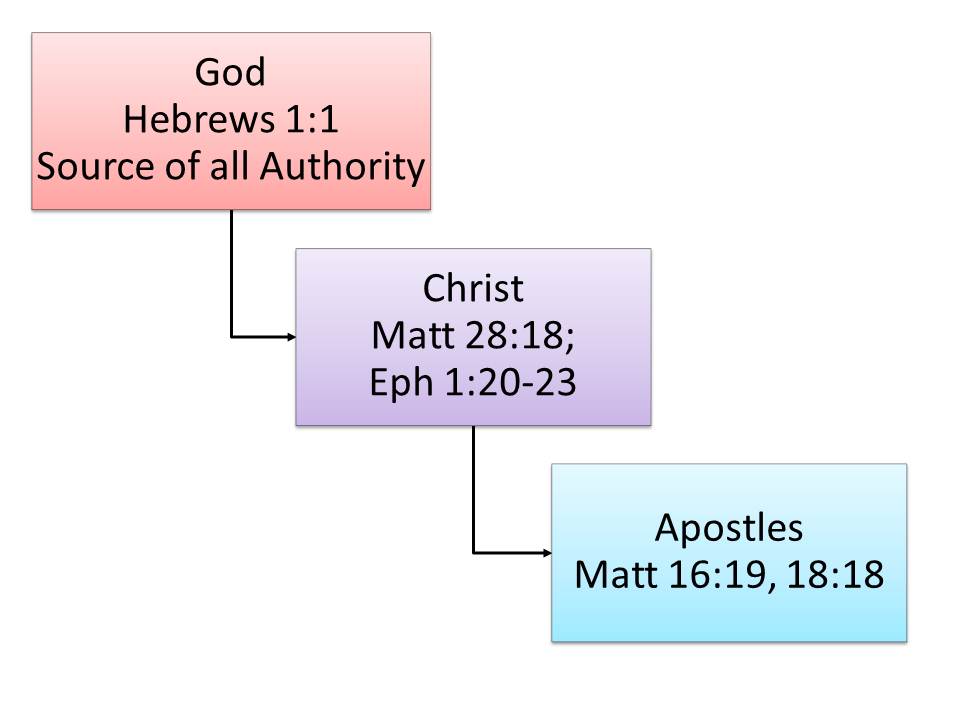
Some adherents to this philosophy want to separate the work of Jesus and the apostles (accept Jesus but reject the teaching of the apostles relative to doctrine) but they cannot be divorced. Instead, Jesus reinforced the authority of the apostles in matters of religion.
As the chart illustrates, all authority flows down from the Father through Jesus to the apostles. The authority form the apostles consists of their teaching and example. The Bible condemns those who do not abide in Christ’s doctrine (2 John 7-11), who follow traditions devised by men (Matthew 15:1-9), and any other authority but God’s word (Galatians 1:6-9, 2 Timothy 3:16-17).
If one wants to condemn the organization of believers into a body (as opposed to just serving God without the church) he will have a problem with Jesus who founded the church, Matt. 16:18. Far from being a foolish organization designed by men, the church is a reflection of the wisdom of God, Ephesians 3:10-13, and is the body of Christ, Ephesians 1:22-23.
Take up stones also to condemn Jesus for instituting ritual practices for on the night before he was betrayed, he instituted a memorial meal to be observed in the church to remember his sacrifice, Matthew 26:26-28, 1 Corinthians 11:17-34. He also commanded his disciples to baptize those who believe the gospel and, sorry if this is scandalous, teach them to observe all of his teachings, Matthew 28:19-20.
Not only did he teach, and commanded his apostles to teach, obedience to his commandments, he outlined what to do when brethren disobeyed the law, Matthew 18:15-20. The apostles reiterated the teaching of our Lord against those who were disorderly, 2 Thessalonians 3:6-15; 1 Corinthians 5:1-5; 2 Corinthians 2:5-11. He went so far as to equate love for him with adherence to his commandments, John 14:15, 21.
The strictness of the moral code of Christ will not sit well with the “I just love Jesus and don’t judge others” crowd. Unlike many who claim to follow Christ today, Jesus had a very narrow view on divorce and remarriage, Matthew 5:31-32, 19:3-12 that caused even his disciples to question whether it might be better to not marry than to marry unwisely. Many in the religious world do not condemn the behaviors condemned by the apostle Paul in Romans 1:18-32 and, instead, condemn Christians who teach that this behavior is “ungodly and unrighteous.”(Paul’s words) Likewise, they bristle against restrictions on sexual immorality, filthy language, and materialism though the apostles, by inspiration of the Holy Spirit, condemn that as well, Ephesians 5:3-12, declaring such behaviors as improper for Christians. True religion, and the word is used in scripture, is praised in James 1:26-27 through the exercise of one’s faith.
Paul warned that times would arise in which men would reject the strict teaching of our Lord and the apostles and find teachers who would allow them to indulge in their passions but have the appearance of piety and serving God, 2 Timothy 3:1-9; 4:1-5. Seems like this is such a time.
Many in the “I love Jesus but am not religious” movement are hesitant to say that those in non-Christian religions will not be saved, yet the Savior himself insisted that salvation is only through coming to the Father through him, John 3:16-18; 8:24; 14:6-7.
As Kevin DeYoung noted in his blog, “If religion is characterized by doctrine, commands, rituals, and structure, then Jesus is not your go-to guy for hating religion” (“Does Jesus Hate Religion? Kinda, Sorta, Not Really” http://thegospelcoalition.org/blogs/kevindeyoung/2012/01/13/does-jesus-hate-religion-kinda-sorta-not-really/)
Problem 3: It condemns true Christians for actions carried out by hypocrites and opportunists
Some advocates for this attitude embrace the argument of the atheists that religious people are the source of more suffering in this world than good. It is a foolish argument that fails to recognize the incredible countless actions by humble Christians who have provided the lowliest service to their fellow man. No one can deny that atrocities have been carried out in the name of Jesus but those actions are out of the boundaries of the moral code of our Lord and true Christians condemn such abuses.
Jesus didn’t throw out the Old Law just because the Pharisees added their traditions. He condemned their error and upheld the holiness of the Law. Jesus addressed the hypocrisy as a problem with people, not God’s law.
That some churches are involved in politics and take a stance as Democrats or Republicans should not condemn those of us who keep politics out of the pulpit. Exercise of political agendas belongs in the personal realm, not in the church. We need to change the hearts of people with the gospel, not the ballot box. Some churches claiming to follow Christ do this because they no longer believe in the inspiration of scripture and the deity of Jesus so they had to redesign the church to be an agent of social change. The alliance of the church and politics (Republican, Democrat, Reformation purges, and Holy Roman Empire) is an unholy one foreign to the Lord who founded a kingdom that was “not of this world.”
Wars fought in the name of the Prince of Peace do not mean that Jesus was pleased with such actions. That some opportunistic leaders and political-religious leaders co-opted the cause of Christ to wage carnal warfare does not mean that all Christians are right to support such action. Some Christians are pacifists and oppose all war, especially in the name of Jesus. The true warfare of the Christian is not of this world and is waged with wars not earthly weapons, 2 Corinthians 10:3-5.
Some claiming to be Christians have used political intimidation and violence to persecute and kill other Christians who did not agree with them. Such actions are not approved by the New Testament and yet the problem was with the individuals and the religious bodies who perpetrated such vile actions, not the church established by Christ.
To condemn the religion of Christ because some people used the name of Christ to make war, oppress others, or to advance their political goals, is naïve and ignorant at best. At worst it is misleading, prejudiced, and arrogant.
Problem 4: Some use non-religion piety to justify immoral or self-centered living
As described above, the moral code of Jesus and the apostles is quite strict. However, some in the modern popular Christian movements are quick to defend a very permissive view of divorce and remarriage, sexual immorality, foul language (even cursing from the pulpit), materialism, and a host of other behaviors with a “judge not” halo glowing over their forehead. They like to emphasize grace but it’s a man-made grace where everything is acceptable, not the Bible grace that calls men to repentance, Romans 2:4. They like the Jesus who forgives but forgets he is also the one who says, “Go your way and sin no more” (John 5:14; 8:11). They like when Jesus says “judge not” but forget that he is also the judge who will weigh the hearts and actions of men on the last day, John 5:30; 12:48; Matthew 12:36.
There have been similar times in Bible history where, instead of following the law of God, “every man did what was right in his own eyes” to the great displeasure of God, Deuteronomy 12:8; Judges 17:6; 21:25. However, Proverbs 12:15 tells us that it is the fool who follows what is right in his own eyes and does not follow the wisdom of God.
Some claim the church should be a hospital for the broken, which is appropriate since Jesus is a physician for those broken down by sin, Matthew 9:12. However, a person goes to the hospital to be healed, not to continue in the sick condition. Jesus calls us from the filth of the world to live clean and pure lives (2 Peter 1:3-4; 1 Peter 4:1-5). It is strange that some are content in their “broken” condition instead of recognizing that God is calling us out of the world into holy living as part of our “reasonable service,” Romans 12:1. Seems that some are ‘holier than thou’ about the virtue of their lack of holiness. Yet God wants us to be holy because he is holy, 1 Peter 1:15.
Conclusion
Like so many Christians, I am disgusted by the materialism and immorality that has characterized so many prominent groups and individuals claiming to be Christian. I mourn for the carnal warfare, persecutions, and abuse carried out in Jesus’ name or by those who claim allegiance to Christ. I believe that much of the “Christian” world reflects a hijacked religion that departed from the simplicity of the gospel in the New Testament. However, I cannot throw out the true religion of Christ because some institutions and individuals have left the way of Christ though they claim a relationship with him. If you love Jesus, you will love religion—the religion that he established, that is described in the New Testament, and that reflects the glory, holiness, and righteousness of our great Lord.
How Can Christ Be The Firstborn?
Of the names of Jesus in the New Testament, one of the most curious is “firstborn.” It seems to imply that Jesus was a created being, like man, and not the eternally existent God. In fact, some religious bodies have seized on this title to assert that Jesus is not God but at best, a god. A Jehovah’s Witness publication says, “According to the customary meaning of ‘firstborn,’ it indicates that Jesus is the eldest in Jehovah’s family of sons.” (Reasonings. Watchtower Bible and Tract Society: Brooklyn, 1989. p.408).
Although firstborn can mean the first child or first son born in a family (Exodus 11:5; Matthew 1:25), the scriptures also use it to indicate prominence. The International Standard Bible Encyclopedia notes, “The laws and customs of all nations show that to be “firstborn” means, not only priority in time, but a certain superiority in privilege and authority.” (ISBE. “First-begotten”). God uses the title to indicate a special relationship with Israel and the tribe Ephraim in Exodus 4:22 and Jeremiah 31:9, respectively. Ephraim was not the oldest son of Jacob (Israel), in fact, he was a grandson of Jacob, a son of Joseph, but the name became synonymous with Israel in many prophetic writings.
Another example of how “firstborn” indicates prominence, not order, is the reference to Jesus as the firstborn from the dead. Jesus was not the first person raised from the dead. Elisha raised a young boy from the dead and a dead man thrown into Elisha’s grave came back to life. Jesus raised Lazarus, Jairus’ daughter, and many dead rose when Jesus died. Jesus was certainly not the first to come back from the dead but He had the most prominence for in His resurrection, He conquered the power of death and seized the keys of death, 1 Corinthians 15:20-26; Revelation 1:5, 18.
Jesus is also called the firstborn over creation, Colossians 1:15. Since we know that firstborn does not always mean the first in order, we must conclude that Jesus is prominent over all creation. He was not created but is the creator of all things, John 1:3. John said that Jesus was in the beginning with God and was God, John 1:1-2. In the book of Revelation, he writes that Jesus is the first and the last, Revelation 1:8, 17. Jesus Himself acknowledged His deity when He called Himself the I AM , John 8:58 (see Exodus 3:14). Jesus was not created but lived in the flesh like the creation and died that our corruptible natures might inherit incorruptibility. He is the source of life and our every breath depends upon Him. Truly He is the firstborn, or the greatest, over creation.
Jesus is also the firstborn among brethren, Romans 8:29. This final title also indicates the superiority of Christ. He is the head of the body, the church. We, as children of God—brethren—answer to Jesus as Lord. Jesus intercedes with the Father on our behalf. He is not the first brother of many brothers but is the firstborn—the preeminent one—among all the brethren because it is through His sacrifice we can become God’s children, Isaiah 53:10; 1 John 3:1. In Romans 8, Paul emphasized that God predestined us to be conformed to the image of Jesus.
Jesus is the firstborn—or greatest—over all creation, over all who have risen from the dead, among many brethren. Let us consider His greatness and worship Him daily.