Social Media Fame Will Not Ease Your Emotional Pain

A Bing search today provided an ironic set of results for celebrity Selena Gomez. She became the first person to reach 100 million Instagram followers AND checked herself into a rehab facility to deal with depression and emotional issues. One would think that someone who has so many fans would have no reason to suffer emotionally, yet this is not the case, as social media followers cannot provide the same emotional support to deal with serious problems in life. As a celebrity, Gomez probably realizes this and understands the difference between fans and friends. However, those of us who do not have fame may feel that if we could just have 1,000 social media followers then our voice could be heard and we would be important. Such is an illusion. There is far more value in a few people who truly love and support you than many times that in “followers.”

Gomez likely is suffering additional problems brought on because of celebrity. If we think fame will solve problems, it will probably only magnify our problems and may create new ones. Many business, sports, and entertainment stars have achieved their goals and received the riches and accolades they desired only to discover a nagging question: “Is this all there is?” The book of Ecclesiastes emphasizes the futility of the things in this life bringing our life meaning; however, we can be satisfied with work and achievement if we have it in perspective. There are famous people who do not care about fame who are able to handle its rise and fall with grace.

From my understanding, Selena Gomez has gone through some significant challenges that would impact anyone’s emotional state. It is wise that she is seeking help to deal with these issues and hopefully she will find strength and encouragement to get through this difficult time. It is good that she is turning to people and not drugs or alcohol. I understand the treatment is from a Christian perspective so I hope, and will pray, she can find God’s wisdom as a strength and guide.

Video – Lessons from the Song “Just As I Am, I Come Broken”

This was a lesson I presented at the 2016 Florida College Alabama camp reflecting on the theme song from camp: “Just As I Am, I Come Broken.” This is a beautiful adaptation of an old hymn that expresses the response of someone coming just as they are to God for healing and transformation.

This was a lesson I presented at the 2016 Florida College Alabama camp reflecting on the theme song from camp: “Just As I Am, I Come Broken.” This is a beautiful adaptation of an old hymn that expresses the response of someone coming just as they are to God for healing and transformation.

Video – Lifeline to God: Using Social Media to Teach and Edify

This is a video of a presentation I did in July 2016 at a teen gathering on using social media in a way that glorifies God.

This is a video of a presentation I did in July 2016 at a teen gathering on using social media in a way that glorifies God. I hope you will find it encouraging. The document I reference early in the presentation on things young people wish their parents knew about how their social media use impacts them can be found here.


Class Book: Sing With Understanding

I wrote this class book to explore the Biblical principles behind the songs we sing. I love learning the stories behind the spiritual songs we sing in books such as*:

*Affiliate links

For some information on enriching your public singing in worship I’d suggest visiting the  Get Them Singing website.

This class book focuses on the major Bible themes of our songs allowing for discussion of both the Bible teaching and reading the words of popular hymns to explore the meaning described in poetic terms. I list suggested familiar hymns for each lesson and some questions reference particular hymns.

Sing With Understanding CoverIt is a 13 lesson series which fits well into most Bible class schedules. There is plenty material to discuss the topics in two class periods per week. I have often taught the Biblical principles in the Sunday class and explored the words of selected hymns in a mid-week Bible class. It would also be suitable for a small group study.

The book contains only questions which will require the teacher to develop the material to suit the class. I have taught it in adult and high school classes.

You may freely copy this book for your classes. It is 16 pages so it will not cost much to print. You may want to print the cover page separately then print pages 2-16 duplex to save paper.

Download Sing with Understanding.

Lesson Listing

  1. Introduction
  2. Eternal God Our Creator
  3. God Our Protector
  4. God Our Shepherd and Guide
  5. Resurrection and Judgment
  6. Crucifixion
  7. Grace and Salvation
  8. Battle Songs and Victory
  9. Kingdom of God
  10. Evangelism
  11. Brotherly Love and Unity
  12. Christian Living
  13. Heaven

How To Deliver a REAL Apology

Real apologyAccept responsibility for your failures

Think of the last time you did something wrong. Why did you do it?

  • “My brother (or friend) made me do it”
  • “Everyone else was doing it.”
  • “The Devil made me do it.”

When we do something wrong it is easy to blame someone else. When Adam and Eve ate the forbidden fruit in the Garden of Eden, Adam blamed Eve for his sin. He was also blaming God because he blamed the woman God gave him. Eve blamed the serpent (Genesis 3). In 1 Samuel 15, King Saul blamed the people for his sin. However, when we do something wrong, we can only blame ourselves.

Other people may urge you to do something wrong or tempt you to disobey your parents, if you are a young person, and God. But you—and only you—choose whether to obey or disobey. Someone might make it difficult to choose the right thing, or you may feel embarrassed to choose the right action, but you can make that tough choice.

I had a sign in my room in high school and college with a saying attributed to the British Foreign Office*:

“Never Excuse. Never Explain. Never Complain.”

When you complain and blame you are saying that other people have control over your life. Irresponsible people make excuses for why they couldn’t complete a task, do their chores, or fulfill the responsibilities expected of them. They have lengthy stories and explanations of what went wrong and why they couldn’t keep their word and fulfill their obligation. They complain about lack of resources, time, ability, or the impact of others on their life.

The sign was a reminder to the officials to do what was expected and keep their word because no one wants to hear their excuses, reasons for failure, or whining. That is why I posted it on my wall.

Be strong and accept the embarrassment and penalty for your wrong.

Irresponsible responses

The non-apology: “If I did anything wrong…” Either you did or you didn’t. Avoiding your obligation to apologize, blaming everyone else and not accepting responsibility, or making excuses instead of owning your behavior. We must accept responsibility for our actions and our response.

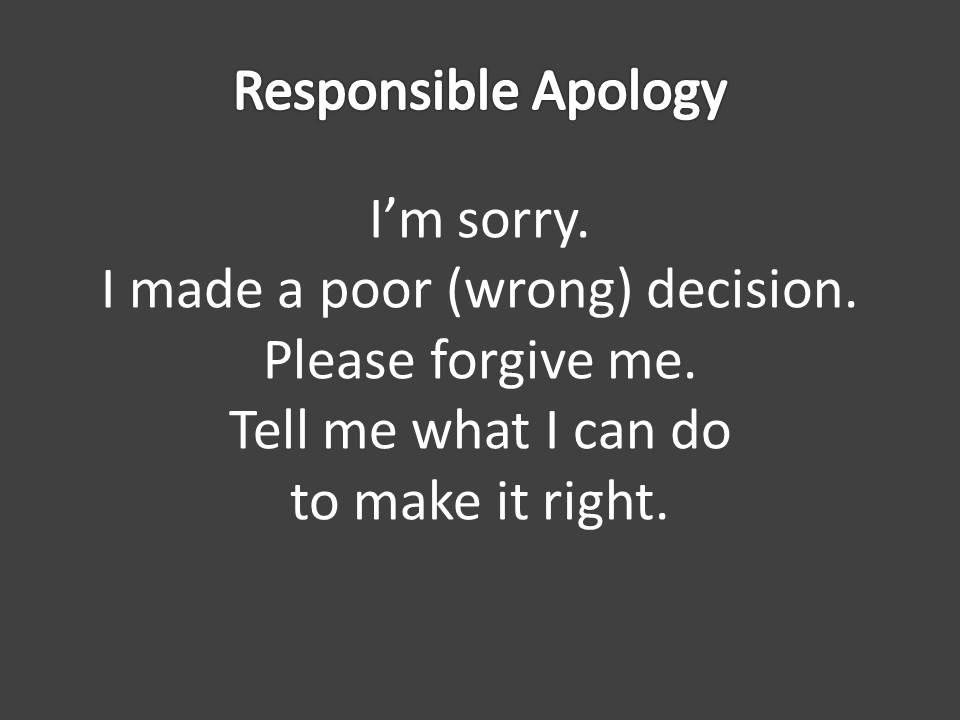
A responsible apology

“I’m sorry. I made a poor (wrong) decision. Please forgive me and tell me what I can do to make it right.”

  • You acknowledge that your choice has hurt or caused difficulty for another and for that you are sincerely sorry.
  • You take responsibility for your choice without offering excuses or explanations.
  • You ask for their forgiveness because you need it.
  • You ask what you can do to correct your poor choice. Maybe you can replace something, apologize to someone else, or maybe you can do nothing. But offer to do what you can to make it right and act quickly.

You will be proud of yourself, you will bring honor to yourself, you will be responsible, and you will glorify God.


*I’ve tried to verify it but have had little success confirming it. Any concrete attribution would be appreciated.