Who Can Live With God?

Though God desires all men to come to Him through Jesus, the one who would accept that invitation must strive to be like God. We cannot simply confess our sinfulness and brokenness and make no effort to purge bigstock-reaching-the-heaven-29396564wickedness from our lives. We must purify our lives in order to reflect the glory of the Father.

David contemplated the character of one who would abide in the tabernacle of God and dwell in His holy hill in Psalm 15. Here are the characteristics he observed:

  1. Walks uprightly: The ESV says one who walks blamelessly. The word “walk” describes a manner of living. To live blamelessly means that no charge can easily be made against him. He strives to live holy because God is holy. 1 John 3:7 says, “Little children, let no one deceive you. Whoever practices righteousness is righteous, as he is righteous.” (ESV)
  2. Does what is right: Not only does he live righteously, he is actively doing good. He follows the righteousness of the gospel (Romans 1:16-17). He produces good fruit because of the living faith planted within (James 2:14-17). Who he is and what he does is right.
  3. Speaks truth in his heart: His life is not a false front. From the depths of his heart, he embraces truth. He does not allow wickedness in the place where no one would see it. He is true to God in the one place that only he and God can see. He also has a tender heart to receive and practice the truth.
  4. Does not slander: James 3 urges the believer to control his tongue. 2 Corinthians 12:20 warns that an uncontrolled tongue can destroy the relationship between brethren. This person does not use his tongue to tear down others but builds them up with graceful words of truth.
  5. Does no evil to a neighbor or friend: He does not speak evil slander nor does he do wrong with his hands against others. His neighborly love is such that he will not listen to gossip or lies spoken against the neighbor or friend. Instead of doing harm to a neighbor, he helps and protects him.
  6. Honors the godly and despises the vile: He gives honor to those who, like him, honor God and respect His word. These are the people with whom he shares a brotherhood and common love. Because of this desire to live holy, he cannot stand that which is wicked. It disappoints him to see people rejecting God and embracing immoral lifestyles. Like Lot, his soul is vexed by the evil conduct of the wicked, 2 Peter 2:7. The Judean king Jehoshaphat was rebuked for his association with the wicked kings of Israel in 2 Chronicles 19:2: ““Should you help the wicked and love those who hate the Lord?” The one who loves God will love the lost souls but despises their behavior.
  7. Keeps his integrity even if costs him financially: He will take a financial loss to preserve his good name and avoid bringing reproach on the name of Christ. If he gives his word, he will keep it no matter what the cost. Of course, one would be wise to keep his mouth from making agreements that will be costly to fulfill. However, for the sake of integrity, one must keep the promise and strive to make better promises in the future. In 1 Corinthians 6:6-8, Paul urges believers to settle financial differences away from the court system instead of being a bad example before the unbelievers. He urged them to take the dispute to knowledgeable and fair brethren or, if necessary, to accept being wronged rather than acting disgracefully and materialistic before the unbelievers.
  8. Generous lender: He does not take advantage of others in financial distress. He is generous and helpful to the needy. He uses his financial blessings to be a blessing to others.
  9. Does not take bribes: Not only is he generous, his integrity and sense of justice will not allow him to take a bribe against the innocent. He does not compromise others and he is not compromised himself. He will not pervert justice for financial or personal gain.

The principles described in Psalms are the core values of the believer. They become part of the character and guiding principles to ensure the person stays on the correct path. Daily Bible study and prayer help refine and improve the strength and depth of these values. Daily exercise of righteousness further integrates the will of God and the character of His follower.

David notes that if a person embraces these principles he can live in God’s holy hill and shall never be moved. From integrity in the heart to the outward display of righteousness and good, this person strives to be like God and to be with God. And to paraphrase a popular song, “No power of hell nor scheme of man can ever pluck him from God’s hand.” He will not budge from his desire to be with God.

The Conversion of Cornelius and the Command to be Baptized

Some people argue that one does not need to be baptized using the conversion of Cornelius and the Holy Spirit’s presence at his conversion as their example. However, a close examination of the Bible account in Acts 10 and 11 teaches the exact opposite. Cornelius and his household was a peculiar case of conversion in the book of Acts in that He is the first non-Jewish convert: the opening of the gospel to the Gentile world. We must be careful not to make a broad application of this unique story to all conversions or put it at odds with other passages about salvation.

Story Summary

The story begin in Acts 10. Cornelius, a Roman military official, receives a vision of an angel of God instructing him to get the apostle Peter who is staying in Joppa. He is instructed to send for Peter because he would tell Cornelius “what he must do,” Acts 10:6. As Cornelius’s servants approach the house Peter has a series of visions in which he sees animals that the Old Law declared unclean and a voice telling him to kill and eat them. Peter, in respect of the Law, refused and received the reply “What God has cleansed you must not call common.” Peter was perplexed about the vision when the servants of Cornelius arrive. The Holy Spirit told Peter to go with them for He sent them. The next day Peter and several of the Jewish brethren went to Cornelius.

When they arrived at the house of Cornelius, there was a a gathering of close friends and relatives. Although the Jews were not supposed to enter the house of a Gentile, Peter said that God taught him that he should not call any man common or unclean: the lesson of the vision of the unclean animals. Cornelius told Peter of his vision  that they were gathered to hear what God commanded to be done. Peter told them about Jesus and his command to preach to the people (Acts 10:42). Certainly Peter is referencing the command in Mark 16:15-16 to “go into all the world and preach the gospel to every person. He that believes and is baptized would be saved. He that didn’t believe would be condemned.” Also Matthew’s account of the command to make disciples of all nations, baptizing them in the name of the Father, Son, and the Holy Spirit, Matthew 28:19. Peter concluded that “whoever believes in Him will receive remission of sins,” Acts 10:43. In Acts 11:14, Cornelius said that Peter would tell them “words by which you and all your household will be saved.”

At this point the Holy Spirit fell on Cornelius and those who heard the word and they began to speak tongues as Peter and the apostles did on the Day of Pentecost (Acts 2). The Jewish Christians with Peter were astonished at this and Peter said, “can anyone forbid water to these who received the Holy Spirit in the manner we did?” (Acts 10:47). Then Peter commanded them to be baptized.

When Peter returned to Jerusalem some of the Jewish Christians confronted Peter because he ate with the Gentiles. Peter explained the whole account from the vision and the Holy Spirit coming on the Gentiles as it did upon the apostles “at the beginning” (Day of Pentecost in Acts 2). Peter realized he would be withstanding God if he forbid the Gentles to be baptized. The Jewish Christians then glorified God saying “Then God has also granted to the Gentiles repentance to life,” Acts 11:18.

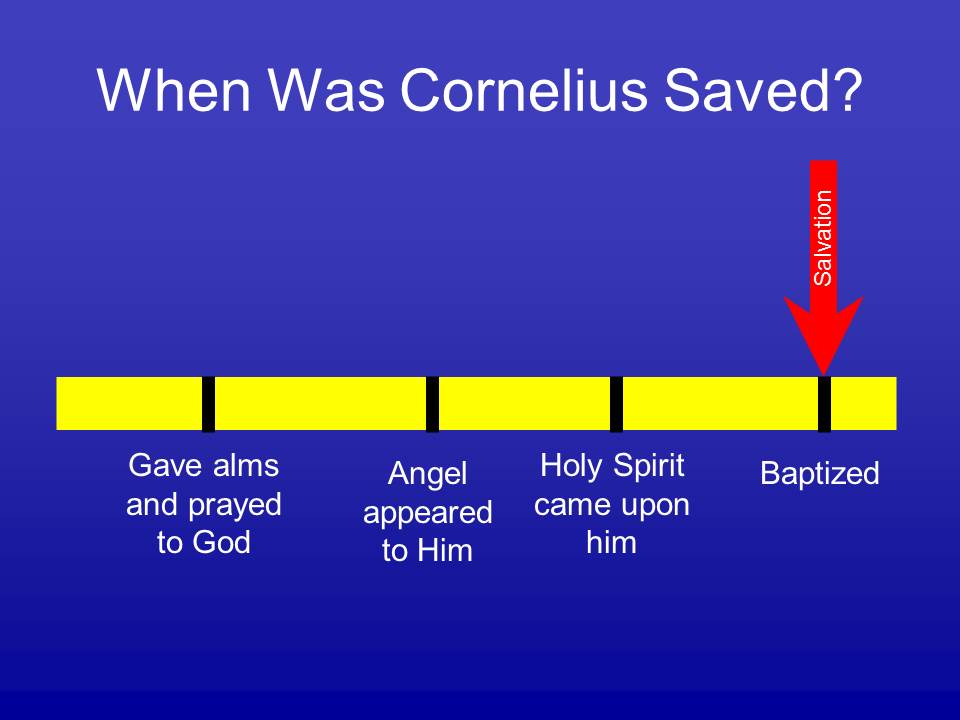
When was Cornelius Saved?

When was Cornelius saved When we consider the story of Cornelius we must understand when he was saved. According to Acts 11:14, he was not saved before the preaching of the word. This poses a problem for some who follow a popular teaching called Calvinism. Many religious bodies follow the teaching of John Calvin who taught the salvation of man by grace alone and the impossibility of being lost. Calvin said man was born in sin and cannot seek God unless God regenerates the man so that He will seek God. According to Calvin, at this point of regeneration the person is saved and will then seek God’s will. Cornelius was a devout religious man before he was told to send to Peter who would tell him words by which he would be saved! How could Cornelius have been baptized by the Holy Spirit after Peter’s preaching when he had to have already been baptized by the Holy Spirit so he could seek God in the first place?

The manifestation of the Holy Spirit proved to the Jews that the Gentiles could be saved. As demonstrated in Acts 11, there was Jewish prejudice against the Gentiles. The Gentiles, like the animals in Peter’s vision, were considered common and unclean because they had not been circumcised and did not follow the Law of Moses. Acts 10:27-29 records how God had to send a vision three times to tell Peter that no man can call unclean those whom God has cleansed. When Peter returned from Cornelius, the Jews chastised Peter for teaching the Gentiles, Acts 11:1-2. This conversion account is as much about the conversion of the Jews to the idea of equal access to salvation through Jesus Christ as it is about the conversion of the Gentiles.

Accepting the Gentiles

The Old Law had been abolished by Jesus when He fulfilled it. According to Ephesians 2:11-18, the removal of the Old Law was a removal of the division between the Jews and the Gentiles. However, the gospel had not been preached to the Gentiles yet. The Jews were to no longer consider the Gentiles unclean but equal. The Jews, steeped in tradition and separation from the Gentiles, needed something profound to show them that the gospel was for all men. Through divine means, God brought together these separate worlds. God sent the Holy Spirit to show Peter and the Jews with him that the Gentiles could be baptized. The Jews were amazed because the Holy Spirit fell on them as it did at the beginning. It is important to note that they did not refer to the Holy Spirit coming upon every convert like this. In fact, the conversion of the Samaritans in Acts 8 shows that after the Day of Pentecost, the Holy Spirit only came on individuals by the laying on of the apostles hands, Acts 8:16-18.  The baptism of the Holy Spirit here proved that God would allow them to be baptized, Acts 10:47-48 and Acts 15:7-9 (when Peter again refers to this event).

In the baptism of the Holy Spirit here we do not have a pattern for every conversion. The gospel going to the Gentiles was as dramatic of an event as the beginning of the church. In Acts 2, the Holy Spirit fell on the apostles to demonstrate that Jesus had ascended to the right hand of God. In Acts 10, the presence of the Holy Spirit showed that the Gentiles could be baptized in the name of Jesus. This was not a common occurrence. Acts 11:15 refers to “the beginning” of the church, not to every conversion since that time.

Response to God’s Word Saved Cornelius and His Household

God could have sent the angel with the words of the gospel. If it was the coming of the Holy Spirit that saved Cornelius, God could have just sent His Spirit and finished the work without Peter. However, God told Cornelius to send for Peter. Note what would be accomplished:

  • Acts 10:6 – He will tell you what you must do
  • Acts 10:33 – Tell what has been commanded
  • Acts 11:14 – Words by which you will be saved
  • Peter would teach Cornelius what he must do to be saved
  • Acts 10:47-48 – Cornelius commanded to be baptized

In order to be saved Cornelius needed to hear and obey what God commanded him to do through Peter’s instruction. If the baptism of the Holy Spirit saved Cornelius, Peter would be commanding Cornelius to do something he had not control over. The Spirit follows the will of the Father; not the will of man. You cannot command someone to be baptized of the Holy Spirit. Peter commanded Cornelius and his audience to be baptized. Notice this was a baptism, immersion, in water for Peter said none should forbid them water. Water baptism was a baptism that a person could command and a person could obey.

Cornelius BaptizedReview

Peter went to a lost man to preach the word of salvation. Peter preached Christ to Cornelius and his household. Cornelius and his household believed the words of Peter and were ready to do what God commanded to be done according to what He commanded them to teach. Jesus commanded Peter and the apostles to teach the gospel and baptize those who wanted to be believers in order for them to be saved (Matt. 28:19-20; Mark 16:15-16). However, the Jews were not convinced the Gentiles could be baptized. The Holy Spirit came upon Cornelius and his household as it came upon the apostles when the gospel was first preached at Pentecost. Seeing God’s approval, Peter baptized the Gentiles, their response to the words of salvation. The sign was such that the Jews in Jerusalem who chastised Peter for being with the Gentiles realized that the Gentiles could be saved and they ceased complaining and glorified God. In a Acts 15, Peter recounted this incident to show that there was no longer a distinction between the Jews and the Gentiles in the kingdom of God.

After this incident, there is no other account of the Holy Spirit coming upon man in this fashion for they were unique periods of Bible history. Peter and the other disciples continued to preach words by which one could be saved and commanded listeners to obey God by repenting of their sins (Acts 2:38), confessing Jesus (Acts 8:36-39; Romans 10:8-9), and being baptized into Christ (Acts 2:38; Acts 8:36-39; Romans 6:1-4; Galatians 3:26-27).

Barabbas and Second Chances

I sometimes think about the first person Jesus saved when He went to the cross. We do not often consider this person as he is not a main character in the New Testament. He is a bit character in the drama of the crucifixion. Though the part he played was brief, his place in history provides some lessons for us to consider.

The Jews put Jesus through the illusion of a judicial process to deliver a sentence of blasphemy and the punishment of a death penalty. Under Roman rule they could not carry out the death sentence so they brought Jesus within the Roman judicial system to be tried for treason and put to death. The Roman officials Pilate and Herod each examined Jesus. Though their men treated Jesus with contempt, they found no reason to execute Him, Luke 23:13-16.

Pilate fought for Jesus’ release. He knew that Jesus had been delivered into his hands because the Jewish leaders were envious of Him. He even had Jesus violently beaten and presented before the people. Perhaps Pilate thought a near-death beating would satisfy the blood lust of the crowd and perhaps draw some pity out of their hearts for the abused man presented before them. But their hearts were not touched. Read John 19:1-16

It was Pilate’s custom to pardon a criminal during the feast. On most occasions, one might imagine a popular individual whose case inspired sympathy but could not be dismissed as a subject of pardon. The people would get someone they liked and Pilate could receive some appreciation from the people. It would be a great political strategy most years to appease the Jews.

“Give us Barabbas!”

In Pilate’s attempt to free Jesus it seems that he introduced a person he hoped the people would hate more than Jesus: a notorious criminal named Barabbas. Barabbas was part of a revolt and committed murderer in the insurrection. John also refers to him as a robber. Certainly the people would prefer to have Jesus released than a notorious hated criminal like Barabbas back on the streets. It seemed like a good strategy to bring a violent criminal as an alternative to Jesus. Pilate would force the people to choose the outcome he preferred: the release of Jesus.

However, the people took Pilate by surprise and asked for Barabbas to be released. Think about this: the people asked for one who took life instead of the one who gives life. They chose someone who embraced violence and chaos to the Prince of Peace. When the people called for Barabbas Pilate is shocked and amazed asking about Jesus, “Why? What evil has he done?” The people did not answer Pilate, the demanded Jesus. Fearing the people, Pilate released Barabbas and crucified Jesus.

Barabbas became the first person Jesus saved by going to the cross. Barabbas was saved crucifixion and even a continued prison sentence for his crimes and was allowed to go free. Jesus saved Barabbas from the penalty due for his crimes by taking his place on the cross.

Second Chances

I’ve often wondered if Barabbas was affected by Jesus taking his place. We do not know what he knew about Jesus. I imagine him having drinks that night with his criminal friends asking what crimes were committed to make the people hate Jesus more than him. bigstock-Another-Chance-Just-Ahead-Gree-55029689Perhaps he laughed at how dumb the mob was and began planning a new insurrection and returning to his criminal lifestyle. It could be that Barabbas took his second chance seriously and obeyed the law from that point forward.

We do know that Jesus was crucified: a just punishment for Barabbas but not for Jesus. We know that Barabbas got a second chance at life because Jesus went to the cross. We all can have a second chance because Jesus went to the cross. That day in Jerusalem, Barabbas literally experienced what we all can enjoy spiritually. Barabbas was condemned to death but Jesus took his place. Barabbas was guilty but did not have to die for his crime because one who was innocent died in his place.

Likewise, Christ died for us though we deserved to die:

  • Romans 5:6-10 – Christ died for us when we were enemies
  • Isaiah 53:4-6 – The Lord laid our iniquity on Him

In the Old Testament, an innocent being killed for the sake of the guilty was understood in the sacrifice of animals for sin: Leviticus 16:6-10; 15-16. Though we deserve death for our sin, Jesus took our place so we could have life.

What will we do with the second chance we have been given? How will we live since Jesus sacrificed Himself to save us when we did not deserve it?

“Earn It”

Many have seen the World War II movie “Saving Private Ryan.” Because of the language, if you watch it I would recommend viewing it on network TV where the language has been edited. Some networks show it all day on Memorial Day and Veteran’s Day. If you are not familiar with the story, it is about a group of soldiers that venture into hostile territory to find the only remaining son of a woman whose other sons were killed in battle. When the soldiers find Private Ryan, he is sad that his brothers have died but he does not want to abandon his comrades with whom he has fought. The group who searched for Private Ryan stay with him and they fight the enemy together.

In the end, in a fierce battle against a strong German force, many of Private Ryan’s buddies and the men who risked their lives to find him were killed. As reinforcements drove the Germans back, Captain Miller, who led the search for Private Ryan, and a character whose leadership and courage inspired the soldiers, was sitting on a bridge dying from his battle wounds. The captain looked around at the dead and dying, and the carnage of war, then looked at Pvt. Ryan and said, “Earn this.” He wanted him to make something of his life as a result of their sacrifice for him.

These words, “Earn this”, echoed in Private Ryan’s mind as he stood at the grave of the captain many decades later. Standing with his wife, with his family in the background, he stares at the captain’s grave and asks his wife for reassurance that he lived a life worthy of the sacrifice of Capt. Miller and the other men: “Tell me I led a good life. Tell me I was a good man.”

We are indebted to so many people who died to make our country free. Their sacrifice should inspire us to use the opportunities we have in this country to make the world a better place. However, we have a greater obligation to make something of our lives for the one who died to give us life. In this sense, when we see Jesus on the cross, dying for our sins, the thought “earn this” should ring in our ears. As sinners who rebelled against a loving and holy God we don’t deserve such mercy and sacrifice. Yet Jesus hangs there between earth and sky as an offering for our sins on a cross we deserve.

Walking Worthy of the Sacrifice

“Earn this.” Live a life worthy of this sacrifice. Don’t get me wrong. I am in no way implying that godly living earns us the sacrifice of Jesus. We could live the most heroic lives as Christians and gain worldwide attention for our good deeds and not earn one drop of the blood of Jesus. But the sacrifice of Jesus should change the way we live in profound ways.

Paul says to walk worthy of the calling made possible because of the cross, Ephesians 4:1-3. John urges us to walk as Jesus walked, 1 John 2:5-6. We were bought with a high price; therefore, we must live in a way that reflects our gratitude for such a high sacrifice.
If a person’s life was saved by another giving his life, the survivor will likely find all he could about the person who saved him and do something to honor their memory.

Our life should be a lived as honor to respect the one who died to save us. We should desire to know all we can about Jesus since He gave Himself to save us. Understanding the sacrifice of Jesus and the sense of debt we should feel towards him helps us to also understand the tragic end and punishment of one who turns his back on Jesus, and does not consider Christ’s sacrifice as anything special, Hebrews 10:26-29.

We don’t know what Barabbas did with his second chance. What will you do with yours? Will you live worthy of the love and sacrifice offered to give us life? Will you be apathetic about Jesus’ sacrifice and do nothing to honor Him?

Honoring Jesus with the Lord’s Supper

Every Sunday Christians approach a table set with a memorial feast in the shadow of a cross. In the bread and the fruit of the vine is a reminder of so great a sacrifice made for us. Reflect on the body and blood of our Lord. As you consider Jesus on the cross, let His sacrifice strike deep in your heart and feel the love and mercy of the God who would die for you to save you. “Earn this.” Let His death mean everything in your life and let it transform the core of your being, the thoughts of your mind, the intents of your heart, and the work of your hands.

Honor the one who gave His life to save you as you thoughtfully and reverently partake of the supper of our Lord. And honor Him by returning to the table, and to His cross, each first day of the week as He commanded until He comes again. Honor Him with your life as you leave the table and carry your cross into the world.

What Is Your Life?

Guest Post by Russell Poe

I saw a commercial the other day regarding the sale of AARP Medicare Supplement plans.  An older, “well preserved” female is shown walking down a beautifully landscaped path toward the camera, smiling and looking quite alive.  After a moment she stops, looks at the camera and says “I’m only in my 60’s – I’ve got a long life ahead of me – big plans.”   And I suddenly found myself wondering if I actually, correctly heard what she said.

The last time I checked, the average American’s life expectancy was about 77 years old.  Assuming this lady was in her mid 60’s, and she lives the average life span of an American, she only has about 9 to 12 years left to live.  And that’s ASSUMING she lives the average number of years for an American – she could EASILY die sooner.

Even if she was Japanese, the race of people who currently have the highest average life expectancy in the world (80 years old), at best she would have 12 to 15 years left to live.

Sure, she may live to be 95, which would give her approximately 30 years left to live, but statistically she only has an 18% chance of doing that.  The odds are definitely not in her favor!

Now I don’t know about you, but if you told me I had another 9 to 15 years to live, I don’t think I would consider that a “long life ahead of me” –  and I’m not sure that’s even enough time to consider making “big plans” either.

Isn’t it sad how our society can so easily ignore things they don’t want to hear or that makes them feel uncomfortable?  Ignore solid facts and figures about death?  Or even make up “truth” of their own?

Most of us here know what the Bible says about the length of our life – in fact, the Bible mentions the human being’s “average” life span.  Moses wrote in the 90th Psalm “The days of our lives are SEVENTY years; and if by reason of strength they are 80 years, yet their boast is only labor and sorrow, for it is soon cut off and we fly away.”  Apparently the eagerness to sell AARP products and make money overrides everything the Bible says about the matter, but that’s not unusual – so many in the world simply ignore what God’s word says.

But I did a spur of the moment test that in a way was shocking (but in a way not at all) and simply shows the wisdom and the accuracy of the Bible.  The test and the parameters were as random as they could be and I actually had most of this invitation written before I even did it.

UndertakerWe had purchased a past Sunday Birmingham News and in the obituary column there were 27 people listed that had recently passed away.  I wrote down all their ages (the oldest was 98, the youngest died at 41), totaled them and then divided by 27. Guess how long their average lifespan totaled?  SEVENTY (.6) YEARS OLD!!  Almost exactly what Moses, an inspired writer, recorded as Scripture – and the world chooses to ignore the Bible, claiming it is a “fairy tale”.

So, going back to our commercial – if our mid 60’s woman lives an average American life span of 77 years – does 10-12 years REALLY sound like “a long life ahead of me?!”  Think back 10 years of your life – does it seem like ages ago, or yesterday?  If you have a 10 year old, has life just slowed down like molasses in winter since they were born???

Well, back to the obituary – what about young people, teenagers?  I mean, the youngest person in the obituary column was still 41.  If you’re a teenager, should you worry about dying?   Let’s let the numbers testify.  In America, from 1996 to 2006, over 16,000 teenagers between 12 and 19 died EACH YEAR.  Each Year!  How do you think all of these teenagers died?  Did I include all those inner city kids who shoot each other every year?  Yes, they’re in there, but only 13% of the 16,000 teenagers died from homicide.  The next lowest percentage of deaths was by suicide, at 11% – that’s a terrible statistic and so sad.  But do you know what IS the leading killer of teenagers 12-19 years old?  Unintentional Injury.  What killed almost half of the 16,000 teenagers every year for 10 years?  Unintentional or Accidental Injury.

I don’t know about you, but what I see in these figures scares me.  First, it bothers me to think of 16,000 plus teenagers dying every year in America, having one myself in that age group.  Next, I look at the percentages of those killed by suicide and homicide and it begins to make me a little sick.  But then I see that almost half of all the teenagers 12-19 years old die from something that was an ACCIDENT!  Something that wasn’t planned!  Something they may never have seen coming….  What I’m trying to tell each of us, those of you who are young, and ESPECIALLY to those of you who are young and haven’t obeyed the Gospel, is that life is uncertain.  People die from doing everyday things – something went wrong, an accident happened and someone died, just like that.  No warning, no symptoms, no clue that you’re about to die – an accident happens and death occurs.

James says in James chapter 4:13-14     “Come now, you who say, “Today or tomorrow we will go to such and such a city, spend a year there, buy and sell, and make a profit”; whereas you do not know what will happen tomorrow.  For what is your life? It is even a vapor that appears for (how long??) a little time and then vanishes away.”

That’s true for babies, it’s true for teenagers, it’s true for grown people and it is true for EVERYBODY – we don’t have a very long time on this earth.  We’re born, we grow up, we die – most do, many don’t!  There are no guarantees – you may be in perfect health today and be gone tomorrow.

NOW – remember that half of the 16,000 teenagers 12-19 years old that died of Accidental Injury for 10 years in a row?  Do you know what killed 73% of that half?  “Motor vehicle traffic accidents”.

How many times have you heard “You could just be driving down the road and” – people usually say something a lot because it’s true.  And dedicating yourself to driving safely won’t guarantee you won’t be in an accident.  In fact, if you are young and don’t have your driver’s license, you aren’t even in control of the situation!  Someone ELSE is doing the driving!

You might be asking this – Am I saying all these things to try to scare teenagers into obeying the Gospel?  I’d have to say no – if anyone wants to be saved by hearing God’s word, believing it and in Him, repenting of all sins, confessing belief that Jesus to be the Son of God and being baptized into Christ to wash away sins, I want (or rather GOD wants) it to be because they’ve decided to give up their own will and follow God’s will, desiring whole-heartedly to live as the Bible teaches – and NOT because something scared them to do these things.

But shouldn’t these facts and figures cause a moment of serious thought?  Another statement people say often is “Numbers don’t lie” and true numbers don’t.  I’m praying that what has been said tonight will cause each one to take a minute, consider your soul’s standing before God right now, and if you haven’t obeyed the Gospel, make up your mind to do it right now.

It may be that someone reading this has obeyed the Gospel in the past but currently isn’t living the way God would want – doing something sinful on a regular basis because it’s enjoyable and counting (or rather GAMBLING) on the fact that good health and life will continue.

God wants us to give up our idols and give ourselves totally to Him – and repentance and confession of such acts are God’s method of restoring us, publicly if the sins have been committed publicly.

Don’t be like the person I noted when I was gathering these facts – on the same website showing all the ways people die, this person commented:

“Anyone with sense knows that if you get enough vitamins and a proper diet you don’t get sick!!!”

The world has so easily learned to deceive itself and believe anything that’s not true – God’s word is truth and says clearly that there is no promise of tomorrow.  This same truth also says “The wages of sin is death”.  On the other hand, God’s word also gives “exceedingly great and precious promises” of eternal life in Heaven where there is “no more death, nor sorrow, nor crying” and “God will wipe away every tear from their eyes”.   Decide to live for Him who died for you.

Thank You Lord for Your Great Works for Your People

God’s people are thankful children and this is expressed in the song of thanksgiving  sung when the Ark of the Covenant was brought to the tabernacle in the City of David as recorded in 1 Chronicles 16. The song opens with praise and thanksgiving for the great works God has performed for His people throughout time.

Then on that day David first appointed that thanksgiving be sung to the LORD by Asaph and his brothers.
Oh give thanks to the LORD; call upon his name;
make known his deeds among the peoples!
Sing to him, sing praises to him;
tell of all his wondrous works!
Glory in his holy name;
let the hearts of those who seek the LORD rejoice!
Seek the LORD and his strength;
seek his presence continually!
Remember the wondrous works that he has done,
his miracles and the judgments he uttered,
O offspring of Israel his servant,
children of Jacob, his chosen ones!
(1 Chronicles 16:7-13 ESV)

Blessings on Israel

Israel of old could recount many blessings from the formation of their nation, deliverance from the bondage of Egypt to inherit the Promised Land, a wonderful law, and God’s abiding care. To give God thanks for these works is to remember the great things He did for them. They were to tell the great deeds of God to their children. As the song suggests, they should share the deeds of God with one another. Deuteronomy 3:24 observed that there is no being like God who can do great and mighty acts.

Blessings on the Church

Paul recounts the greatness of God in Ephesians 1:15-23 exhibited through Jesus Christ for the world and, especially, His people. Like old Israel, Christians can recount the great works of God from the formation of the church, deliverance from the bondage of sin to “an inheritance incorruptible and undefiled that does not fade away reserved in heaven for you.”  God has defeated our greatest enemy and will give us victory over death. He has taught us how to live through the gospel. God’s children should tell of these wondrous works to one another for edification and non-Christians for evangelism.

Take time to read this very short Psalm of thanksgiving for the greatness of God: Psalm 111

Meditate on the great blessings you have received and offer prayers of thanksgiving to God for His great works.