
Some modern Christians say God speaks into their heart to guide them towards a course of action. Others say that God answers prayer decisions by emotional response. Are these concepts taught in the New Testament?
Hear a sermon I preached on this subject
God’s Word vs. Man’s Myths
2 Timothy 3:12-4:4 exalts the the holy scriptures and the danger of departing from them. Let’s examine the text:
“Indeed, all who desire to live a godly life in Christ Jesus will be persecuted, while evil people and impostors will go on from bad to worse, deceiving and being deceived. But as for you, continue in what you have learned and have firmly believed, knowing from whom you learned it and how from childhood you have been acquainted with the sacred writings, which are able to make you wise for salvation through faith in Christ Jesus. All Scripture is breathed out by God and profitable for teaching, for reproof, for correction, and for training in righteousness, that the man of God may be complete, equipped for every good work. I charge you in the presence of God and of Christ Jesus, who is to judge the living and the dead, and by his appearing and his kingdom: preach the word; be ready in season and out of season; reprove, rebuke, and exhort, with complete patience and teaching. For the time is coming when people will not endure sound teaching, but having itching ears they will accumulate for themselves teachers to suit their own passions, and will turn away from listening to the truth and wander off into myths.”
Paul warned Timothy about religious deceivers but reminded him that God’s revealed word would prevent him from being deceived. The God-breathed word is all-sufficient to teach and lead man and equip him everything he will face in life. Therefore, Paul urged Timothy to preach the word faithfully and patiently because some would leave the sound teaching of God’s word, following myths that teach what they want to believe. The sound teaching from God’s inspired word trains and equips the Christian, makes him wise for salvation, and prepares him for judgment. It is knowledge of God’s word and its integration into one’s life that prevents the Christian from being deceived and drawn away from God by evil people and impostors speaking myths (false narrative) in the name of God. If I want to know God’s will, I must know His word.
The Revelation of God’s Will to Man
God has thoughts and plans that He does not reveal to us. Deuteronomy 29:29 tells us the secret things belong to God. Isaiah 55:8-9 reminds us that God’s ways are higher than ours and a great gulf separates His infinite knowledge and our finite awareness. However, God, through His word, has revealed part of His will for us to know and follow.
 In warfare, the highest levels of military authority develop an overall strategic war plan, individual battle plans to support strategic goals, and analyze information that can affect outcomes. As commanders communicate the plan down the chain of command each level gets the information it needs to know but not all the plan. If each level achieves their objectives they will achieve the overall goal even though the lower levels do not know the entire plan. The officer in the battlefield does not need to know the naval or air combat plans except how it impacts the battlefield such as bombardment and air support. Even then, the officer doesn’t need to know the number of ships or planes or how they will be deployed, only how they will help him achieve his objectives. The officer in the field does not need to know the overall war plan but must know the battle plan he must execute. The soldier needs to know where to go and what to do to execute his part of the battle plan and does not need to be concerned with a broader scope of information. In these relationships, each role has objectives defined by the plans of higher authority. They don’t have to know the overarching plan but they must know what they must do.
God has revealed His will for man in the scriptures. It is obvious that the Bible does not contain the exhaustive knowledge of God, for He has infinite knowledge and we could not grasp all that could be known. The Bible reveals what God wants us to know about Himself, His work, and His instructions for living and serving Him. Let’s consider how God revealed His will for humanity in the scriptures.
Revelation in the Old Testament era (before the church)

Before what we might call the Church Age (Old Testament through the Gospels), God spoke directly to people through various means:
- Direct speaking
- Genesis 6:13f – God told Noah to build an ark
- Genesis 12:1f – God directed Abram to leave his country
- Spoke through physical appearance or manifestation
- Genesis 18:1-3 – Three men (Note also verses 16-21: “Lord said” in the men’s discussions)
- Spoke through angels
- Genesis 19:1, 12-13 – the angels communicated God’s plan
- Genesis 21:17f – angel spoke God’s will to Hagar
- Luke 1 – angels appeared to Zechariah and Mary to tell of John and Jesus
- Spoke through visions
- Genesis 15:1f – God and Abraham talked in a vision
- Ezekiel 1:1 – God’s message delivered through visions
- Spoke through dreams
- Genesis 20:3-7 – warned Abimelech in a dream
- Genesis 28:10f – Jacob’s dream in Bethel
- Matthew 2:13, 19 – angel spoke to Joseph in a dream
- Spoke through prophets
- Jeremiah 1:9-10 – words given to Jeremiah to proclaim to the people
- Ezekiel 2:7 – instructed to speak the words of God
- Inspired writers recorded His will
- Deuteronomy 5:22-23; 9:10 – God gave His law written on stones
- Jeremiah 36:32 – Jeremiah’s message recorded on a scroll
An important thing to remember is that although the means of communication varied, the message was verbal, there was no doubt that God was speaking, and the message was clear and understandable.
Revelation in the Church Age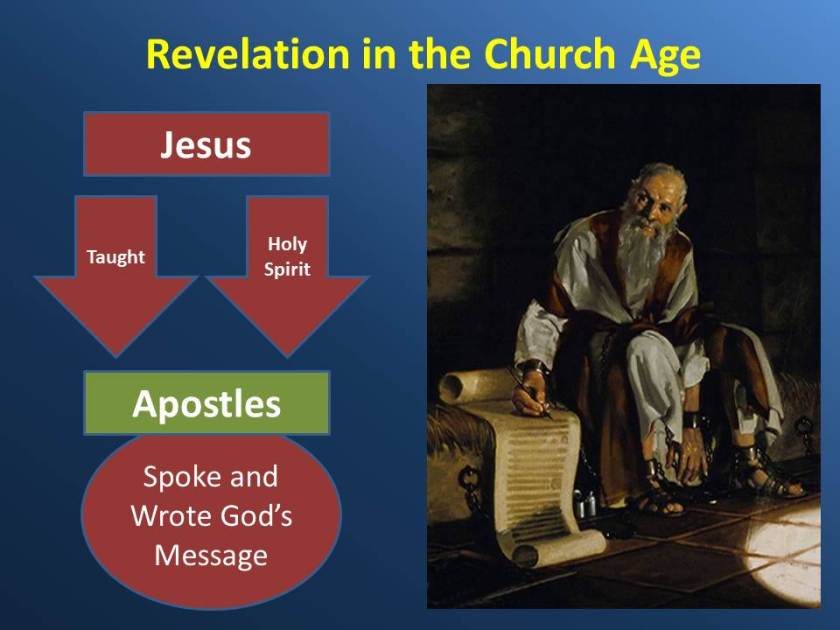
Though God spoke in diverse ways in the Old Testament, God speaks to the church through His Son.
“Long ago, at many times and in many ways, God spoke to our fathers by the prophets, 2 but in these last days he has spoken to us by his Son, whom he appointed the heir of all things, through whom also he created the world.” Hebrews 1:1-2
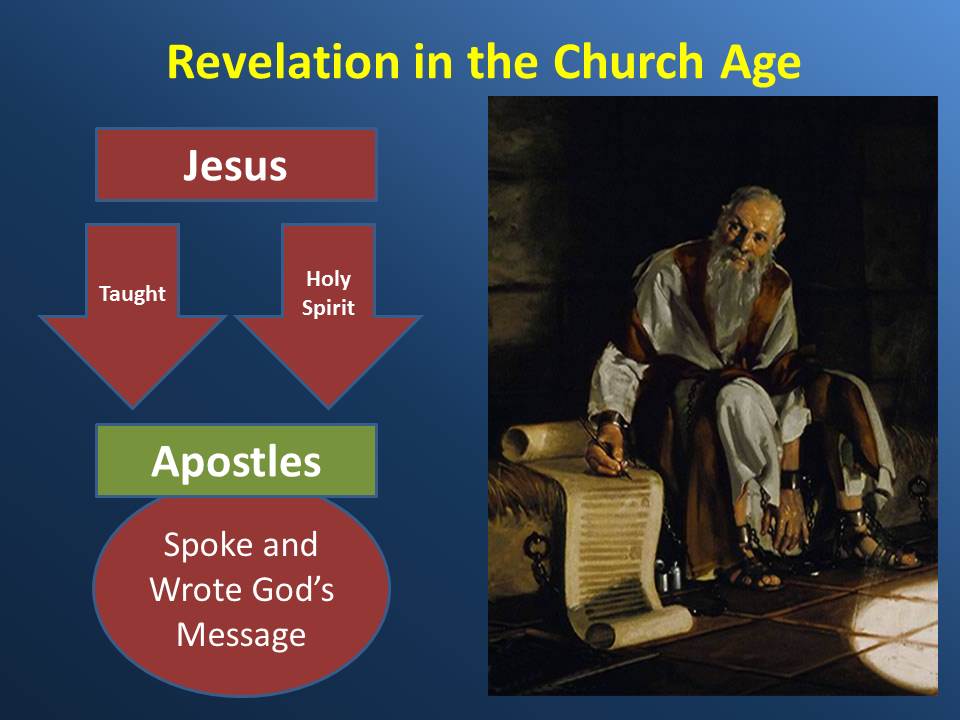
Jesus becomes the central focus of New Testament revelation. Jesus acknowledged that He was given all authority and instructed the apostles to teach each new disciple to follow what Jesus taught the apostles, Matthew 28:18-20. While Jesus was teaching the apostles it was clear that they didn’t always understand His message so He promised to send the Holy Spirit to them when He returned to heaven. The Holy Spirit would remind them what Jesus taught and guide their understanding as they taught the disciples, John 14:25-26, John 16:12-15. It is important to note that the Holy Spirit impart the message to the apostles who would share the message with the disciples.
The apostles and those who heard them teach recorded the message of God. The Holy Spirit inspired the word, 2 Peter 1:20-21. As noted earlier in 2 Timothy 3:16-17, the inspired message brings us to spiritual maturity. Although the scripture is inspiring, that is not what is meant by this passage. The scripture was “God breathed”; He gave it life when He gave the words. In Ephesians 3:1-4, Paul wrote what God revealed to him. When the Ephesian Christians read Paul’s letter they would know what Paul knew about God’s revealed message. Jesus gave His message through the Holy Spirit to guide men for all time.
God’s Will Revealed Once For All Times
The book of Revelation ends with a warning not to add to or remove any part of the message, Revelation 22:18. Though some may apply this only to the book of Revelation consider that such a warning is inherent in the rest of Scriptures. What man with finite knowledge could presume to edit God’s word or add his own message and consider it equal to what God revealed? In 2 John 4-11, the apostle commands that we walk in God’s commandments and that anyone who does not abide in them or goes beyond the commandments does not have God. Paul warned that even if an apostle or angel from heaven preached a gospel different from what had been revealed would be accursed, Galatians 1:6-9.
According to Jude 3-4, the message was once for all times delivered to the saints. Peter encouraged his readers to remember what had been revealed through the holy prophets and the apostles when confronted by scoffers, 2 Peter 3:1-2. He reminded them that God’s word was a source of knowledge and encouragement that they should return to for encouragement.
God’s revealed will teaches the saving plan of God and instruct us in righteousness, Titus 2:11-15. It is a message with the power to perfect us, Ephesians 4:11-16. Christians are told to seek guidance from God’s word:
- 2 Timothy 2:2, 14-15- Know it, live it, and teach it
- 2 Timothy 3:15-17 – Mature through studying God’s word
- 2 Timothy 4:2-4 – Remember that when people leave God’s word they embrace error
- Galatians 1:6-9: – Ignore messages that contradict God’s revealed word even if it is from someone claims to be an apostle or angel
Should Christians Expect Other Revelations From God?
Some Christians teach that God reveals His will directly to people outside of scripture. Some modern Christians believe that God speaks through various means:
Emotions – Good feelings directing them towards a course of action and bad feelings indicating God’s displeasure with a choice
- Feeling an impulse to act
- Feeling peace about a decision as a revelation from God of His approval of that decision
Direct Revelation – God placing thoughts and desires into their hearts (an inner voice).
- “God is telling me to…” (though rarely do they say He is conversing with them)
- “God is speaking to my heart”
- “God laid it on my heart”
- “The Lord laid a scripture on my heart”
This idea is promoted in popular religious books. Francis Chan, in his book Forgotten God, wrote
“My hope is that instead of searching for ‘God’s will for my life’ each of us would learn to seek hard after ‘the Spirit’s leading in my life today.’ May we learn to pray for an open and willing heart, to surrender to the Spirit’s leading with that friend, child, spouse, circumstance, or decision in our lives right now.”
Elsewhere in the book he writes, “It’s much less demanding to think about God’s will for your future than it is to ask Him what He wants you to do in the next ten minutes.”
Chan is urging readers to ask God and expect Him to direct the person towards a course of action. While that might seem like the obvious thing to do, as I will observe later, the New Testament does not tell us to seek or expect God to communicate with us in this way.
Divine appointments – feeling that God led them to choose certain actions that brought about certain results (“Coincidence is when God chooses to remain anonymous”)
In his book Multiply, Francis Chan wrote,
“God may well want you to take His gospel overseas. Too many Christians discount that possibility too quickly. Some people are too comfortable with their current lifestyle and would never dream of sacrificing their comfort for God’s glory. Others quickly assume that they are called to something else, something more normal. We shouldn’t make these assumptions. Have you ever genuinely told God that you would submit yourself to His will in this area? Right now, you should ask God if He wants you to pursue living in a different location for the sake of the gospel. It may be a terrifying thought, but we have to trust God more than we trust ourselves.”
We see a more conservative approach in the Bible with Esther’s uncle, Mordecai. Knowing the Persian king was tricked into issuing a decree to kill the Jewish people throughout the empire, Mordecai urged Queen Esther, who was a Jew, to intercede for the people. Mordecai did not tell Esther that her being the Queen was God’s plan all along for the salvation of His people nor did he ascribe it to chance. He took the only view a person can take without direct revelation from God regarding his plan: “Who knows?” Esther 4:14: “For if you keep silent at this time, relief and deliverance will rise for the Jews from another place, but you and your father’s house will perish. And who knows whether you have not come to the kingdom for such a time as this?”
Ecclesiastes 9:11 acknowledges that time and chance are factors in our lives. It may be that God is working a specific plan that brings two people together or accomplishes some other purpose (ie., Romans 8:28). The event or meeting may be the result of chance but the Christian, using wisdom learned from God’s word, can act in a way that leads to the salvation of a soul or help for someone in need. It seems that some Christians believe they are God’s puppets or that He is micromanaging their lives. In fact, as observed in the previous verses, God’s word teaches and trains us so that we will make the right choices in situations and use opportunities to glorify God. Maybe God did bring me into contact with someone and, as a result, they became a Christian. It might be that we met by chance but, having been trained by God’s word, I knew the person was lost and needed the gospel and proclaimed the word to him. We need to exercise caution saying “God made this happen” since God doesn’t reveal His actions to man. We can simply give glory to God that whether by His will or chance the good was accomplished. I am not saying that God doesn’t work in our lives, I am saying that we need to exercise humility and respect the silence of God and simply glorify God for all that happens in our lives.
Interpretation of omens and signs
- Viewing random texts of scripture as divine guidance for a course of action.
- Viewing opportunities as God wanting them to take a course of action
- Viewing coincidental events as having a God-given meaning
The challenge is that one must determine if events are signs and, if so, where they point. Is the job offer in Kansas because God wants me to move there or is it a test to see if I will stay in my current place at a lower salary instead of chasing the money. This becomes more complicated when one can see many positive ways to glorify God despite the choice made. However, if we understand that God has not determined a path for us but left the choice to us, we can glorify God no matter what we do and we don’t have to agonize over what is or is not a sign and what the sign means.
The Grace Communion Site has a humorous story of how trying to read the tea leaves to determine God’s will can lead to awkward situations and confusion instead of clarity.
“God told me to move my family to Saudi Arabia.”
Alex stared at his friend, wondering if he was just joking or had gone mad. Alex had known Tom for more than 10 years. He’d been best man at Tom’s wedding, not to mention godfather to Tom’s and Alicia’s twin girls. And Alex knew that Tom and Alicia were as cut out for missionary life in Saudi Arabia as toads are for an omelet.
“That’s, well, a pretty big decision, Tom. How do you know it’s really God’s will for you?”
“Well, just a lot of things.” Tom stared deep into his coffee cup. “Pastor Mel’s sermon a few weeks ago really got me thinking.” He glanced up at Alex. “We’re pretty selfish enjoying the good life here in America while people all around the world need help. I gave it a lot of prayer, and God seemed to answer that we should go.”
Alex nodded thoughtfully, weighing how to respond. “How did God give you that answer?”
“Well, for one thing, I was talking to the Hogarths, you know, the missionaries in Saudi Arabia. They said they could use some help.”
“What kind of help?”
“Well, you know, I’m pretty good at carpentry, and they said that’s just what they’d been praying for—somebody good at carpentry. It was like God was just saying to me, ‘This is what I want you to do, Tom.’”
“What does Alicia think about it?”
“Oh, she’s not as excited as I am, but I’m praying she’ll come around.”
“Not as excited?” Alex said.
“Well, actually she’s dead set against it. She can get pretty hardheaded sometimes. But I think the Lord will show her it’s the right thing for us to do.”
“Hmm, I see,” Alex dumped a pack of powdered sweetener into his coffee. “What if he doesn’t?”
“He will, Alex. I trust the Lord. And I have a really good feeling about this decision.”
Tom is not unique. Every day, Christians somewhere are convincing themselves that God is telling them to marry a certain person, take a certain job, go to a certain college, or “get out there” and do something really big and meaningful for him.
Problems With Modern Revelation
We do not find individuals in the New Testament claiming God was leading them by emotions. New Testament Christians acted in response to specific verbal instructions from God or His agents. Of greatest importance is this fact:
There is no New Testament instruction for believers to expect messages from God through feelings, impulses, interpretation of events, or message directed to their hearts nor is there guidance for interpreting feelings, events, or speaking to the heart to determine God’s message, discriminate it from one’s own thoughts, or how to make sure that is not evil feelings or thoughts influenced by Satan.
In fact, the scriptures teach us to be inherently distrustful of the heart:
- Proverbs 28:26 – Fool trusts his heart
- Jeremiah 17:9 – Heart is exceedingly wicked
- Proverbs 14:12 – There is a way that seems right to man
Consider this observation by D. Martin Lloyd-Jones:
“Let us imagine I follow the mystic way. I begin to have experiences; I think God is speaking to me; how do I know it is God who is speaking to me? How can I know I am not speaking to man; how can I be sure that I am not the victim of hallucinations, since this has happened to many mystics? If I believe in mysticism as such without the Bible how do I know I am not being deluded by Satan as an angel of light in order to keep me from the living and true God? I have no standard. The evangelical doctrine tells me not to look into myself but to look into the Word of God; not to examine myself, but to look at the revelation that has been given to me. It tells me that God can only be known in His own way, the way the way which has been revealed in the scriptures themselves.” (excellent article)
As Mark Copeland said in his excellent work on the Holy Spirit, “Don’t let feelings of the human spirit keep you from following the teachings of the Holy Spirit!”
Some say that good feelings show God’s approval, yet self-satisfaction and self-justification will produce the same emotional feedback. Who is to say that a feeling or impulse is not the product of a seducing spirit who portrays himself as an angel of light (1 Timothy 4:1-2)? Some proponents admit this but claim that one can discern the message of God when he becomes one of the spiritually elite who is in tune with the wavelength of God. Henry Blackaby, a leading proponent of this view, when challenged about how he knew the source was from God but not others said, “You come to know His voice as you experience Him in a love relationship. As God speaks and you respond, you come to the point that you recognize His voice more and more clearly.” (As quoted in Gary Gilley’s excellent book* “Is That You Lord?” -al.)
Special insight only available to a uniquely spiritual person was the claim of the first century Gnostics. Recognized as heretics, the Gnostics claimed to have a superior walk with God due to divine insights and mystical experiences (Col. 2:18-19). Some claim the Holy Spirit only directs in the divine application and interpretation of the written word through feelings, promptings, impressions, and insights but they cannot even find the scriptures to prove that such takes place. (Gilley, 33) Historically, those who have recognized an authority outside of God’s word to accompany it tend to eventually supplant God’s word with personal revelation (David Wells).
Seeking God’s Signs as Divination
Some spend much time trying to interpret their feelings, coincidental events in life, etc. to determine what God wants them to do in life or what choices to make. Bruce Waltke ( Finding the Will of God: A Pagan Notion? -al):
“When we seek to ‘find’ God’s will, we are attempting to discover hidden knowledge by supernatural activity…If we are going to find His will on one specific choice, we will have to have to penetrate the divine mind to get his decision…this is a form of divination. The idea was common in pagan religions…in fact it was the preoccupation of pagan kings.”
Just as idolatrous people sought the Oracle at Delphi, reading tea leaves or animal entrails, astrology, and omens to determine a course of action, some Christians are acting with a superstitious approach to their feelings and events in life to determine God’s will.
“God’s Leading is Non-Authoritative”
Some argue that God speaking in this way is “non-authoritative”. How could one say that God is leading or directing them but conclude that there is no authority with that leading? If we determine that God wants us to choose a course of action and we ignore or disobey it, will we be judged as disobedient and rebellious (as Jonah who disobeyed the direct instruction of God)? If not, why not?
When multiple Christians believe God is expressing His will through feelings, though they don’t all get the message, some difficult situations will arise. Consider this one:
On one occasion we were discussing various ministry strategies and plans when a member of staff shared what they believed was a word from God with us. To be honest I cannot even remember what it was that God was meant to have said but I do remember the unease in the room as the rest of the people around the table tried to figure out how to proceed. Do we disagree and argue God has it wrong? Do we tell them they did not hear from God?
How do we know if that’s true? Do we go to scripture to test the Word that they have given? What if there is nothing contrary to scripture in the Word? Do we simply have to accept it?
It was clear from the mood in the room that there were at least some reservations about acting on this supposed word from the Lord. The hardest part was that the person sharing this word genuinely believed that God had spoken to them and were offended when people did not fully believe in the same way they did. They left the meeting convinced that they were right and that God was on their side and on reflection it was another marker on the way to the division that would eventually befall this leadership group. (As told in the article “God Told Me”)
Even people who believe that God is directing them often express uncertainty as to whether God is actually instructing them on a course of action based on feelings, etc. There is confidence that God uses such means to communicate but no confidence in the exact message is that is being communicated! Non-believers have impulses, feelings, coincidental encounters, and random events that influence their actions but they do not consider such events to be a message from God. They recognize these as insights or being open to other options.
Spiritual Maturity: Being Led By God’s Word
We should be grow and mature as God’s people through daily study, prayer, and godly living.
- 2 Peter 1:3-4 – Scripture gives all things that pertain to life and godliness
- Colossians 2:6-7 – Established in the faith
When we grow in our knowledge we become more spiritually discerning and blend our natural thoughts with God’s revealed and inspired word. Our thinking should change:
- We should become more aware of opportunities to teach and serve others.
- We should become better decision makers as we make choices in light of whether it will please God, make us more holy, and allows us to glorify God in our lives.
- We will become more useful in God’s service by applying the revealed word.
The Holy Spirit, through the revealed word, leads us in righteousness and service. We still glorify God because He taught us how to live.
Note: Proponents of God’s leading often believe God has a specific will for their life and that He is nudging them along the path through feelings, omens, etc. I wrote an article that discusses God’s plans in our lives. If God has left the decision making in our hands then we shouldn’t look for mystic signposts to point us to some hidden path but follow the clear leading of the revealed word to be the right person so we can please God no matter the situation we are in.
*I highly recommend this book. It was a primary source for this article. There is also a very good podcast in which Gilley discusses this issue.


 Godly Youth