How To Feel More Comfortable about Sin

The word “sin” seems so harsh. Members of the church and especially non-Christians don’t like the word. No one likes to have their actions called sins. Naturally, to commit an action and have it called sin will make us feel uncomfortable. If you want to continue sinning but not feel so bad about it, follow these tips:

Emphasize other people’s sins, minimize your own sins

Jesus illustrated this in the parable of the Pharisee and the tax collector in Luke 18:9-14.

9 He also told this parable to some who trusted in themselves that they were righteous, and treated others with contempt: 10 “Two men went up into the temple to pray, one a Pharisee and the other a tax collector. 11 The Pharisee, standing by himself, prayed [1] thus: ‘God, I thank you that I am not like other men, extortioners, unjust, adulterers, or even like this tax collector. 12 I fast twice a week; I give tithes of all that I get.’ 13 But the tax collector, standing far off, would not even lift up his eyes to heaven, but beat his breast, saying, ‘God, be merciful to me, a sinner!’ 14 I tell you, this man went down to his house justified, rather than the other. For everyone who exalts himself will be humbled, but the one who humbles himself will be exalted.” ESV

by Rody Davis
A drawing of two paths by Rody Davis

The tax collector clearly had a negative view of his sin which is evidenced by his humility when approaching God. He considered himself a sinner and even said it out loud!  He would not even look up to God when asking God for mercy. He clearly was not comfortable with his sin.

However, the Pharisee knew that he needed to compare his life with those who were considered inferior and known in the world as sinners. He was even thankful to God that he was not like those terrible sins. He was also quick to point out all that he did for God and could even look God in the eye, so to speak, and declare his righteousness.

Matthew 7:1-5 records the most beloved saying of scripture (not “God so loved the world that He gave His only Son…” but the real favorite: “Judge not that you be not judged”). Jesus compared one who ignores his own sins while focusing on the sins of others as one who has a piece of lumber sticking out of his eye trying to remove a speck of dirt from his brother’s eye. Be careful not to read the whole passage because Jesus does not actually condemn judging others but rather that we need to work on ourselves in order that we may help others

Think on evil things without doing them

Some are rightly worried that if the do certain things, they will be lost:

“9 Or do you not know that the unrighteous will not inherit the kingdom of God? Do not be deceived: neither the sexually immoral, nor idolaters, nor adulterers, nor men who practice homosexuality, 10 nor thieves, nor the greedy, nor drunkards, nor revilers, nor swindlers will inherit the kingdom of God. 11 And such were some of you. But you were washed, you were sanctified, you were justified in the name of the Lord Jesus Christ and by the Spirit of our God. 1 Corinthians 6:9-11, ESV

However, these people who do not want to commit these acts (and others condemned in scripture) might let their minds wander and imagine sinful thoughts but think that they are safe since it is only in the mind. However, in Colossians 3:1-2 Paul urges us seek the things that are above and not dwell on worldly things. If we seek the things above, we will not want evil thoughts to remain in our minds to grow and pollute our thinking.

Jesus taught, in Matthew 15:11, 15-20, that evil inside our hearts defiles us. The sins that we commit come from things planted in our hearts. Note that all of these actions are prompted by lust, covetousness, hatred, envy, and ungodliness in our hearts.

Play near the “big” sins without committing them

Many people see committing sin as a line not to cross. When one steals or kills, they have crossed the line into unrighteousness. Jesus addressed this attitude with the Pharisees in Matthew 5:21-22; 27-28. Clearly murder and adultery were condemned by God and the Jewish audience recognized this as true. However, Jesus taught that before the “big” sins were committed, many little sins preceded them!  There are no “big” and “little” sins. All sin is unrighteousness.

We must also remember that sin is deceptive. After all, it is authored by the father of lies. When you think you are close to the edge of sin, you are actually already into sin. James 1:12-16 teaches about the progression of sin towards death. Most people do not jump into the deep end, they step into the shallow end and go until they are completely immersed.

Laugh at sinful things

I have no doubt that some will read this article and laugh at the idea of sin and that anyone should be concerned about it. They condemn very little and think that the concept of sin is outdated. This attitude itself is ancient and condemned by God

Woe to those who call evil good and good evil, who put darkness for light and light for darkness, who put bitter for sweet and sweet for bitter! Isaiah 5:20, ESV

Mocking sin and the concept of sin and laughing at sinful actions or stories help make sin not seem so serious. This is the magic of TV and movies. Using filthly language, condemned in passages such as Colossians 3:8, doesn’t seem so bad when a cute kid does it. In fact, it usually generates a good laugh.

Sexual immorality is much easier to deal with when you can laugh at the behavior and laugh at those who condemn it. Adultery and premarital sex is always cause for a good laugh on TV and movies. One can find himself wanting the main character to have an affair or premarital sex with one of the other characters. Even if we would not endorse this if the characters were our friends or parents, we excuse it because it is “entertainment”. We can even watch couples having sex, something we don’t do in real life–and would be arrested if we were looking in bedroom windows. But hey, it’s part of the plot.

Sinful behaviors don’t seem so bad when they are flooded into the cable or satellite dish on a 24-hour basis. It is godly living and standing for the truth that really gets the good laughs.

Follow worldly philosophies

Let pithy sayings, suppositions about what the Bible teaches (without actually studying it thorougly yourself), and “accepted knowledge” guide your thoughts instead of clear reasoned arguments. Undersand that the problem with this approach is that Paul wrote, in 2 Corinthians 10:4-5, that the Bible can peel through the transparent knowledge and empty philosophy of the world. To feel more comfortable about sin,  deep and medidative Bible study should be avoided.

To follow the spirit of this world you must convince yourself that it doesn’t really matter what you believe. Of course, you will need to ignore passages like 1 Timothy 1:5-7.  If you find a preacher who will tickle your ear by teaching what you want to hear, that will help (2 Timothy 4:2-5).

Give into worldly habits since you can’t fight them

The best way to become comfortable with sinning is to convince yourself that you just can’t keep from sinning. Keep telling yourself that you are just too weak and that God will just have to deal with your lack of self control. You will need to ignore the exampe of Paul who disciplined his body and mind so he would be faithful to Christ, 1 Corinthians 9:27. Also, stay away from the exhortation to not let sin reign in your life, Romans 6:12-14. If you can avoid the instructions of 2 Peter 1 to develop self-control and the numerous exhortations to flee immorality and live “soberly, righteously, and godly in this present age” (1 Corinthians 6:18; Titus 2:12) it will help you to accept your lame excuse that you just can’t resist temptation and that it is just the way you are.

Don’t clutter your mind with spiritual things

If you are not thinking spiritually, you won’t have to be concerned whether an action is wrong or right. You can chant the mantra “peace and safety” while feeling comfortable with sin, 1 Thessalonians 5:3. Spiritual thoughts can cloud the mind and perhaps cause your conscience to hurt if you are committing sin.

A different approach

Some reading this might decide that they shouldn’t feel comfortable about sin in their lives. It is understandable since the Bible teaches that we will be judged for all that we do or think (Revelation 20:12-13; Hebrews 4:12-13) and that the punishment for sin is eternal death.

You might also see that sin brings you down from the beauty of holiness to the filth of the world (2 Peter 1:3-4). The more we sin the less we look like Christ. It cheapens our life for we can never be all that we should be, and do great things for the cause of Christ if sin rules in our lives.

If you realize this, then it would be best if you never became comfortable with sin in your life. Peace, joy, and contentment are only found in Christ. The devil can promise it through pleasures, possessions, and prestige, but he can never deliver.

Don’t Talk Your Dreams To Death

In all toil there is profit, but mere talk tends only to poverty. Proverbs 14:23

“In all toil (labor) there is profit”
Diligent work always leads to some result or profit of benefit to the worker. Most work is neither easy nor fun but it does pay the bills and provides money for doing good and having fun. Even if you have a job you enjoy, there will be  unpleasant duties. People who love to garden still must get dirty, sweaty, and dig through the soil if they want to have the flowers or produce of the garden.

“Mere talk leads to poverty”
In contrast to diligent labor, talk without action leads to poverty. Idle talking does not pay and has gotten some people fired. Grandiose plans and slick presentations may impress others but it does not pay one cent if no labor is expended to make the dream a reality.

The first obvious application—indeed the natural application—of this verse is to the business world. In the early days of personal computers —before the average person could access the Internet—a man I knew had great plans to work with realtors to put pictures of houses for sale on videodisc (pre-DVD) with sale information for agents and customers. He had a prototype system, good marketing plan, and enthusiastic presentation. He talked with people in the office about his plans and the unlimited potential for profits. One problem: he did not have customers or profit from the work because he did not get out and talk to the customers who needed the system. In short, he planned and talked his way to poverty while other people, through hard work, were able to profit from similar ideas.

The world is made up of  poor creative geniuses and  rich people of average intelligence. The difference is not what they know but by what they do.

This principle is especially important for spiritual growth. Is your spiritual life the product of hard work or mere talk?

Some people talk about “getting their life right” or “straightening up” but still hang out with ungodly friends, feed their minds with filth, and do not change. Some say they want to pray or study more—and do so year after year. Some talk about doing more things with their brethren, helping the sick or needy, or getting involved with some work in the church but do not act.

Some people realize their life is displeasing to God, is yielding undesirable consequences, and is unsatisfying so they change their behavior. Some want a closer relationship with God and execute a plan to study and pray more frequently. Some take action to involve themselves with their brethren so they can have richer and deeper fellowship with other Christians.

If you want to have a rich and meaninful spiritual life, you’ll have to work for it.

  • Romans 13:11-14 – Awake and get busy
  • Thessalonians 5:4-8 – get busy with good things
  • Ephesians 5:14-17 – wake up and make good use of your time

 “He who works his land will have abundant food, but the one who chases fantasies will have his fill of poverty.” Proverbs 28:19 (NIV)

“The road to hell is paved with good intentions.” How sad it will be for those who dreamed of a close relationship with God and their brethren, a close loving family, and a meaningful life’s work to fail because they only dreamed and did not act.

Developing Focus and Flow in School Studies

Several months ago, my dear niece Kaylin was feeling overwhelmed with a lot of school assignments, tests, essays, papers, and book reports. I sent her the following which she said greatly helped her and others that she shared it with. If school work (or tasks at work) frustrate you, I hope the following tips will give you help. These principles are useful at work, managing a home, and even Bible study.
(Hat tip to David Allen and Getting Things Done book for teaching me many of these lessons.)

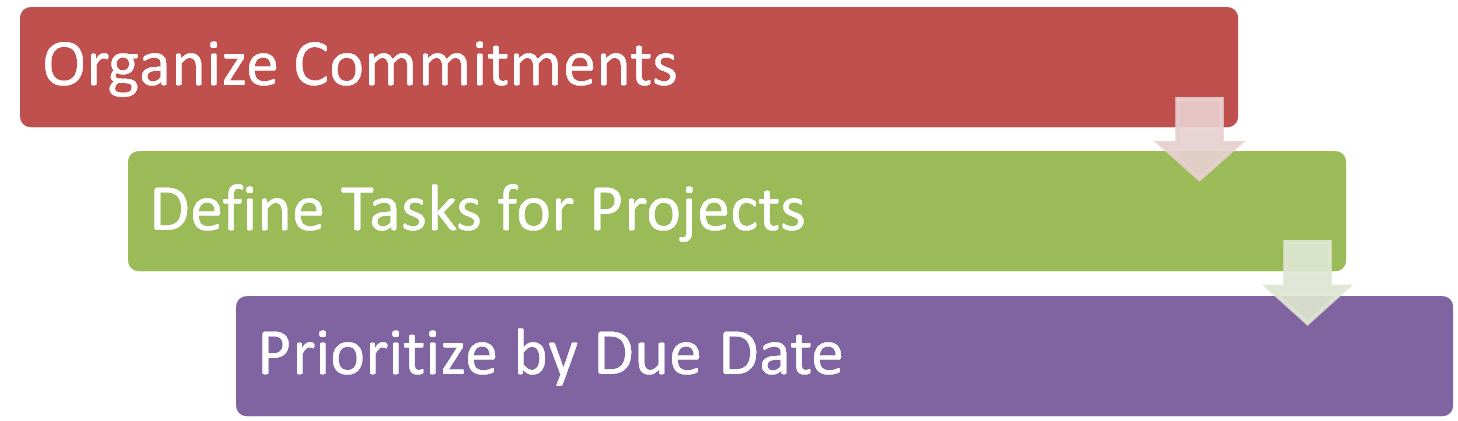
Organize your commitments. Make a list of all of your commitments–papers to write, test dates, and other assignments and sort the list  by due dates (earliest due at the top of the list).

Define tasks for “projects.” For term papers or assignments that require multiple steps to complete (going to library to get research materials, making outline, turning in first draft…), list the specific actions that you will need to finish the project. For example:

  • Get 3 library books on History of Spain
  • Read research materials
  • Make reference cards
  • Write first draft, etc.

Assign due dates to each action allowing plenty of time to do each task and complete the last task before the project due date.

Prioritize. Review the list of all steps (individual tasks and project steps) and list them by due date starting with the earliest due.. This will help you understand what you must finish first, second, third, etc. This will also assure you that you are doing things in the right order so you won’t stress while doing one assignment worrying that you should be doing something else.

Fighting Distractions

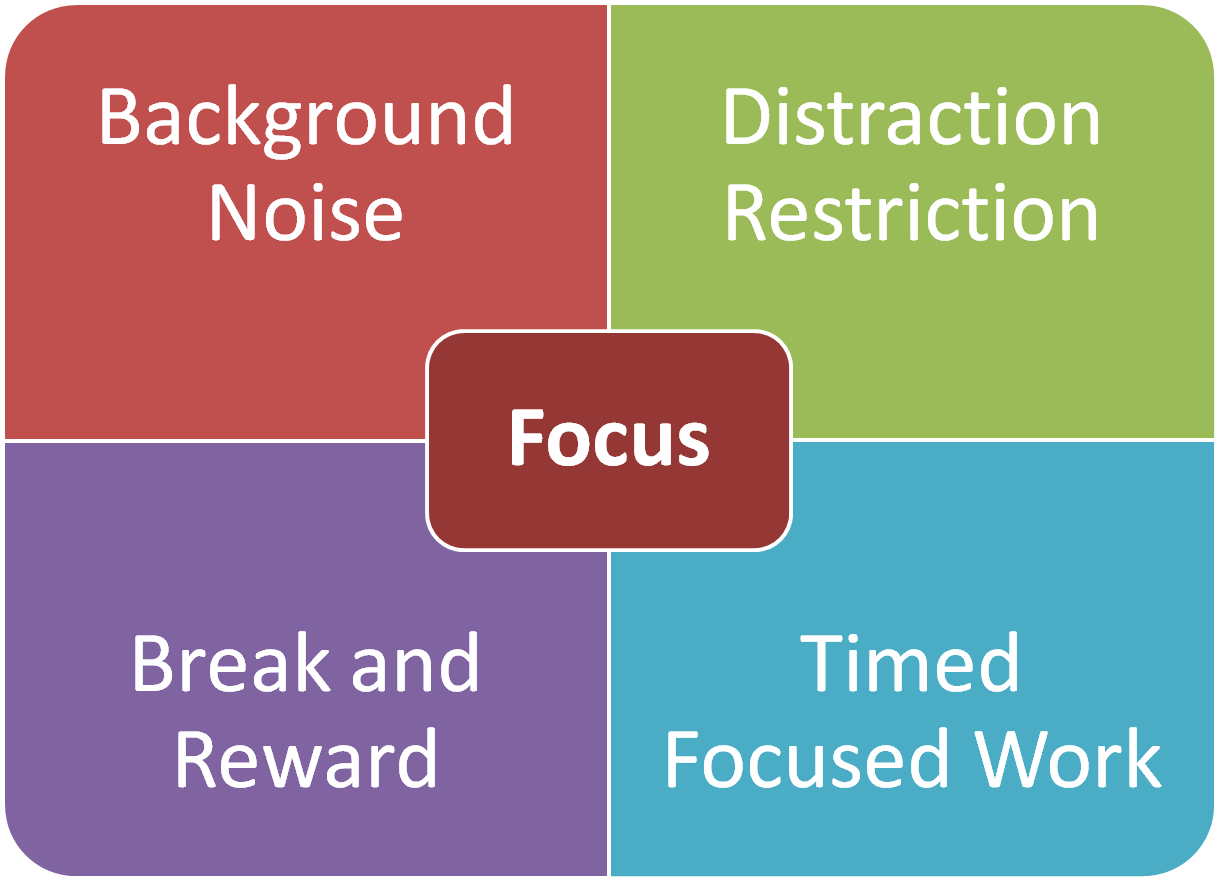
Background Noise. Turn on instrumental music (ambient music, classical, DJ/Dance…) to listen to while you work. Music with lyrics will be distracting as your mind tries to process the words while doing critical thinking. Your brain doesn’t have to listen to or interpret non-vocal music. Vocal music is fine when doing non-analytical processing (crafts, building projects) but there is a cognitive cost of listening to lyrics while trying to process words in a textbook or writing.  You could also use a sound machine that generates peaceful sounds like ocean waves, crickets, or running water.

Restrict Interruptions. This means no texting or phone calls. Put your phone on silent and in a drawer to remove the temptation.  Also, unless you are doing Internet research do not have your browser open. If you are doing research, make sure social media networks are off (not in a hidden tab…OFF) and chat is unavailable. This will help you get in “the zone.” Interruptions throw off your “flow” and work takes longer to complete. Also, having these available makes it easy to “just check that message, updates…” when you run into something that is not much fun or difficult–this is evil. Put a “do not disturb” message on your door.

 Focused Work. Set a timer for a specific period (~30-50 minutes) and do NOTHING but task #1. Try to complete the task within the time (but don’t stress if you don’t–make it a game to see how much you can do in the allotted time). Do not stop the work–no message checking, cleaning your room, NOTHING!!–until the timer goes off. If the only timer you have is on your phone, go to http://www.e.ggtimer.com and set the time you want to study. A kitchen timer would be best since you don’t have to leave the Internet up or have your phone (with text alerts) visible.

 Break/Reward. When the timer goes off, set the timer again for 5-10 minutes (less if you have a lot of work to do. While standing and stretching text, check social media, or whatever. As soon as the timer goes off (IMMEDIATELY), shut the devices off and close social media. Do not “check one more message…”

Resume. Reset the timer and either finish the assignment you started or begin action #2. Continue this until you complete all the actions that you need to complete today. Some tasks will have to take place tomorrow but your priority list will give you the confidence that you know what must be done today and what can wait for another day. This also gives you peace when you finish today’s task list you can enjoy time with friends or doing something you enjoy knowing that you have planned time to complete your remaining assignments on time.

Other tips and observations:

  • Don’t work to perfection–especially at first. For example, if you have a writing assignment, just get the ideas on paper as they flow and go back and correct grammar, and reword things later. This is important for two reasons. First, if something bad happens that leaves you with little time you still have something to turn in instead of no assignment. Two, it relieves the stress when you have a lot of assignments, knowing you have something to turn in and can return to the assignment later, if you have time, to improve the work quality.
  • “Don’t let perfect be the enemy of good.” Don’t spend so much time on formatting, appearance, etc. that you have little time to do other assignments. Do the best you can and when (if) you have time, go back and make it prettier, more profound, etc.
  • Be careful with sugary foods and energy drinks as they can give you a quick high but you will feel more tired (and hungry) when you quickly crash. Drink lots of water and snack on nuts, fruits, and other foods that will give you sustained energy.
  • Pray to God for strength and thank Him for the opportunity to be in school and ask for His help since you want to use your education to His glory.
  • For lengthy reading assignments, learn to scan well and note important parts. Most of books are fillers with nuggets of info. Some speed reading techniques will help you harvest the important information without being caught up in unnecessary info.
  • For test prep: Try to make as many mental images to help you remember lists and associate terms and ideas. The more outrageous the image the better. Have a buddy quiz you and quiz them. Learn memory techniques.

Now available! A PDF copy with the basic guidelines to post by your study area to remind you of the study principles. Download here.Developing Focus and Flow in School Studies

Please Don’t Text and Die (or Kill)

Texting and driving can result in your death, the death of others, or life altering tragedies. Messages can wait. Mourning is too long and life is too short. Please watch this clip: Don’t Text and Drive

All My Lame Excuses (and 5 ways to get rid of them)

Excuse. Sounds like a reasonable word. Acceptable. Perhaps even respectable. The word “excuse” describes a plea or request to be released from a promise or obligation or an appeal for forgiveness for failing to meet an agreement. So an excuse is something I offer when I’m not doing what I should be doing, failing to keep a promise, or as part of an apology for not doing what I said I would do. Excuses sound fine to a rationalizing mind but under the harsh light of the truth, they look pretty weak and ugly.

How many excuses do you generate in a day and for what?

  • Do you make excuses at school for why you didn’t have an assigment or do well on a test?
  • Do you make excuses to the coach or teacher for why you didn’t give 100% or perform well?
  • Do you make excuses to your parents for why you didn’t do your chores?
  • Do you make excuses to God for why you can’t study your Bible or spend time with Him in prayer?
  • Do you make excuses to yourself for why you didn’t stay on the exercise program, diet, or daily practice?

See, we even make excuses to ourselves…AND BELIEVE THEM! The better approach is just to admit that we gave up, didn’t give our best, got distracted, or whatever, then apologize and fulfill our commitment.

If we continue to offer excuses people will learn not to trust us. If we keep giving ourselves excuses, we limit and cripple ourselves and will eventually expect less of ourselves. As Benjamin Franklin said, “He that is good for making excuses is seldom good for anything else.”

5 Ways to Eliminate excuses

  1. Don’t make promises you don’t intend to keep. You have a right to refuse anyone’s request for a favor and still be a good person. Recognize that the person might be disappointed but they would rather get an honest “no” from you and find someone else to fulfill their request than to get a “yes” then endure the frustration when you don’t keep your word. Jesus said to let your “yes” be “yes” and “no” be “no” and that anything beyond that was evil, Matthew 5:37.
  2. Keep your commitments and promises. It is good to make good promises and some commitments. If you have given your word, make haste to fulfill the obligation. You will preserve your integrity and the trust of others. Keeping your commitments strengthens the “no” that you must give for people learn that they can depend on your “yes” and “no”. As Elbert Hubbard, American writer, said, “Don’t make excuses–make good.”
  3. http://www.flickr.com/photos/thomasguest/5061459807/sizes/s/in/photostream/
    By Thomas Guest via Flickr (Creative Commons)
  4. Eat the toad. Excuses often follow procrastination. You agree to something, put it off telling yourself that you will get around to the task (excuse to yourself), then finally abandon the task and generate an excuse. If you absolutely had to eat a live toad every day when should you do it? First thing in the morning of course! You do it, get it out of the way, and you don’t have to dread it, put it off, brood over it, or kick yourself for not doing it. Don’t make an excuse–eat the toad, get it over with, and go on with your life.
  5. Embrace a “no excuses” policy. I used to keep a sign with what I understand is the motto of the British Foreign Office: “Never excuse. Never explain. Never complain.” If you are doing what you supposed to be doing, you should not have to explain or excuse your actions. If you commit to not giving excuses you have to commit to keeping your word. Remember that excuses weakens, execution strengthens.
  6. Practice at home. Decide that you will not offer any more excuses to your parents or God. You will “obey them in the Lord for this is right” (Ephesians 6:1). Strive for completion of your promises and obligations.If you fail, give them a straightforward apology and ask what you can do to correct the situation: no excuses or reasons for failure then strive to do better in the future. Don’t offer God lame excuses for not praying, studying, or doing other work in service to Him. Admit your failures, ask His forgiveness, then make specific plans for how you can fulfill these expectations (which ultimately are for your good anyway!)

This Nike commercial might inspire you to give up your excuses today.