Well, Since We’re All Christians…Let Me Tell You This Joke

That was how my friend started his filthy joke. I guess since we were all Christians he thought he wouldn’t ruin his reputation. He felt justified in telling his brothers in Christ something that he wouldn’t tell his non-Christian friends. But this action did harm his reputation among the small audience. It demonstrated that he enjoyed that type of humor but, constrained by what he understood to be appropriate behavior for a Christian, he could only enjoy it himself of fellow Christian confidants. His conviction seemed to be with appearance, not dedication to holiness in God. The oldest of the group said, “Well, I am a Christian and I don’t appreciate that type of humor” to provide much needed correction.

It reminds me of a story of a man in a group who said, “Since there are no ladies present, let me tell you a joke.” Quickly a man arose and said, “There may be no ladies present but there is at least one gentleman and I’ll ask you to wait until I leave before telling your joke.” If you think this is not serious and that God really doesn’t care about such humor, consider Ephesians 5:4

But sexual immorality and all impurity or covetousness must not even be named among you, as is proper among saints. Let there be no filthiness nor foolish talk nor crude joking, which are out of place, but instead let there be thanksgiving. Ephesians 5:3-4 (ESV)

Christians must be Christians among Christians

We should not use our association together to let our guard down but to build each other up! Every act of holiness, meekness, helpfulness, love, compassion, and kindness should be amplified when Christians are together! It is so disappointing to hear of Christians treating their brethren with contempt, unkindness, or apathy. We get enough abuse in the world, the company of Christians should be our place of safety, rest, and building. Yet sometimes when we are among fellow Christians we allow such petty behavior and attitudes to exist as if our brotherhood allows such treatment. We forget that we are a body, under a single head, that is to work in unity and love for one another. Heed the warning of Galatians 5:14-15:

For the whole law is fulfilled in one word: “You shall love your neighbor as yourself.” But if you bite and devour one another, watch out that you are not consumed by one another.

Christians in the Family

We can see this in families as well. Among husbands and wives, parents and children, where there should be love and edification there is animosity, apathy, and abuse. It seems the attitude is “we are bound together as a family so no matter how I treat or ignore you, you are stuck with me.” Instead of enjoying the bond and building it through love, mutual respect, and edification, they demoralize and demean the others. In the physical family and the family of Christ, this should not be. If Christ commands us to “love our neighbor as ourselves,” do we have any closer neighbors than our spouse, parents, and siblings? I read a quote once that the household of the Christian should be such that even the dog feels blessed to be in it.

We should shine as lights into the dark world and demonstrate the holiness of Christ in our lives so that all will know we are Christians. Especially among fellow Christians.

Quit Sawing Spiritual Sawdust!

Our house has recently undergone a major transformation as we added living space for my mother-in-law. During the building a lot of lumber was cut which generated many piles of sawdust. The carpenters were careful to measure and check their measurements before cutting the wood because cutting wood is a permanent change. We even have phrases like “measure twice, cut once” to remind us of the permanence of our decision when we have cut the wood. You cannot rejoin the wood once it is cut. Even if you glue or otherwise join the wood, it will be shorter because of the wood lost in the kerf-the slot where the wood was cut. Some strength will be lost that would not be lost in the uncut lumber.

Sawdust is the bits of wood sawed away from the lumber (or the “work”). Sawdust is worthless for the building construction and it is often swept or vacuumed away. It is the waste product of the productive work of building. So if you came upon someone piling up sawdust and trying to saw it again, you would think they were crazy. You can’t saw sawdust. There is no value in the action and nothing good is produced.

Spiritual Sawdust*

However, many people waste a lot of time sawing spiritual sawdust. As I noted before, sawdust is a product of action and is a visual reminder of the cutting process. In a sense, sawdust is the “past” of the finished product. There was a piece of lumber, now it is two pieces of wood, and the sawdust is left behind as a reminder of the action of the process of separation.

Some people have made decisions (or failed to make a decision) then spend long periods of times reliving the decision, digging up the pain and memories, and will not let the past go. Instead of letting the decision stay in the past, the bring it back to the future and agonize over it again and again. The result of this effort is bitterness, misery, failure to forgive themselves and possibly others, regret, and self-reproach.  They can do nothing to change the past, nor can they “uncut the wood” to make things right. What can we do?

5 Steps To Dealing With The Past

  1. Accept it and own it. The past cannot be changed: it is part of the permanent record. When we get on a scale, the weight is not a reflection of what we intend to do in the future but choices we have made in the past. The attention to our diet, exercise, and other physical factors are reflected in the displayed weight. Wishing or regrets will not change the number. However, we can make different choices and those results will be displayed when we weigh again. What has happened is like the weight: you cannot affect it anymore.
  2. If needed, repent and ask for forgiveness. We may regret and ruminate over things that were poor decisions but not sinful. Perhaps you are beating yourself up because you didn’t finish college or you left a good job. Such actions do not demand repentance. However, some decisions you agonize over were also sinful rebellion against God. To move forward you need to ask God’s forgiveness. In Revelation 2:5, Jesus told the Ephesian church to repent and do the first works: the old habits of faithfulness that they gave up. 1 John 2:1 tells us that God is faithful to forgive our sins. If you are challenged with this, I urge you to read this post as well. It may be that you need to seek forgiveness from someone. Do so quickly so you can move on with life and know that you have tried to make amends for your offense.
  3. Learn from it. It does no good to ruminate over your regrets. However, take time to learn from your mistakes. Look at what you did and why you did it. What were the circumstances? What was your attitude that led to the choice? What can you do to avoid doing this again and create better outcomes in the future? You can take the power from Satan’s victories by turning them into victories for God when you create learning experiences to prevent future regrets.
  4. Let it go. The past does not hold onto you, you have the grip on it. You give it power to ruin the future. You give it power to hold you back and keep you down. If it was a sin and you asked God’s forgiveness, He no longer holds it against you. Learn from the past then let it go. You cannot undo the past but you can quit allowing the past to have power in the future.
  5. Create tomorrow’s fruits. Where you are today is the result of prior decisions. Where you will be tomorrow is a result of the choices you make today. You can change direction. The direction of the past does not have to determine the direction of your future. You can get on a different road, travel at a different speed, and choose new travelling companions. You can build on the foundations of the past or, if you are changing direction, build on its ruins. Plant good seeds today so you can eat good fruit tomorrow. Follow the wisdom of God’s word and build a great tomorrow, especially a heavenly eternal tomorrow, regardless of what you have done in the past.

*I can’t remember where I heard the illustration of trying to saw sawdust. It is not original to me.

Preparing for Life’s Storms

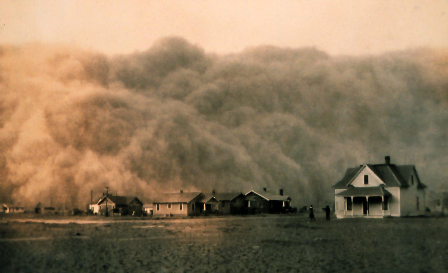
An farmer advertised for a farm hand but for a long time no one applied for the job. Finally, a young man applied for the position but he was not much to look at. His skills were basic and when asked why he should be hired, the young man replied, “I can sleep when the wind blows.” The farmer did not understand the cryptic answer but hired the young man as there were no others to take the job.

Dust-storm-Texas-1935

For many days the young man did a fine job. One night, the farmer was awakened by a sudden storm. He rushed out the door before realizing he should wake up the young man to help him but, since the storm was very close, he continued rushing to the barn to prepare for the storm. When he ran to cover the straw but found that it was covered with a tarp and staked to the ground. In the barn he found the animals safely in the stall and though there was not threat of a storm that day, the young man prepared in case a storm arose. The farmer then understood the young man’s words, “I can sleep when the wind blows.” The young man knew how to prepare so that when difficult times arose, he was ready to face it. (story source unknown)

Those who are prepared can weather the spiritual storms of life.

Good Foundation

A familiar story to Bible students is found in Luke 6:46-49 contrasting the wise and the foolish man. The wise man built the house on the rock, a good foundation, for stability whereas the foolish man just built on the sand with no thought to the consequences. When a flood came, the wise man’s house remained while the foolish man’s house was destroyed. They didn’t build the houses for the flood, they built the houses to live in. The wise man anticipated potential problems and built a strong foundation to protect the house no matter what would come. To build in this manner required more difficult and thoughtful preparation, harder work, and longer time. A strong foundation provided strength against destructive forces.

Christ built the church on himself, the strongest foundation, Ephesians 2:19-22. As Christians, we are built up on that foundation. We accomplish this by making sure we know the basics of the faith (Hebrews 5:11-6:2) and knowing the reasons for our faith (1 Peter 3:10-17). The knowledge of truth and the application in our life of that truth is the foundation upon which we can build our life.

Prepare for Opposition

In order to prepare for the storms in life that will come, we must build on the foundation of knowledge in practical ways.

Put on Spiritual Armor

The child of God must put on the armor of God describe in Ephesians 6:10-18. The child of God must be dressed to fight for truth and against evil. When dressed for battle, we must expect opposition, Matthew 5:10-12. Though we will be tried and suffer, if we trust God we will not be ashamed, 1 Peter 4:12-19. Though we will suffer for a little time in our battle for right, God will give us strength for the battles and will establish us – give us a good foundation, 1 Peter 5:6-11. Peter says that our sufferings are shared by our brethren around the world and that the devil is prowling around attacking so we must be on guard. If we stand firm, even though we face death, we will be protected by God and can have victory through the blood of Jesus, Revelation 12:10-11.

Conquer False Teaching

It is important to build our knowledge of God’s word so we can recognize, expose, oppose, and resist false teaching that will separate us from God. Even so called religious books can contain error. The Bible warns of people teaching destructive things in the name of Jesus, 2 Peter 2:2-3:

And many will follow their sensuality, and because of them the way of truth will be blasphemed. And in their greed they will exploit you with false words. Their condemnation from long ago is not idle, and their destruction is not asleep.

Through their greed and and preference of sensual things, things that are felt, they will teach in ways that blaspheme the truth. Error can corrupt godly minds so that things can be taught as “Christian” but is worldliness instead. There can be great dangers in religious bookstores.

Since these dangers abound, we must strive to be holy and watch for the teaching of unstable and ignorant men who “twist the truth to their own destruction,” 2 Peter 3:14-18. We must build ourselves up in the faith to not only save ourselves, but to lead others away from false teaching, Jude 17-23. We should never forget that knowledge is the antidote to error, 2 Timothy 3:1-17.

Personal study is what is most needed. Study in the Bible. Take advantage of opportunities to grow in your Bible knowledge:

  • Pay attention to the Bible teaching in the church
  • Do your lessons for Bible class
  • Be attentive to sermons, take notes to study and reference later
  • Don’t feed yourself on spiritual “junk food” (false teaching that is empty of truth)
  • Prioritize spiritual growth in your life
  • Make specific goals for spiritual growth

Coming Storm

There is a storm coming. False doctrines are growing. Idolatrous views of God are spreading so that some who think they are serving God are serving a false version of Him. So much “Christian” teaching mixes worldliness and spirituality and encourages too much love of sensual and material things of this world. Ignorance abounds even among Christians. Know God’s word and hold it dear in your heart and even when there is a storm of error, you can have peace.

Regret 5: I Wish I Had Let Myself Be Happier

Several years ago, a former palliative care nurse, Bronnie Ware, wrote a widely circulated article, based on her discussions with dying patients, describing the regrets they shared with her in their final period of life. The top five were featured in an article on her site and she has since turned the article into a book.  Last week the web site addicted2success listed 10 Regrets In Life By Those About To Die. This week I am discussing five of those regrets.

I wish that I had let myself be happier.

This is a surprisingly common one. Many did not realise until the end that happiness is a choice. They had stayed stuck in old patterns and habits. The so-called ‘comfort’ of familiarity overflowed into their emotions, as well as their physical lives. Fear of change had them pretending to others, and to their selves, that they were content. When deep within, they longed to laugh properly and have sillyness in their life again. When you are on your deathbed, what others think of you is a long way from your mind. How wonderful to be able to let go and smile again, long before you are dying.

As Ware observed, “happiness is a choice.” This is wisdom that is often overlooked. We cannot control the situations in our life but we can control how we react to them. I wrote another post on how we can find blessings in adversity. We can choose to see the good or bad in our lives but we must remember that it is our judgment of the events and that the events themselves are neutral. A person may lose their job and consider it a bad event but find an even better job so that the event that was initially considered bad (losing the job) became a great blessing. I take comfort that God makes all things work together for the good for His children, Romans 8:28. Even in the time of darkness we can find sunlight and comfort when we realize this work of God in our lives.

Consider the sadness described in Ecclesiastes 6:1-9:

There is an evil that I have seen under the sun, and it lies heavy on mankind: a man to whom God gives wealth, possessions, and honor, so that he lacks nothing of all that he desires, yet God does not give him power to enjoy them, but a stranger enjoys them. This is vanity; it is a grievous evil. If a man fathers a hundred children and lives many years, so that the days of his years are many, but his soul is not satisfied with life’s good things, and he also has no burial, I say that a stillborn child is better off than he. For it comes in vanity and goes in darkness, and in darkness its name is covered. Moreover, it has not seen the sun or known anything, yet it finds rest rather than he. Even though he should live a thousand years twice over, yet enjoy no good—do not all go to the one place? All the toil of man is for his mouth, yet his appetite is not satisfied. For what advantage has the wise man over the fool? And what does the poor man have who knows how to conduct himself before the living? Better is the sight of the eyes than the wandering of the appetite: this also is vanity and a striving after wind. (ESV)

There was a sight that depressed Solomon and was a burden for men: people blessed by God who did not enjoy or appreciate what they had. It was considered a great thing to have many children but if one had a hundred children and lived a long life but couldn’t be happy with the simple joys of life, a child who was born dead was better off than him! Some work hard but do not appreciate what they have because they are always wanting more. Some cannot appreciate the wisdom they have and so a poor man who knows what is important, who knows how to live life, is better off than the scholar.

We must learn to be happy and content with what we have instead of constantly wanting more. Such is an empty life. Remember the words of 1 Timothy 6:6-10:

But godliness with contentment is great gain, for we brought nothing into the world, and we cannot take anything out of the world. But if we have food and clothing, with these we will be content. But those who desire to be rich fall into temptation, into a snare, into many senseless and harmful desires that plunge people into ruin and destruction. For the love of money is a root of all kinds of evils. It is through this craving that some have wandered away from the faith and pierced themselves with many pangs. (ESV)

Happiness for Young People

Remember what we observed earlier from Ecclesiastes 11:9-10:

Rejoice, O young man, in your youth, and let your heart cheer you in the days of your youth. Walk in the ways of your heart and the sight of your eyes. But know that for all these things God will bring you into judgment. Remove vexation from your heart, and put away pain from your body, for youth and the dawn of life are vanity. (ESV)

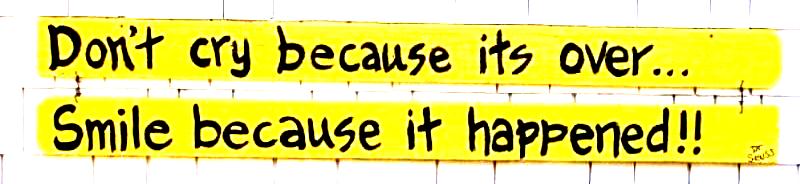
Allow yourself to be happy. Don’t worry about what others think of you. If you are pleasing God and not sinning, do what you enjoy. Enjoy the simple things around you: the warmth of the sun on your face, the smell of a cooking meal, the smile of a friend, the hug of a loved one, time spent doing what you enjoy with people you like, and a hundred other things you can list. Ecclesiastes 3:4 says there is a time to laugh and dance. Take the time to be happy.

smile2

Other posts in the Series:
Regret 1: I Sacrificed My Dreams to Please Others
Regret 2: Missed Much by Working Too Much
Regret 3: I Wanted the Courage to Express My Feelings
Regret 4: I Miss My Friends

Regret 4: I Miss My Friends

Several years ago, a former palliative care nurse, Bronnie Ware, wrote a widely circulated article, based on her discussions with dying patients, describing the regrets they shared with her in their final period of life. The top five were featured in an article on her site and she has since turned the article into a book.  Last week the web site addicted2success listed 10 Regrets In Life By Those About To Die. This week I am discussing five of those regrets.

I wish I had stayed in touch with my friends.

Often they would not truly realise the full benefits of old friends until their dying weeks and it was not always possible to track them down. Many had become so caught up in their own lives that they had let golden friendships slip by over the years. There were many deep regrets about not giving friendships the time and effort that they deserved. Everyone misses their friends when they are dying.

It is common for anyone in a busy lifestyle to let friendships slip. But when you are faced with your approaching death, the physical details of life fall away. People do want to get their financial affairs in order if possible. But it is not money or status that holds the true importance for them. They want to get things in order more for the benefit of those they love. Usually though, they are too ill and weary to ever manage this task. It is all comes down to love and relationships in the end. That is all that remains in the final weeks, love and relationships. (Ware)

When I was in middle and high school I thought that my friends would be friends forever. Even in our yearbooks we would write that a person is “too good to be forgotten [2good 2b forgotten]”, remembered always, or that we freindswould be friends forever. Yet, with the exception of some I also went to church with, I have no more close contact. I have been reacquainted with some through Facebook, I am not close to them like I was in school. These were people that I spent years of my life with but we pursued different paths in life and grew away from one another. This is an extremely common experience which should encourage us not to sacrifice our values to impress our friends at school because they will probably have little place in our lives even a few months after we graduate.

Occasionally there are friends that mean so much in our lives. We endure much together and have great memories together. However, circumstances or distance may keep us apart. We are blessed with so much technology to stay in touch so maybe this will not be a regret that people continue to have. Even with the many ways to communicate, we must still make the effort to stay in touch with those that we love so that we may remain an important part of each other’s lives.

Value of Friends

The Bible speaks to the great value of friends. Proverbs tells us that a friend loves at all times (17:17) and that there are friends who are closer than relatives (18:24). According to Ecclesiastes 4:9-12 friends have good reward for the work they do together, can lift up the one who falls, and can protect one another. If one has more than one friends he is blessed with even more strength. Proverbs even encourages us to respect the friends of our parents who can be a strength to us and that friends can be more valuable than family at times, Proverbs 27:10.

Take time today to build up the relationships with your friends. Reach out to a friend you have not talked with in a long time to refresh the love between you. Those who are about to leave the earth regret that they do not have a close relationship with those who meant so much to them. As Ware observed, in the final stages of life you do not take comfort in your possessions, you are comforted with relationships.

Other posts in the Series:
Regret 1: I Sacrificed My Dreams to Please Others
Regret 2: Missed Much by Working Too Much
Regret 3: I Wanted the Courage to Express My Feelings
Regret 5: I Wish I Had Let Myself Be Happier