Problems With The “I Love Jesus But I’m Not Religous” Attitude

Audio version of this lesson available here.

Bumper stickers, T-shirts, viral YouTube videos, and pop religion books are filled with the pious sounding mantras of “I love Jesus but I’m not religious” or “I’m spiritual, but not religious.” Though presented as a humble and simple declaration of faith in Jesus alone, it is delivered with a spirit of judgment and superiority over Christians who attend worship services and strive to live holy lives in an ungodly world. Adherents to this attitude emphasize the grace of God as all Christians should, yet teach it as a grace that makes no demands on the believer; a concept foreign to the gospel. They frequently quote Matthew 7:1 “Judge not, that you be not judged” but generally not the rest of the passage or the many other New Testament passages that require Christians to make judgments about themselves and others. This attitude is a show of piety but in words and actions they deny the Jesus they claim to exalt.

Religion Defined: We must first understand what it is we are rejecting if we reject religion. There are many good dictionaries one could consult. Consider this definition from Dictionary.com that represents what I found with other sources:

“a set of beliefs concerning the cause, nature, and purpose of the universe, especially when considered as the creation of a superhuman agency or agencies, usually involving devotional and ritual observances, and often containing a moral code governing the conduct of human affairs.”

It appears from the articles and videos promoting this attitude that it is the ritual observances, organization of believers, and moral code governing affairs that believers are required to follow that it is the source of their grief.

Problem Considered: To be an acceptable attitude to God it must be demonstrated that Jesus condemned ritual observances, the organization of believers into a group, and a moral code governing affairs that believers are required to follow. However, if the scriptures demonstrate that Jesus encouraged and established these things then it is the attitude of these people that is out of step with Jesus. The latter is, in fact, what we find in the scriptures.

Problem 1: Jesus was very religious when he lived as a man

When Jesus lived as a man he had reverence for the Old Law and was obedient to it. In Matthew 5:17 he said that he came to fulfill the Old Law. Matthew 5:19-20 records Jesus condemnation of those who took a casual view of adherence to the law and urged his hearers to be exceedingly righteous. He condemned the Sadducees because they didn’t know the scriptures and embraced error as a result, Matthew 22:29. Many conflicts with the Pharisees occurred when Jesus violated their traditions, not the Old Law itself. To reinforce the seriousness of obedience, when discussing judgment, Jesus said he’d send his angels to remove those who cause sin and are law-breakers from the kingdom, Matthew 13:41.

He condemned those who disobeyed the Old Law by following man-made traditions. In Matthew 7:21-23, Jesus condemned those who claimed to follow him, even doing great works, but had no relationship with him. The problem was not adherence to ritual or good works but expecting good works apart from a relationship with Jesus to have any effect.

Jesus is praised for keeping the law without sin, Hebrews 7:26. His religious life is evident as he studied in the temple (Luke 2), attended synagogue worship and even delivered a message during an assembly (Luke 4), and he observed the Jewish feast days such as the Passover.

Jesus had to deal with the abuse of the law by those who claimed to love God but he did not urge a rejection of religion, just the error practiced by men. He condemned hypocrisy in the Pharisees but he told his followers to listen and obey what they taught from the Law while rejecting their example, Matthew 23:1-3. In an often quoted passage, Jesus did not say that it was wrong to follow the strictness of the tithe (as some claim) but that it should be done in addition to not forsaking the weightier matters of the law, Matthew 23:23-24.

Problem 2: Jesus and his apostles established a religion!

Some adherents to this philosophy want to separate the work of Jesus and the apostles (accept Jesus but reject the teaching of the apostles relative to doctrine) but they cannot be divorced. Instead, Jesus reinforced the authority of the apostles in matters of religion.
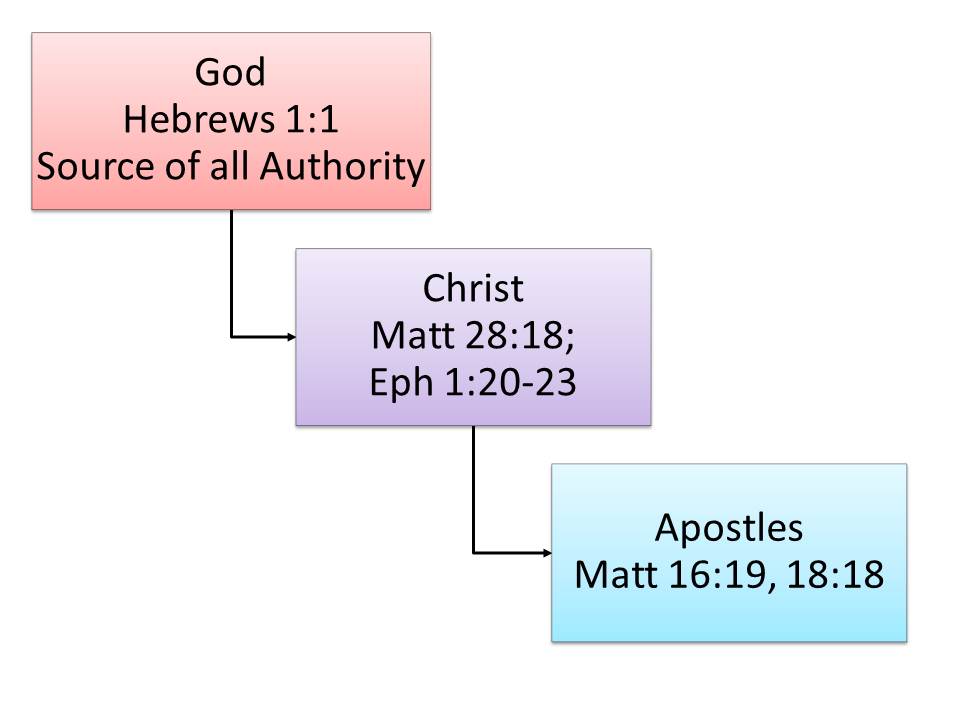
As the chart illustrates, all authority flows down from the Father through Jesus to the apostles. The authority form the apostles consists of their teaching and example. The Bible condemns those who do not abide in Christ’s doctrine (2 John 7-11), who follow traditions devised by men (Matthew 15:1-9), and any other authority but God’s word (Galatians 1:6-9, 2 Timothy 3:16-17).

If one wants to condemn the organization of believers into a body (as opposed to just serving God without the church) he will have a problem with Jesus who founded the church, Matt. 16:18. Far from being a foolish organization designed by men, the church is a reflection of the wisdom of God, Ephesians 3:10-13, and is the body of Christ, Ephesians 1:22-23.

Take up stones also to condemn Jesus for instituting ritual practices for on the night before he was betrayed, he instituted a memorial meal to be observed in the church to remember his sacrifice, Matthew 26:26-28, 1 Corinthians 11:17-34. He also commanded his disciples to baptize those who believe the gospel and, sorry if this is scandalous, teach them to observe all of his teachings, Matthew 28:19-20.

Not only did he teach, and commanded his apostles to teach, obedience to his commandments, he outlined what to do when brethren disobeyed the law, Matthew 18:15-20. The apostles reiterated the teaching of our Lord against those who were disorderly, 2 Thessalonians 3:6-15; 1 Corinthians 5:1-5; 2 Corinthians 2:5-11. He went so far as to equate love for him with adherence to his commandments, John 14:15, 21.

The strictness of the moral code of Christ will not sit well with the “I just love Jesus and don’t judge others” crowd. Unlike many who claim to follow Christ today, Jesus had a very narrow view on divorce and remarriage, Matthew 5:31-32, 19:3-12 that caused even his disciples to question whether it might be better to not marry than to marry unwisely. Many in the religious world do not condemn the behaviors condemned by the apostle Paul in Romans 1:18-32 and, instead, condemn Christians who teach that this behavior is “ungodly and unrighteous.”(Paul’s words) Likewise, they bristle against restrictions on sexual immorality, filthy language, and materialism though the apostles, by inspiration of the Holy Spirit, condemn that as well, Ephesians 5:3-12, declaring such behaviors as improper for Christians. True religion, and the word is used in scripture, is praised in James 1:26-27 through the exercise of one’s faith.

Paul warned that times would arise in which men would reject the strict teaching of our Lord and the apostles and find teachers who would allow them to indulge in their passions but have the appearance of piety and serving God, 2 Timothy 3:1-9; 4:1-5. Seems like this is such a time.

Many in the “I love Jesus but am not religious” movement are hesitant to say that those in non-Christian religions will not be saved, yet the Savior himself insisted that salvation is only through coming to the Father through him, John 3:16-18; 8:24; 14:6-7.

As Kevin DeYoung noted in his blog, “If religion is characterized by doctrine, commands, rituals, and structure, then Jesus is not your go-to guy for hating religion” (“Does Jesus Hate Religion? Kinda, Sorta, Not Really” http://thegospelcoalition.org/blogs/kevindeyoung/2012/01/13/does-jesus-hate-religion-kinda-sorta-not-really/)

Problem 3: It condemns true Christians for actions carried out by hypocrites and opportunists

Some advocates for this attitude embrace the argument of the atheists that religious people are the source of more suffering in this world than good. It is a foolish argument that fails to recognize the incredible countless actions by humble Christians who have provided the lowliest service to their fellow man. No one can deny that atrocities have been carried out in the name of Jesus but those actions are out of the boundaries of the moral code of our Lord and true Christians condemn such abuses.

Jesus didn’t throw out the Old Law just because the Pharisees added their traditions. He condemned their error and upheld the holiness of the Law. Jesus addressed the hypocrisy as a problem with people, not God’s law.

That some churches are involved in politics and take a stance as Democrats or Republicans should not condemn those of us who keep politics out of the pulpit. Exercise of political agendas belongs in the personal realm, not in the church. We need to change the hearts of people with the gospel, not the ballot box. Some churches claiming to follow Christ do this because they no longer believe in the inspiration of scripture and the deity of Jesus so they had to redesign the church to be an agent of social change. The alliance of the church and politics (Republican, Democrat, Reformation purges, and Holy Roman Empire) is an unholy one foreign to the Lord who founded a kingdom that was “not of this world.”

Wars fought in the name of the Prince of Peace do not mean that Jesus was pleased with such actions. That some opportunistic leaders and political-religious leaders co-opted the cause of Christ to wage carnal warfare does not mean that all Christians are right to support such action. Some Christians are pacifists and oppose all war, especially in the name of Jesus. The true warfare of the Christian is not of this world and is waged with wars not earthly weapons, 2 Corinthians 10:3-5.

Some claiming to be Christians have used political intimidation and violence to persecute and kill other Christians who did not agree with them. Such actions are not approved by the New Testament and yet the problem was with the individuals and the religious bodies who perpetrated such vile actions, not the church established by Christ.

To condemn the religion of Christ because some people used the name of Christ to make war, oppress others, or to advance their political goals, is naïve and ignorant at best. At worst it is misleading, prejudiced, and arrogant.

Problem 4: Some use non-religion piety to justify immoral or self-centered living

As described above, the moral code of Jesus and the apostles is quite strict. However, some in the modern popular Christian movements are quick to defend a very permissive view of divorce and remarriage, sexual immorality, foul language (even cursing from the pulpit), materialism, and a host of other behaviors with a “judge not” halo glowing over their forehead.  They like to emphasize grace but it’s a man-made grace where everything is acceptable, not the Bible grace that calls men to repentance, Romans 2:4. They like the Jesus who forgives but forgets he is also the one who says, “Go your way and sin no more” (John 5:14; 8:11). They like when Jesus says “judge not” but forget that he is also the judge who will weigh the hearts and actions of men on the last day, John 5:30; 12:48; Matthew 12:36.

There have been similar times in Bible history where, instead of following the law of God, “every man did what was right in his own eyes” to the great displeasure of God, Deuteronomy 12:8; Judges 17:6; 21:25. However, Proverbs 12:15 tells us that it is the fool who follows what is right in his own eyes and does not follow the wisdom of God.

Some claim the church should be a hospital for the broken, which is appropriate since Jesus is a physician for those broken down by sin, Matthew 9:12. However, a person goes to the hospital to be healed, not to continue in the sick condition. Jesus calls us from the filth of the world to live clean and pure lives (2 Peter 1:3-4; 1 Peter 4:1-5). It is strange that some are content in their “broken” condition instead of recognizing that God is calling us out of the world into holy living as part of our “reasonable service,” Romans 12:1. Seems that some are ‘holier than thou’ about the virtue of their lack of holiness. Yet God wants us to be holy because he is holy, 1 Peter 1:15.

Conclusion

Like so many Christians, I am disgusted by the materialism and immorality that has characterized so many prominent groups and individuals claiming to be Christian. I mourn for the carnal warfare, persecutions, and abuse carried out in Jesus’ name or by those who claim allegiance to Christ. I believe that much of the “Christian” world reflects a hijacked religion that departed from the simplicity of the gospel in the New Testament. However, I cannot throw out the true religion of Christ because some institutions and individuals have left the way of Christ though they claim a relationship with him. If you love Jesus, you will love religion—the religion that he established, that is described in the New Testament, and that reflects the glory, holiness, and righteousness of our great Lord.

The Doctor or the Waitress: Who Will Tell You What You Need To Hear?

The Doctor

I am grateful to have such a good doctor. In addition to his extensive medical knowledge, he has an excellent bedside manner and is enthusiastic about his work. I really think that he likes me as a person and wants the best for me. Recently, however, he has not been such a fun person to visit.

It all started after my last physical. I expected him to look at me quickly and tell me that I was in good health. Instead, he ran some tests. Some, like the blood test, actually hurt! I did not see why his examination should be painful.

After the tests, he came in to talk with me. I expected this nice doctor, whom I am sure would like to keep my business, to compliment me on my good health. Instead, he told me that I needed to change my diet, removing bad foods that would raise my cholesterol. I agreed completely until he started to list the bad food—and it was food that I liked. He also prescribed some medicines, which cost me money, and I have to remember to take daily. He even told me to exercise more though it requires additional time and effort. When I was sick recently I expected him to tell me that I would just get better. Instead, I had to take more medicine and avoid some fun activities for a few days. As you can see, he is not much fun to visit anymore.

Sometimes I wonder if he still cares anything about me.

The Waitress

A couple of weeks ago I ate out at a popular steak restaurant. I immediately liked our waitress; she was not sullen or rude but very friendly to me and my family. She took care of us very well. Our drink glasses stayed full and she got our orders correct the first time.

I think what I liked most about her was that she was not judgmental. When she took our drink order, I asked for a Coke. She gave me no lecture on caffeine and its affect on my heart but brought me a full glass and plenty of refills. When we ordered the food, it soon became apparent that I could order anything on the menu, even some of the “bad” foods my doctor warned me about, and she would bring them out with a smile. I would guess that I could have even ordered a large quantity of food and she would never have told me that it was too much or that I might get indigestion.

After the meal, she asked if we wanted dessert. Nearly everything on the doctor’s “banned” list was on the dessert menu. I summoned my courage and asked for the brownie with ice cream and fudge topping. I expected rebuke but instead received a very large (and delicious) dessert.

After I forced down the last spoonful of ice cream, the waitress brought the check. It began to dawn on me that for every thing that I ordered, I was expected to leave at least a 15% tip. It was in her financial interest for me to order a lot of food, whether it was good for my physical health or not. However, she did not seem to be motivated by the money but just wanted to do her job well.

It was not her concern, of course, whether the food that I ordered was good for me or not. I think she expected me to know what food was good and bad and to order accordingly.

Replace your doctor with your server?

None of us would like our doctor to be our food server at a restaurant. He would tell us that we could not order certain foods because of health concerns, would probably limit the size of our portions, and not bring us any dessert. Likewise, though we might joke about it, we would not want our server to be our doctor. He would tell us what we want to hear, not bring any bad news or hurt us, and would tell us to eat anything we want. Of course, our health would suffer greatly under such treatment for he would not correct poor health habits nor cure our ailments.

Who do you want for a preacher?

A certain preacher often preached on things the congregation needed to hear but would require them to change some bad behaviors. It would cause them some inner pain to realize that they were disobeying God and would have to change their lives to please God. Some thought he was mad at them or did not want them to enjoy themselves.

Another preacher would tell the congregation the things that they wanted to hear. He preached about entertaining things and avoided issues that would require effort to understand. He was careful not to preach on anything that would cause his audience discomfort, make them question cherished beliefs, or change bad habits (2 Timothy 4:1-5).

Which preacher do you need?

One Thing Worth More Than Eternal Life

“Everyone has a price, you must simply determine what it is,” some have said. In every era and in every country, some judges, officials, police officers, and politicians have turned their back on the law because someone bribed them with enough money to persuade them to sacrifice conviction for cash. Some business leaders have been derelict in their duty because they sought personal wealth at the expense of their company’s financial health. Some adults have sacrificed their children’s emotional and mental well-being and intimate marriage relationships in order to purchase the material wealth of the world. All of these people valued what they could obtain over what was best for their community, business, or family. They had a selling price.

The story of Jacob and Esau illustrates this principle well. Esau and Jacob were twin brothers and sons of Isaac. Esau was a hunter, a rugged man of the field. Jacob was a milder man; a homebody. Esau was the oldest of the brothers and, being the oldest son in the family, had the birthright. The birthright was a legal privilege of the firstborn in which he received a double portion of his father’s inheritance and would become the patriarchal head of the family. He would also receive favored blessings from God through his earthly father that, once given, could not be retracted (ISBE, “Birthright” p.478). However, in this family, Esau would not receive the birthright.

Genesis 25:29-34 records an incident in the lives of Esau and Jacob as youths. Esau, who had been hunting, returned home very tired and hungry. If you have ever been so hungry that your body shook and you felt faint, you may have an idea of the weariness that Esau probably felt. He wanted something to eat, and wanted it quickly. Jacob, who was cooking a stew when his brother returned, used the situation to take advantage of his brother. Esau asked for some stew and Jacob said Esau could have some for a price: his birthright. Through either ignorance or exaggeration, Esau gave Jacob the birthright saying that if he died of hunger it would be of no use to him. After Esau had his meal, he went his way. The scripture records that “Thus Esau despised his birthright.”

Think of all that Esau gave up: headship of the family, a special blessing from the father, and a double portion of the inheritance. Esau gave this up for one meal. Perhaps he thought he could bargain back for it later or that Jacob would realize the inequity of the agreement. Jacob, however, was a cunning deceiver and would not give up such a bargain. As we consider this story, we wonder why Esau would have given up something so valuable for so little.

Yet we should not judge Esau too harshly for we may make a similar bargain. The Hebrew writer uses this incident to stress the importance of living carefully and not be trapped by the deceitfulness of sin so that we would lose eternal life.

“Lest there be any fornicator or profane person like Esau, who for one morsel of food sold his birthright. For you know that afterward, when he wanted to inherit the blessing, he was rejected, for he found no place for repentance, though he sought it diligently with tears.” Hebrews 12:16-17

Some will sell their spiritual birthright for a mess of stew. As Christians, we have the right to eternal life and the hope that we will obtain it. However, as Hebrews 10:35-39 stresses, we can draw back from God to destruction, cast away our confidence, if we will not endure. Satan cannot take our eternal life from us but he can barter with us to see if we will sell ourselves to him. Satan just needs to know the price at which we will desert God.

Some leave God for the passing pleasures of this world. Though tempted with this, Moses would not sell (Hebrews 11:24-26). Yet some, like the rich young ruler and Demas, would (Luke 18:18-27; 2 Timothy 4:10). However valuable the treasures of this earth may be, we will lose them all when we die. We came into the world empty handed and will leave the world the same way. Only a foolish person would trade eternal life, bliss, peace, and treasures in heaven for earthly treasures that wear away during his life and abandoned at death. Jesus asks, “For what profit is it to a man if he gains the whole world, and loses his own soul? Or what will a man give in exchange for his soul?” Matthew 16:26.

Satan lures some away by physical pleasures and earthly fame. The pleasures these temptations bring are empty, short-lived, and fail to satisfy the deepest needs of man. However, the deceit of indulgence leads one to believe that they are living the “ideal” life. Soon, they cannot satisfy themselves with pleasure and they become bored with life. They seek other pleasures to comfort only to see these fail as well. Upon death, they realize that they gave up eternal reality and true joy in heaven and earth for shadows and illusions.

Some will not obey God or will give Him up in order to save relationships with family and friends. Though these are extremely important bonds, Jesus said that if they interfered with obedience to Him, we must push them aside, Matthew 10:34-38. In that same passage, Jesus commanded us to give up our own lives, if required, in obedience to Him. For many, the price is too high. Some will not become Christians or serve God in a way they see commanded in Scripture for fear of offending or alienating their friends or family. Some will deny Christ in order to save their own lives. For them, the price of friends and family, who must also stand before God in judgment, is worth more than an eternal life with their heavenly father and spiritual family.

We could go on with other examples but these are sufficient. What is your price at which you will barter away eternal life? Will you despise your heavenly reward as Esau despised his birthright? Will you sell something so precious for something as insignificant as a bowl of stew; a morsel of food? On the other hand, will you, like the merchant seeking pearls, sell all that you have, even yourself, in order to obtain eternal life and hold onto it no matter the ongoing cost? One thing is worth more than eternal life with God: the thing for which you are willing to exchange your soul. Yet only eternal life has eternal value.

Does God Wish You Wouldn’t Bother Him?

Could you imagine coming to worship God and Him telling you He wishes you would just go home and lock the doors of the place of worship so you didn’t waste His time or yours? What if He told you that your sacrifices were insulting and you wasted your time giving to Him? Someone might think that God was being cold and unfeeling since you were taking the time to serve Him. You might think He was ungrateful for not accepting what you were offering in sacrifice. What could drive such a loving and merciful God to wish you wouldn’t come into His presence? The answer is in Malachi 1:6-14.

In the first chapter of Malachi God is bringing charges against His people and answers the defense they might present. He describes how He detests their assembly and sacrifices. Their worship was so foul to Him that He wished that they would just stay home and lock the doors of the temple. Consider the case against God’s people:

They didn’t offer their best worship

The Old Law specified the animals to be brought for various sacrifices but all were to be of the best quality. The Creator deserves the best of His creation. Instead of bringing the best animals for sacrifice they brought the animals that were blind, lame, and sick animals that were useless or ready to die. Some even brought stolen animals. God considered such a sacrifice insulting. Such sacrifices reflected a lack of honor for serving God. He challenged them to take these animals as a gift to the governor to see if he would appreciate them. If an earthly leader would be insulted how much more the God of heaven! Perhaps they thought that God would have to accept whatever they offered. They were wrong.

They considered worship a burden

God who knows the hearts revealed their secret thoughts. They said worshiping God was a weariness. Such an attitude was disrespectful to God who is “a great king” and “the Lord of hosts.” Do we think the host of angels in heaven consider adoration of God to be tiresome? How sad it is when someone cannot be bothered to worship God or must go complaining of the inconvenience.

Because of these attitudes God wished that there was someone who recognized the foolishness of thinking God would accept such empty worship and close the doors of the temple to prevent such abominations from continuing. Spiritual emptiness and half-hearted gestures dishonor and insult the name of God.

What about your worship?

Hebrews 13:15: “Through him then let us continually offer up a sacrifice of praise to God, that is, the fruit of lips that acknowledge his name.”

  • When you worship God do you offer Him your best in offering the sacrifice of praise through singing or do you mumble the words, singing without thinking about what you are doing, or not sing at all?
  • Do you give prayers and Bible study your focus and attention or do you use the time to whisper with friends, text, or sleep?
  • You do not bring animal sacrifices but you are a living sacrifice to God, Romans 12:1. Do you indulge in sinful pleasures and practices during the week and present yourself to God spiritually lame and blind and expect Him to accept your defiled offering? Some people think that they can live an immoral lifestyle and be acceptable to God as long as they go to some worship services and put some money in the collection plate. God is not pleased with such offerings.
  • Do you give God the best of your time, money, and service or do you pray, study, and serve others only when it is convenient for you?
  • Will you quickly sacrifice attending a worship service to attend to your own pleasures?
  • Do you prepare your Bible lesson for class and meditate on the message or show up unprepared and uninterested?
  • Do you give money willingly, cheerfully, and liberally to the work of the Lord or do you bring a meager offering of what is left after you have spent money on your own pleasures?
  • Are you giving yourself in worship to God or just showing up, putting in your time, and getting back to the earthly things that really bring you joy in life.
  • If everyone worshiped as you do would God wish that you would just stay home because it does not honor Him?

If you feel your worship is empty, boring, and uninspiring look carefully at what you are bringing to God. The problem is not the order of worship, the quality of the preacher or singing, or the number of people assembled together. Those who do not give their best in worship will not leave spiritually nourished and refreshed or encouraged.

Let your attitude in worship be that of David:

  • Psalm 122:1 “I was glad when they said to me, ‘Let us go to the house of the LORD’!”
  • Psalm 42:1-2, 4 “As a deer pants for flowing streams, so pants my soul for you, O God. My soul thirsts for God, for the living God. When shall I come and appear before God? …These things I remember, as I pour out my soul: how I would go with the throng and lead them in procession to the house of God with glad shouts and songs of praise, a multitude keeping festival.”

You Are Too Blessed Not To Give Thanks

sunsetbayI feel strong displeasure for unappreciative people. It is frustrating to prepare a special meal, plan a party, find a special gift uniquely suited for that person, or some other unexpected show of appreciation only to be met with a mumbled “thanks,” or, worse yet, no thanks at all. It is more disturbing to go out of your way to do something special for someone and they react as if we owed them or that what we did was nothing special. I do not think that it is praise that we want; we want other people to recognize and appreciate the effort exerted for them. Is God angered when we ignore His kindness?

I wonder sometimes God’s reaction when He blesses richly and some fail to notice or thank Him. Sometimes we do not express the common courtesy to God that we do with people. When Jesus healed ten lepers and only one returned to give thanks, Jesus noticed.

Thanksgiving should characterize our life. It should be a natural part of our personality to notice what others do for us and give thanks. It means much to the person who serves us at the restaurant or from whom we buy services; yes it is their job to do this but we should show the appreciation that we would like if we were in their position. We may start to realize just how much others do for us if we look for opportunities to thank others for their consideration and efforts.

Some people have problems giving thanks

Some are not thankful. A person with an exalted self-perception who sees no need for God will feel no debt of thanks to Him. Some are dissatisfied with the way their life turned out but cannot see the good things that they can thank God for. These people moan and gripe that things are not going their way and cannot see the good for their self-imposed misery. They can’t find blessings in adversity. Those who are thankful have a sense of gratitude for what God has done and wonderment as to why He is concerned about them.

Some people are forgetful. Some make supplication to God but forget to thank Him for His blessings. Luke 17:11-19 records the story of ten lepers healed by Jesus but only one returned to Jesus to give him thanks. No one hears the expression of thankfulness you forgot to send. Thank people immediately so you will not forget.

How can we become more thankful?

Consider how you have been blessed

People are often fond of asking, “why me?” Usually we ask, “Why am I sick, being laid off work, or having financial problems.” We do not usually ask

  • “Why was I born into a country with many great freedoms including the freedom to assemble and worship God as I should?”
  • “Why was I born into a family or blessed with friends who taught me the gospel?”
  • “Why me? Why do I live in a country with the best medical treatment available so that I do not suffer many chronic illnesses and am able, if I listen to the doctor, to live a long, healthy life?”
  • “Why was I born in a city that is not in constant turmoil from warring parties trying to destroy each other? Why do I go to bed at night without the sound of gunshots and bombs exploding outside?”
  • “Why am I able to read when 861 million people (2/3 of which are women) cannot read?”
  • “Why am I able to ask, ‘what’s for dinner?’ when millions in the world have no food to eat?”
  • “Why do I have a Bible, translated into my native language, that I can own when, for many centuries Bibles were only kept by the elite scholars and very wealthy people?”
  • There are many more things that we could ask, “why me,” but these are sufficient to remind us that we are far more blessed than we could possibly imagine.

Make thankfulness part of your daily prayers

According to Philippians 4:6-7 thanksgiving should be part of your daily prayers. Notice that thanksgiving  is linked with supplication—appealing to God to grant a request. We should not be afraid to bring our requests to God but we must remember to thank Him for listing, for His wisdom in answering, and for the answer we receive.

According to Colossians 2:2 we are to be vigilant in prayer (implies diligence and watchfulness) with thanksgiving to God. Thanksgiving in prayer should not be occasional nor should we need to be reminded to thank God. We should constantly be aware of the blessings that surround us and give thanks to God for them.

Practice Thankfulness at Home

Thankfulness and gratitude should fill our homes. Spouses should thank each other often for the things they do for one another. Thank your spouse for being married to you and putting up with you. Thank your spouse for the work they do around the house, or the work that brings in income for the house. Thank them for coming home to you at night and not going out to bars or participating in behavior that would endanger the marriage. Do not forget the common courtesies; thanking them when they refill your tea glass, when they pass the biscuits, when they get your door…

Parents should teach their children by example and thank them for things they do and, sometimes, for being themselves. Thank them for being good children and point out something in particular that they do well. Thank them for the drawings, crafts, and other things they make for you. Parents and teachers encourage kids to say “please” and “thank you” early in life so they will notice and appreciate acts of kindness. We get frustrated with adults that forgot this lesson.

Children, especially, should thank their parents often. They sacrifice much for their children. They provide opportunities for entertainment, personal development, and recreation. They provide spiritual opportunities and, hopefully, instill Bible-based lessons for living. Thank your mom or dad each time they make food for you. Thank them for letting you participate in sports, take music or art lessons, or get involved in school activities. Thank them for bringing you to church services and teaching you about God and trying to help you understand how to be a decent person.