Guest post by Joshua Sanders. He is a sophomore at Plant City High School in Plant City, Florida. He worships with the brethren at University church of Christ in Tampa, FL.
If any of you are in public school like me, you are bound to face the concept of the origin of the world. My current unit in Biology is evolution. For those who don’t know, evolution is the process by which all species develop from earlier forms of life (according to scientists). It can be hard to stand strong in your faith while facing all the adversities that come from this theory. How do we overcome this as young Christians?
In Biology class the other day, my teacher decided to show us a video. It was the History of the World in 2 Hours. In this video scientists explained their theory from the Big Bang to now. It was an interesting video, but obviously false. First off, a Big Bang did not create our universe, an awesome God did (Genesis 1:1). Secondly, we did not evolve from animals, God created man. He even created us in His own image (Genesis 1:27).
A common phrase in the video was “lucky for us.” “Lucky for us” the Earth is placed in the perfect position to sustain life; “lucky for us” we developed opposable thumbs to grab objects, and the list goes on. This did not happen by chance! We have an amazing Creator who loved us so much that He sent His son to die on the cross (John 3:16). That to me is the only explanation for the “history of the world.” But even though some are too stubborn to believe this truth, I do not fret. As it says in Philippians 2:10-11“… so that at the name of Jesus every knee should bow, in heaven and on earth and under the earth, and every tongue confess that Jesus Christ is Lord, to the glory of God the Father.”
In 1 Thessalonians 5:17, Paul taught the people to “pray without ceasing.” What does this mean? To pray without ceasing is to pray every day and many times a day. If you have a best friend, you want to talk with them many times during the day. God wants us to talk with Him many times during the day as well.
These prayers do not have to be long. We may pause to pray for a minute or two but it is precious time spent with God. We can share with God the good and bad things that are happening that day and ask for His help. He always listens to His children.
Make prayer your daily habit. You can find many things to talk with Him about if you just take the time. But you may ask, “What should I pray for?” The Bible gives us that answer.
Good Health for You and Others
When you pray, it is good to pray that you, your loved ones, and other faithful people will be in good health. In 3 John 2, John said that he prayed that Gaius would be in good health. We certainly do not want the people we love to suffer because of illness; however, there are other reasons to pray for someone’s health.
If a person is healthy they can do some things in service to Christ much better. When I am sick it is hard to prepare lessons and a sore throat makes it almost impossible to preach. We pray for the good health of those who work in the church so that they can continue in their service to God.
Pray also for your own good health and, whether you are sick or healthy, do the best you can do in service to God.
Elders
When God established the church he also gave the elders the responsibility to oversee, or rule, over the church. The elders are like shepherds who take care of sheep; the elders help feed us spiritually by making sure the teachers and preachers are teaching the truth. They make sure that your Bible classes are planned well and that the teachers are presenting lessons that will help you grow in your Bible knowledge.
They also help people in the church who are having problems by talking with them and giving them advice from the Bible. They must be wise about how to handle problems and using the Bible to help people know what they are supposed to do.
Does your church have elders? Do you know who they are? If not, ask your parents to tell you who they are. Pray for them and their important work in the church. Thank them for their important work as well.
Preachers and Teachers
As a preacher, I am so glad to hear when people pray for me as I am ready to preach. I want to make sure that I do not teach false things and that I teach the good things well. When people pray for me, I know that they want God to help me do what is right.
When you pray, be sure to pray for your Bible class teachers and your preacher. Both spend a lot of time during the week preparing classes and sermons to help you grow because they love the Lord and they love you and want you to go to heaven.
God warned teachers that they would be judged even harder by God because they might lead people away from Him if they teach false things, James 3:1 Pray that they may always speak the truth. Pray that they may be able to teach their lessons in a way that others can easily understand the important message of God.
Thank God for such men and women who are willing to spend time preparing lessons to teach you what is right. (Don’t forget to thank your teachers personally!)
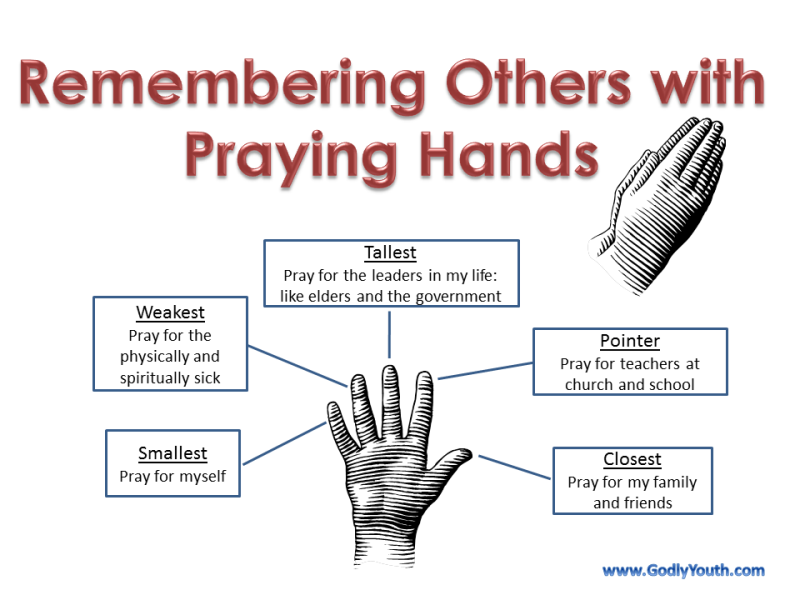
How I was taught to remember others when praying.
When you pray, be sure to pray for your parents. They will appreciate you asking God to help them. As a parent I want my children to pray for me to be in good health. I want them to pray for me to do well in my work and that we will have the things that we need, such as food and clothes.
I also want my children to pray for me to be a good father and for my wife to be a good mother. We have never been parents before so we want God’s help. We want our children to pray that we will be wise in our decisions and to forgive us when we make wrong decisions. I want my children to pray that I will be a good example to them.
I also want my children to pray that I will give them my attention and love; that when I punish them I will be fair and understanding. Be sure to pray for your parents. Do not forget to pray for them every day.
Government Leaders
If you listen to the news or study current events in school, you know that there is trouble with different nations in the world. The government has to protect us from terrorists as well as protect many of our rights. Government leaders have many great responsibilities and the Bible tells us to pray for them, 1 Timothy 2:2.
We should pray that they make decisions that allow us to live as Christians without persecution from the government or any other person. We should also pray for the leaders of the world governments that they would allow their people to worship God freely; not all people enjoy our freedom to worship God as He commanded.
We should also pray that God will give them wisdom in their many difficult decisions. We should pray that they will decide the things that will bring peace, not war. If we have to go to war, we pray that the war will end quickly with few deaths. We should pray for them to make decisions that will benefit all people and allow them to live right.
Spiritual Wisdom
James 1:5 encourages his readers to pray to God for wisdom: If any of you lacks wisdom, let him ask of God, who gives to all liberally and without reproach, and it will be given to him. Godly wisdom is one of the most important things that we can have. Godly wisdom helps us make good decisions and avoid things that we should not do.
We get knowledge by studying God’s word. Wisdom is the ability to use what we have learned from God’s word. Study for knowledge; pray and learn from godly people to receive wisdom.
Pay attention to what your teachers, the preacher, and your parents try to teach you from God’s word. Use what you have learned to make good decisions and avoid things that displease God and will do you harm. Pray for wisdom and trust God’s promise to give it to you.
Wisdom When Making Decisions
Every day each of us has to make good choices. Friends at school, in our neighborhoods, and even friends from church ask us to do things and to go places. We must make good decisions about what is right to do and what we should avoid. We should also pray for the courage to explain to others why they should not do things that are wrong. You can teach them this way.
You become stronger when you make good choices. In Hebrews 5:14, the writer compares it to exercising. When you exercise your muscles you become stronger. When you exercise good decision making, it is easier to choose the good in the future.
Even your parents have to make good choices. Pray for them to make good choices as they try to raise you. They are probably praying to God for the same thing. You will pray for good choices all of your life.
Help During Temptation
In the model prayer of Matthew 6:13, Jesus told His followers to pray that they would not be led into temptation and that, when tempted, they would be delivered.
Through bad choices, some people find themselves tempted when, if they had made better decisions, would not have been tempted. If you hang around people who do things that you know are not right, you will likely find yourself in a situation that you could have avoided. We should pray to God for wise judgment to avoid temptation.
It is not always possible to avoid temptation so we should also pray that God would help us in temptation. In 1 Corinthians 10:13, God promised that with each temptation He will provide a way to escape evil. We must pray to God for the wisdom to see the way of escape and the courage to take it. Since Satan is our enemy, we need to pray for God’s help.
Opportunities to Teach Others
In John 8, Jesus used the example of harvesters in a field to tell His apostles to pray for teachers to lead people to Him. The lost need to hear the gospel. You may not feel like you could teach someone but you can lead that person to a teacher or invite them to Bible class or worship services where they can hear God’s word taught.
Pray for chances and the courage to invite friends to Bible classes, gospel meetings, Vacation Bible School, and worship services. By leading someone to Jesus you can change their lives for the good and they can have eternal life with God.
Which of your friends or family members needs to hear the gospel? Pray for them and try to find opportunities to teach them or lead them to a teacher.
Food
We should develop a habit of thanking God for our food. Paul taught that we should give thanks to God for the food we eat, 1 Timothy 4:3-5. Jesus taught His disciples to thank God for their daily bread, Matthew 6:11.
One day, a father, who did not serve God, was fed up with his wife and children giving thanks to God for the food. He told them, “I worked to earn the money to pay for that food. God did not give it to you, I did. You should be praying to me for the food.”
The wise wife quietly reminded her husband that it was by God’s hand that he had his job and the health to do it. God also gave the rain, the sunshine, the seed, and allowed the plants to grow and bear fruit. God provided the nourishment for the animals and the lives of the animals themselves. Last of all, He provided the rain that, in a pure form, filled their water glasses.
The father saw her wisdom and humbly thanked God for the food He had given.
Give Thanks to God
Consider some of the the different things for which we should pray already discussed. When we pray, we must also give God thanks for the prayers He has answered and that He listens to us. Though some adults may ignore you when they are busy or at other times, God always has time for us. He wants us to visit Him in prayer and open our hearts to Him. However, we should not just spend our time asking things from Him. We would not like it if people only talked to us when they wanted something we had.
Luke 17:11-19 records the story of ten men with a terrible, incurable disease called leprosy. These people had to stay away from all healthy people. They cried to Jesus, asking Him to heal them. He told them to go to the priest who could determine if they were healthy. As they went, they were healed, but only one returned to thank Jesus for what He did.
Let us remember to give thanks for all that God does for us and the care that we enjoy. Let us not be unthankful.
Pray Through The Name of Jesus
“…giving thanks always for all things to God the Father in the name of our Lord Jesus Christ ” Ephesians 5:20
Do you ever wonder why we often say, “in Jesus’ name” at the ending of prayers (or something similar)? This verse helps us understand why. We approach our Father through Jesus. He is an intercessor (pronounced: enter-says-her). An intercessor is one who asks something on behalf of another person. When we pray to the Father, Jesus is on our side.
We must give thanks for all things because all things come from God. Every blessing comes from God (James 1:17).
If you spent a lot of money or a lot of time on a gift for someone and they acted as if they did not care you would feel hurt, perhaps even angry. We are ungrateful if we do not give thanks for all things that God has given.
We give thanks for the good things we enjoy for we are very blessed. We should even give thanks for some bad things. If we are tempted but we do not sin, we become stronger. When we are sick, we appreciate our health. When we have bad days, we appreciate the good days. In all things, we must give thanks to God.
We can only approach the Father through Jesus; therefore, we must do all things in His name.
Having written a general article about the craving some have (which I fight) to become a celebrity in their own cyber world and asks the introspective question: could we live in obscurity?
There is a spiritual angle to this as well. Could I serve Christ with few knowing what I am doing for the Lord’s cause? Can I do a good deed to His glory and to accomplish His will and be content that my brethren do not know what I have done? Could I truly keep the right hand uninformed of the left hand’s work?
Do I serve Christ so that others may see. I may not sound the trumpet for all to hear and may refrain from praying loudly on street corners, but do I “glorify God” by proclaiming on social media all the good things I am doing in the kingdom? Could it be that I would never boast in what I have done but would “humblebrag” freely to the clicking likes of others?
Then the accusing question sounds within but a question asked too late for me. You are a preacher. You are not invited to speak in lectureships or gospel meetings around the nation and you write nothing that is posted for a broader audience in bulletins, newsletters, or on the Internet. You do incredible work for the Lord but only the people in Flyover Town, USA (or a small remote town in a foreign country) know what you do. They love you dearly and credit you with their great spiritual growth and you help generations of people follow the Lord. But no one else knows what you are doing and you receive no accolades from brethren in other places. Could you be content with this? Could you be content that aside from your local associations, your works are known only to God? The question is moot for me but may be life changing for another.
Who are we serving? Why are we serving? What is the real answer to these questions?
Consider the attitude of the apostles in 1 Thessalonians 2:4-6:
but just as we have been approved by God to be entrusted with the gospel, so we speak, not to please man, but to please God who tests our hearts. For we never came with words of flattery, as you know, nor with a pretext for greed—God is witness. Nor did we seek glory from people, whether from you or from others, though we could have made demands as apostles of Christ.
As bondservants of Christ, we should heed Paul’s command to those who were physical servants of men in Ephesians 6:5-8:
Bondservants, obey your earthly masters with fear and trembling, with a sincere heart, as you would Christ, not by the way of eye-service, as people-pleasers, but as bondservants of Christ, doing the will of God from the heart, rendering service with a good will as to the Lord and not to man, knowing that whatever good anyone does, this he will receive back from the Lord, whether he is a bondservant or is free.
Celebrity is an illusion. How sad if we chase the praise of men and disqualify ourselves from the praise of God (Matthew 6:4, 6, 18). How futile is the fickle praise of men. Let all be done to the glory of God.
In the modern religious world it seems almost heretical to think that God doesn’t have a specific plan for each person (by specific plan I mean that He has planned details of our lives). In everyday conversation and on social media, people attribute events in their life to the specific fulfillment of God’s plans and comfort themselves regarding tragedy considering it was sent by God for a purpose and was not mere chance. Some people anguish trying to discover God’s will for their lives or wonder why God’s plan is bringing them such trials and sorrows. Some interpret many events or Bible passages as signs or messages from God guiding them on this supposed road-map.
What does the Bible say about God’s plans and our lives?
God Had Specific Plans For Some People
Before we study the issue we must make it clear by stating that God did have specific plans for some people in history. The Old and New Testament are filled with people whom God used to accomplish His will. Using words like “I have chosen you” or “you have been appointed” He describes plans for people like Moses, Pharaoh, David, John the Baptist, and Paul (among others) to accomplish specific objectives. He even used nations to accomplish His purposes. Even within these exceptions most, like Pharaoh, He used for a limited purpose and there is not mention of further plans for them outside of that defined need.
Also, with the nations, Pharaoh, and the Jews who killed Jesus God used their evil motives and personal ambitions to accomplish His purposes. He accomplished His will in spite of their wickedness or disobedience. With others, like the apostle Paul, the plans were not obvious or revealed to them even though they spoke other things by inspiration (see also the future of Peter and John in John 21:20-25). God, as sovereign ruler, can use His creation as He wills to accomplish His purposes, Romans 9. But a distinction needs to be made between a specific detailed plan for their whole life or a specific plan for a part of their life that moves His master plan forward. In other words, just because God had a plan for Pharaoh during the time of Israel’s bondage and their release does not mean that He had a continuing specific plan for Pharaoh once Israel left Egypt.
Blueprint or Game Plan?
When thinking of God’s plans in our lives, I think Don Truex explained the two approaches best in an excellent sermon asking if God has a blueprint for our life or a game plan. A blueprint is a specific detailed plan with a defined outcome. There is no room for choice because if you diverge from the blueprint you can’t build what was designed. A game plan, by contrast, is a general approach or strategy that allows a lot of flexibility for choice and many possible outcomes that are in harmony with the general objective. As Brother Truex notes, “with blueprints, there is no ‘Plan B’.”
Discovering the Blueprint
The crux of the problem is revealed when we try to discover God’s plan for us. God’s word was written to a universal audience so I find passages that apply to me but not only to me. My name is not listed in scripture with a unique plan for my life. Therefore, if God has a blueprint for our lives, His will must be revealed outside of scripture. The central problem is that we have no guidance in the New Testament on what signs to look for in our lives, how to tune into the messages of God, or how to discern what is a message from God pointing down one path or from Satan leading me down another path. We have no scriptures telling us that God speaks through feelings, promptings, or a sense of peace to direct our decisions as He navigates us through life. We are not told to expect the leading of the Holy Spirit or instructions on how to discern it. Yet many Christians interpret (and that is the key: they interpret) events and feelings as indications from God that He wants them to take a certain action, make a decision, or is satisfied with their choice. Some have called this the “third revelation.”
Though foreign to the New Testament, this “third revelation” is described as God’s leading through emotions, impulses, and “speaking to/putting upon your heart” to fulfill God’s specific plan for your life. This is idea, rooted in mysticism, is popular in Christian bookstores, but is foreign to God’s word. Though a former believer in this idea, Reformed writer Gary Gilley, in an enlightening podcast answers biblical arguments offered in support of God’s inner leading and the absence of Bible instruction about listening for God’s voice in our heart or how to detect His prompting. He also addresses what proponents do not: why is the “prompting” not considered binding or obligatorily and disobedience considered a sin?
The last question is quite important because if God does have a blueprint, what if we ignore it or choose another path? Proponents argue that many of the choices are not moral choices but are lifestyle choices (should I choose this job or that or live in this city or that) but if God is giving us signals that we should live in Atlanta but we choose to live in Tampa, why would we not be rebellious sinners for circumventing His plan? Any divergence from the plan means we cannot build exactly what God planned! Will God then force us to do His will and take away our free will? I think it might surprise some who teach that predestination is not taught in scripture to realize that they are contradicting their view of man’s free will by promoting the blueprint concept. When we talk of people that God has planned for us to marry, jobs He has planned for us to have, etc. we are promoting this blueprint concept whether we have realized the implications or not.
Discovering the Game Plan
If we understand that the Bible does not have a specific plan for a mate, job, place to live, or the minute details of life we understand that God could still have a general plan for us to follow. We are faced with the same dilemma described above: discovering the plan. Since this plan is not “personalized” we are given general direction and boundaries and the flexibility to choose within those boundaries. The New Testament is filled with general guidance for the Christian to be holy in his life, edify his brethren, be a light in the world, abstain from immorality, teach the lost, etc. These commands and expectations are bound on all Christians. Some specific life decisions that blueprint followers look for feelings or impressions from God to guide them, game plan followers look to the principles of scripture to guide their judgment. Consider these examples:
How much should I give to the contribution? Whatever you determine is appropriate, 2 Corinthians 9:6-7.
Who should I marry? Whoever you want to as long as they have a scriptural right to marry, 1 Corinthians 7.
To find the game plan, we study the New Testament instructions for all Christians. We follow general plans such as Titus 2:11-14:
For the grace of God has appeared, bringing salvation for all people, training us to renounce ungodliness and worldly passions, and to live self-controlled, upright, and godly lives in the present age, waiting for our blessed hope, the appearing of the glory of our great God and Savior Jesus Christ, who gave himself for us to redeem us from all lawlessness and to purify for himself a people for his own possession who are zealous for good works.
The challenge here is not to try to find God’s will through some mystical and mysterious promptings but to submit our will and our desires to the will and desires of God expressed in His word.
My View: God’s Game Plan
We understand that “all things work together for good for those that love God” (Romans 8:28). It is not for us to figure out what He is doing through His providence, but to obey His will so He can accomplish His purposes through us. Instead of wondering where God wants me to live or what job H wants me to take, I must make those choices using wisdom taught by God’s word and in whatever city I choose to live and what career I pursue, live to His glory. God can use me where I am even though He has left the decision making to me.
Trust in the Lord with all your heart, and do not lean on your own understanding. In all your ways acknowledge him, and he will make straight your paths. (Proverbs 3:5-6) ESV
Instead of attributing events to the direct hand of God, I take the Mordecai attitude of “PERHAPS you were brought here for a reason” because PERHAPS it was just chance but you can use the opportunity to serve God. Unless God explicitly reveals His actions, I feel it is presumptuous of me to say “God did THIS.” Give glory to God that whether by chance or His purpose, the action took place but in humility remember that “His ways are past finding out.”
To take the game plan view, we realize that God has given us boundaries in which to act, guidance on decision making, authority to make choices in our lives, consequences for our choices, and acts providentially to take care of us and make all things to work together for our good. It does not diminish His role in our lives but recognizes that God has a role and has created a role for us to accomplish His will. I do not have to anguish that I may have married the wrong person, lived in the wrong place, chosen the wrong career, or messed up other choices because I wasn’t in tune with the vibrations of the Spirit or hearing the voice of God in my feelings or some signs. If I am obeying His will I am accomplishing His will.
Your View
Your view will largely depend on your view of predestination and free-will. However, there is confusion when people teach that God has given us free-will to act but then speak of trying to find God’s specific plan for our lives. Thinking through your view, based on what God’s word teaches, will help you be more consistent in how you think and how you speak.
Our house has recently undergone a major transformation as we added living space for my mother-in-law. During the building a lot of lumber was cut which generated many piles of sawdust. The carpenters were careful to measure and check their measurements before cutting the wood because cutting wood is a permanent change. We even have phrases like “measure twice, cut once” to remind us of the permanence of our decision when we have cut the wood. You cannot rejoin the wood once it is cut. Even if you glue or otherwise join the wood, it will be shorter because of the wood lost in the kerf-the slot where the wood was cut. Some strength will be lost that would not be lost in the uncut lumber.
Sawdust is the bits of wood sawed away from the lumber (or the “work”). Sawdust is worthless for the building construction and it is often swept or vacuumed away. It is the waste product of the productive work of building. So if you came upon someone piling up sawdust and trying to saw it again, you would think they were crazy. You can’t saw sawdust. There is no value in the action and nothing good is produced.
Spiritual Sawdust*
However, many people waste a lot of time sawing spiritual sawdust. As I noted before, sawdust is a product of action and is a visual reminder of the cutting process. In a sense, sawdust is the “past” of the finished product. There was a piece of lumber, now it is two pieces of wood, and the sawdust is left behind as a reminder of the action of the process of separation.
Some people have made decisions (or failed to make a decision) then spend long periods of times reliving the decision, digging up the pain and memories, and will not let the past go. Instead of letting the decision stay in the past, the bring it back to the future and agonize over it again and again. The result of this effort is bitterness, misery, failure to forgive themselves and possibly others, regret, and self-reproach. They can do nothing to change the past, nor can they “uncut the wood” to make things right. What can we do?
5 Steps To Dealing With The Past
Accept it and own it. The past cannot be changed: it is part of the permanent record. When we get on a scale, the weight is not a reflection of what we intend to do in the future but choices we have made in the past. The attention to our diet, exercise, and other physical factors are reflected in the displayed weight. Wishing or regrets will not change the number. However, we can make different choices and those results will be displayed when we weigh again. What has happened is like the weight: you cannot affect it anymore.
If needed, repent and ask for forgiveness. We may regret and ruminate over things that were poor decisions but not sinful. Perhaps you are beating yourself up because you didn’t finish college or you left a good job. Such actions do not demand repentance. However, some decisions you agonize over were also sinful rebellion against God. To move forward you need to ask God’s forgiveness. In Revelation 2:5, Jesus told the Ephesian church to repent and do the first works: the old habits of faithfulness that they gave up. 1 John 2:1 tells us that God is faithful to forgive our sins. If you are challenged with this, I urge you to read this post as well. It may be that you need to seek forgiveness from someone. Do so quickly so you can move on with life and know that you have tried to make amends for your offense.
Learn from it. It does no good to ruminate over your regrets. However, take time to learn from your mistakes. Look at what you did and why you did it. What were the circumstances? What was your attitude that led to the choice? What can you do to avoid doing this again and create better outcomes in the future? You can take the power from Satan’s victories by turning them into victories for God when you create learning experiences to prevent future regrets.
Let it go. The past does not hold onto you, you have the grip on it. You give it power to ruin the future. You give it power to hold you back and keep you down. If it was a sin and you asked God’s forgiveness, He no longer holds it against you. Learn from the past then let it go. You cannot undo the past but you can quit allowing the past to have power in the future.
Create tomorrow’s fruits. Where you are today is the result of prior decisions. Where you will be tomorrow is a result of the choices you make today. You can change direction. The direction of the past does not have to determine the direction of your future. You can get on a different road, travel at a different speed, and choose new travelling companions. You can build on the foundations of the past or, if you are changing direction, build on its ruins. Plant good seeds today so you can eat good fruit tomorrow. Follow the wisdom of God’s word and build a great tomorrow, especially a heavenly eternal tomorrow, regardless of what you have done in the past.
*I can’t remember where I heard the illustration of trying to saw sawdust. It is not original to me.


 Godly Youth