
In 1 Thessalonians 5:17, Paul taught Christians to “pray without ceasing.” What does this mean?
To pray without ceasing means to make prayer a daily habit, talking to God many times throughout the day. Just like you want to talk to your best friend often, God wants us to stay in close communication with Him.
These prayers do not have to be long. Even pausing for a minute or two is precious time spent with God. We can share both the good and bad parts of our day and ask for His guidance. God always listens to His children.
If you take the time, you will find endless things to talk to Him about. But you might wonder, “What should I pray for?” The Bible gives us clear guidance.
Good Health for You and Others
It is good to pray for the physical health of your family, friends, and other Christians. In 3 John 2, the apostle John prayed that his friend Gaius would enjoy good health.
While we naturally want to protect our loved ones from suffering, there are also spiritual reasons to pray for health:
- Strength to serve: When people are healthy, they can serve Christ more effectively.
- Support for church workers: It is hard to prepare lessons or preach with a sore throat or serious illness. Praying for the health of workers helps God’s word keep spreading.
Pray for your own health, too. Whether you are sick or healthy, always do your best to serve God with the strength you have.
Elders
Elders have the serious responsibility to oversee and guide the local church. The Bible compares elders to shepherds who protect and care for sheep.
Elders care for our spiritual needs in several ways:
- They make sure teachers and preachers are teaching the truth.
- They ensure Bible classes are well-planned to help you grow.
- They offer biblical advice and encouragement to members who are going through tough times.
Do you know who the elders are at your congregation? If not, ask your parents. Pray for them and their vital work, and remember to thank them for their service.
Preachers and Teachers
Preachers and teachers spend many hours preparing lessons to help you grow. They do this because they love God and they love you.
As a preacher, I am always encouraged when people pray for me. Preaching is a heavy responsibility. In James 3:1, God warns that teachers will be judged more strictly because their words can lead others toward or away from Him.
Pray that your preachers and teachers will:
- Always teach the truth.
- Speak clearly so that others can easily understand God’s message.
- Be encouraged in their work.
Remember to thank your teachers and preacher personally for their hard work!
Parents
[caption id=“attachment_2046” align=“alignleft” width=“300”]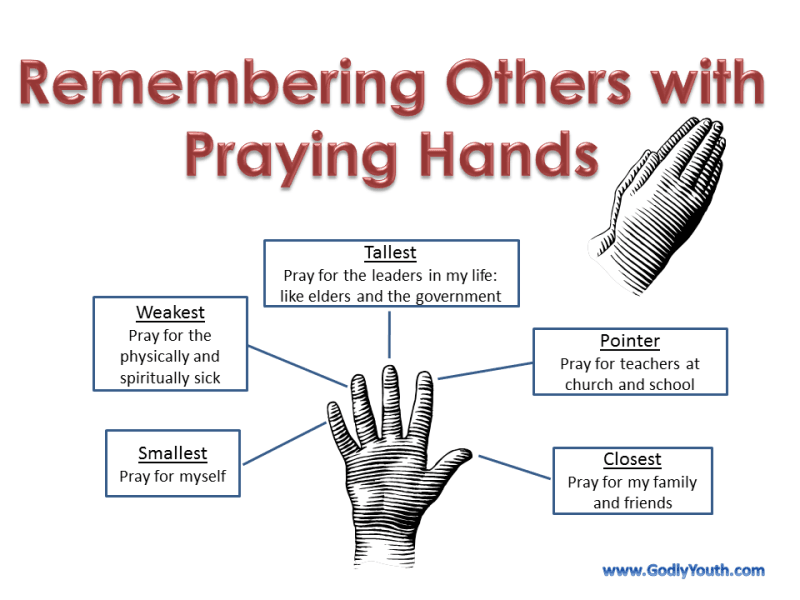 How I was taught to remember others when praying.[/caption]
Your parents need and appreciate your prayers. Being a parent is a big responsibility, and they need God’s help every day.
Pray for your parents daily. You can ask God to:
- Keep them in good health.
- Help them provide for your family’s needs, like food and clothes.
- Give them wisdom to make good decisions.
- Help them show love, patience, and fair guidance.
Ask God to help you be a good example and a blessing to them.
Government Leaders
We live in a world with many challenges and international conflicts. Government leaders have the difficult job of protecting citizens and defending our rights.
The Bible commands us to pray for those in authority (1 Timothy 2:2). We should pray that:
- They make decisions that bring peace rather than conflict.
- They allow us to live and worship God freely, without persecution (mistreatment or harassment for our faith).
- God grants them wisdom in their difficult choices.
Spiritual Wisdom
We should regularly pray for spiritual wisdom. In James 1:5, the Bible promises:
“If any of you lacks wisdom, let him ask of God, who gives to all liberally and without reproach, and it will be given to him.”
Knowledge is learning what God’s word says, but wisdom is knowing how to apply it. We gain knowledge by studying the Bible. We gain wisdom by praying for it and learning from faithful, experienced Christians.
Use what you learn to make good decisions that honor God and protect you from harm.
Wisdom When Making Decisions
Every day, you face choices. Friends at school, in your neighborhood, or even at church will invite you to do different things. You need wisdom to choose what is right and avoid what is wrong.
Making good choices builds your spiritual strength. In Hebrews 5:14, the Bible compares this to physical exercise:
“…those who by reason of use have their senses exercised to discern both good and evil.”
Just like working out makes your muscles stronger, practicing good choices makes it easier to do the right thing next time. Pray also for the courage to stand up for the truth and explain your choices to others.
Help During Temptation
In the Model Prayer, Jesus taught His disciples to pray:
“…do not lead us into temptation, but deliver us from the evil one.” — Matthew 6:13
Sometimes, we face temptations because of our own poor choices. If we hang out with people who do wrong things, we put ourselves in danger. We should pray for the wisdom to avoid tempting situations entirely.
When temptation is unavoidable, pray for strength. God has promised that He will always provide a way to escape temptation (1 Corinthians 10:13). Pray for the eyes to see that escape route and the courage to take it.
Opportunities to Teach Others
Jesus compared sharing God’s word to harvesting crops in a field. He told His followers to pray for more workers to help teach the lost.
You might feel like you are not ready to teach a full Bible study, but you can still help:
- Invite your friends to Bible classes, Vacation Bible School, or worship services.
- Introduce your friends to a preacher or teacher who can answer their questions.
Pray for opportunities and courage to share your faith. Leading someone to Jesus can change their life forever.
Food and Daily Needs
We should always thank God for providing our daily needs. Jesus taught His disciples to pray for their “daily bread” (Matthew 6:11), and Paul wrote that we should receive our food with thanksgiving (1 Timothy 4:3-5).
Consider this story of a father who did not serve God. He became frustrated when his family prayed before a meal and said:
“I worked to earn the money for this food. God didn’t give it to you—I did. You should thank me instead.”
His wife gently replied:
“But who gave you the health and the job to earn that money? Who sent the rain, the sun, and the soil to make the seeds grow? Who fed the animals, and who provided the water in our glasses?”
The father realized his mistake and humbly thanked God for his blessings. Remember that everything we have ultimately comes from God’s hand.
Give Thanks to God
When we pray, we should not just ask for things. We would not like it if our friends only talked to us when they wanted something. We must always thank God for answering our prayers and listening to us.
In Luke 17:11-19, Jesus healed ten men suffering from leprosy (a painful, infectious skin and nerve disease). These men were forced to live apart from society. Though all ten were healed, only one returned to thank Jesus.
Let us make sure we are not ungrateful. Always take time to thank God for His constant care.
Pray Through the Name of Jesus
When we end our prayers, we usually say “in Jesus’ name.” We do this because we approach God through Him.
“…giving thanks always for all things to God the Father in the name of our Lord Jesus Christ.” — Ephesians 5:20
Jesus is our intercessor (someone who pleads or speaks to God on our behalf).
We should thank God in all circumstances. When we resist temptation, we grow stronger. When we recover from sickness, we appreciate our health. Even on bad days, we learn to value the good ones. Since all blessings come through Christ, we pray and give thanks in His name.
Private Reflection Journal
What is one thing from this study that you can apply to your life today? Jot down your thoughts below.