
Some people argue that water baptism is not necessary for salvation. They often use the story of Cornelius—where the Holy Spirit came upon him before he was baptized—to support this claim. However, a close look at the biblical account in Acts 10 and 11 teaches the exact opposite.
Cornelius and his household represent a unique, historic moment: the first Gentiles (non-Jewish people) converted to Christ. We must not mistake this one-time historical transition for the standard process of conversion (the process of turning to God in faith) or use it to contradict other scriptures on salvation.
Story Summary
The story begins in Acts 10. Cornelius, a Roman military officer, sees a vision of an angel instructing him to send for the apostle Peter in Joppa. The angel tells Cornelius that Peter will tell him what he must do (Acts 10:6).
Meanwhile, Peter receives his own vision of a sheet lowered from heaven containing animals that Jewish law considered unclean. A voice commands him to kill and eat, but Peter refuses out of respect for the Old Law. The voice replies, “What God has cleansed, you must not call common.”
While Peter is still wondering what this means, Cornelius’s messengers arrive. The Holy Spirit tells Peter to go with them. The next day, Peter and several Jewish companions travel to Cornelius’s home.
When they arrive, Peter finds Cornelius has gathered his close friends and relatives. Under Jewish custom, Jews were strictly forbidden from visiting or eating with Gentiles. However, Peter explains that God’s vision taught him not to call any human being common or unclean.
Cornelius then explains his own vision and tells Peter they are ready to hear whatever God has commanded. Peter begins preaching about Jesus. He highlights Christ’s command to preach the gospel (Acts 10:42).
Here, Peter is pointing back to the Great Commission (Jesus’ final instructions to His disciples). In Mark 16:15-16, Jesus commanded them to preach the gospel to everyone, stating:
“He who believes and is baptized will be saved; but he who does not believe will be condemned.”
Peter also references the command in Matthew 28:19 to make disciples of all nations, baptizing them. He concludes his sermon by explaining that everyone who believes in Jesus receives the remission (forgiveness) of sins (Acts 10:43). Peter’s words were the message by which Cornelius and his household would be saved (Acts 11:14).
While Peter is speaking, the Holy Spirit falls on Cornelius and his household. They begin speaking in tongues, just as the apostles did on the Day of Pentecost (Acts 2).
The Jewish Christians who came with Peter are astonished. Peter asks:
“Can anyone forbid water, that these should not be baptized who have received the Holy Spirit just as we have?” (Acts 10:47)
Peter then commands the household to be baptized in water.
When Peter returns to Jerusalem, other Jewish Christians criticize him for eating with Gentiles. Peter explains the entire sequence of events: his vision, the messengers, and the Holy Spirit falling on the Gentiles just as it did on the apostles “at the beginning” on Pentecost.
Peter explains that opposing their baptism would mean opposing God Himself. Hearing this, the Jewish Christians stop their criticism and glorify God, realizing that salvation is now open to all nations:
“Then God has also granted to the Gentiles repentance to life.” (Acts 11:18)
When was Cornelius Saved?
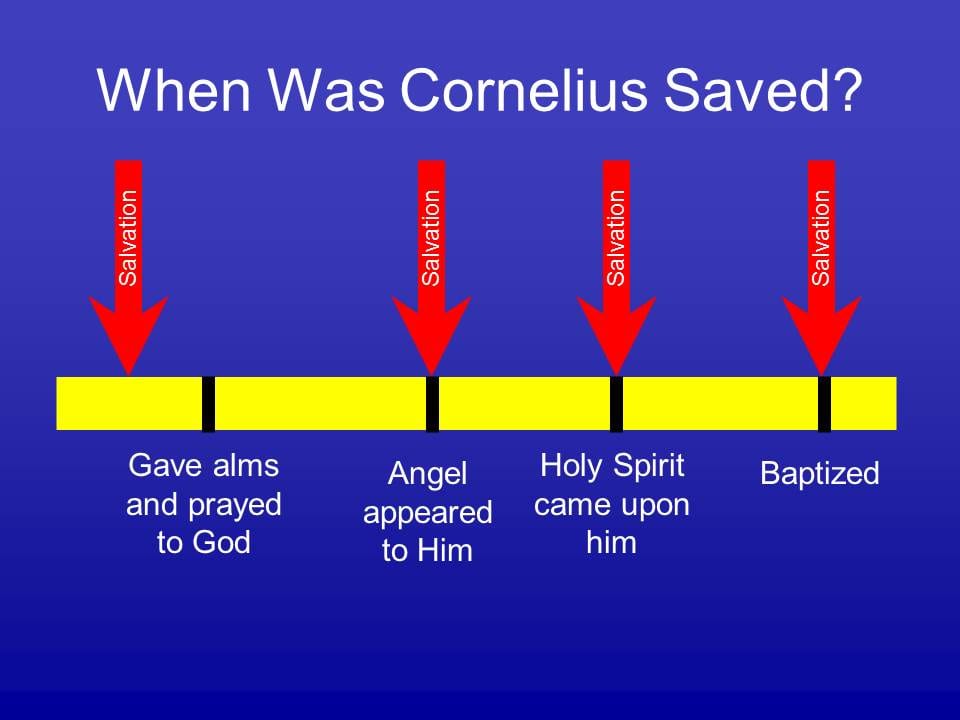 To understand this account, we must ask: at what point was Cornelius saved? According to Acts 11:14, he was not saved before hearing the gospel preached.
This fact poses a major challenge to Calvinism (a theological system taught by John Calvin which emphasizes that salvation is entirely God’s work, claiming humans are completely unable to choose God on their own). Calvinists teach that a person must be regenerated (spiritually reborn by the Holy Spirit) before they can even seek God or believe the gospel.
However, Cornelius was already a devout, God-fearing man before Peter arrived. Yet, the angel clearly stated that Peter would bring the message by which Cornelius would be saved. If Calvinism were correct, Cornelius would have already been regenerated and saved before Peter ever spoke a word. This contradicts the Bible text.
The sudden arrival of the Holy Spirit was a sign designed to overcome Jewish prejudice. At that time, Jewish believers viewed Gentiles as unclean and separate because they did not practice circumcision or follow the Law of Moses. God had to repeat Peter’s vision of the animals three times to convince him to preach to a Gentile (Acts 10:27-29).
Even after the event, Peter was criticized by the church in Jerusalem for interacting with Gentiles (Acts 11:1-2). Therefore, this conversion account is as much about converting the Jewish believers to the idea of universal salvation as it is about converting Cornelius.
Accepting the Gentiles
Jesus abolished the Old Law when He fulfilled it, tearing down the wall of division between Jews and Gentiles (Ephesians 2:11-18). However, the apostles had not yet taken the gospel to the Gentile world.
To overcome generations of cultural and religious separation, God used a dramatic miracle. He poured out the Holy Spirit on Cornelius’s household to show that they were accepted.
This Holy Spirit baptism was not the standard experience for every convert. For comparison, when the Samaritans believed in Acts 8, they did not receive the Holy Spirit in this miraculous way until the apostles laid hands on them (Acts 8:16-18). The miracle in Cornelius’s house was specifically designed to prove that Gentiles had the right to be baptized in water (Acts 10:47-48; Acts 15:7-9).
The baptism of the Holy Spirit here was an exceptional event, not a template for all future conversions. The opening of the gospel to the Gentiles was a massive milestone, just like the launch of the church.
Consider the two unique instances:
- In Acts 2, the Spirit fell on the apostles to show that Jesus was now reigning in heaven.
- In Acts 10, the Spirit fell on the Gentiles to show they had a place in Christ’s kingdom.
Peter later connects this directly to “the beginning” (Acts 11:15), showing it was a rare and historic sign rather than a regular occurrence.
Response to God’s Word Saved Cornelius and His Household
God could have delivered the gospel directly through the angel or the Holy Spirit. Instead, He chose to use human preaching, commanding Cornelius to send for Peter. This demonstrates that salvation requires hearing and obeying God’s message.
Look at the progression of the text:
- Acts 10:6: Peter will tell Cornelius what he must do.
- Acts 10:33: Peter is sent to speak what God has commanded.
- Acts 11:14: Peter will speak words by which Cornelius and his household will be saved.
- Acts 10:47-48: Peter commands Cornelius and his household to be baptized.
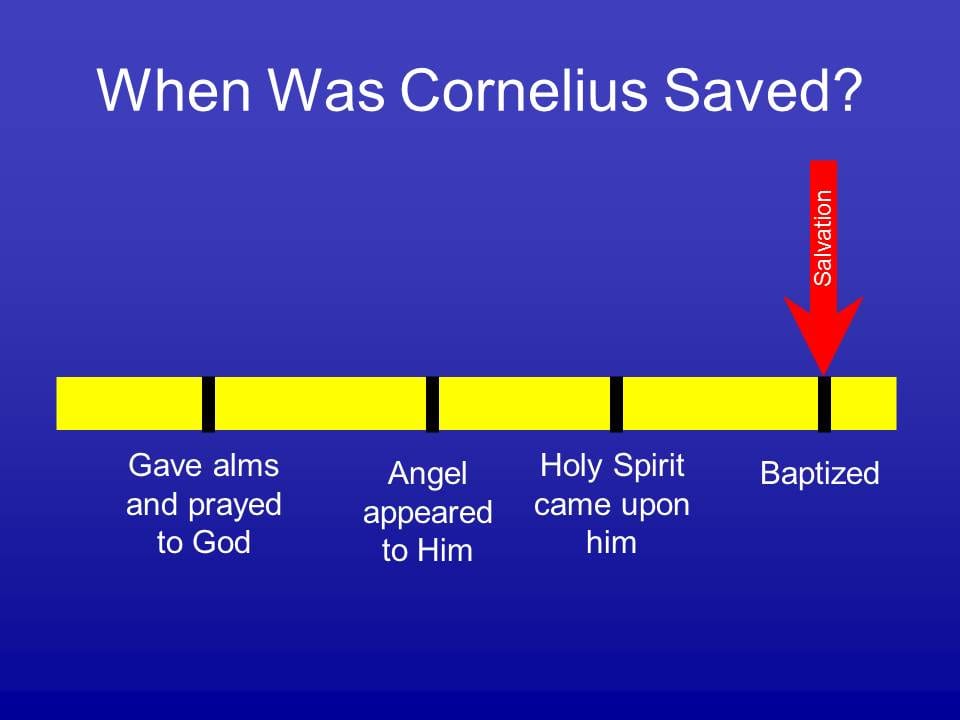
Cornelius was saved by responding to the words of the gospel, not simply by the miracle of the Holy Spirit. If the Holy Spirit’s falling saved him, Peter’s command to be baptized would make no sense. Humans cannot control or command the Holy Spirit; the Spirit moves according to God’s own will.
Instead, Peter commanded them to be baptized in water. This is an action a person can choose to submit to and obey. Water baptism is a command that can be given and a command that can be followed.
 Review
Peter went to a lost man to preach the words of salvation. Cornelius and his household believed the message and were ready to obey.
This matches the Great Commission, where Jesus commanded His apostles to preach and baptize believers for their salvation (Matthew 28:19-20; Mark 16:15-16).
To convince the hesitant Jewish Christians, God poured out the Holy Spirit as a visible sign of approval. Once this divine approval was clear, Peter immediately commanded the Gentiles to be baptized in water.
Later, Peter recounted this event in Acts 15 to prove that God makes no distinction between Jews and Gentiles. All people are saved in the same way: through faith and obedience to Christ.
Following this event, the New Testament records no other instance of the Holy Spirit falling on people in this manner. With the door to the Gentiles now fully open, conversion followed the normal pattern of hearing and responding to the gospel.
The apostles continued to preach the same path of salvation, calling on people to:
- Repent of their sins (Acts 2:38)
- Confess faith in Jesus (Acts 8:36-39; Romans 10:8-9)
- Be baptized into Christ for the forgiveness of sins (Acts 2:38; Acts 8:36-39; Romans 6:1-4; Galatians 3:26-27)
Private Reflection Journal
What is one thing from this study that you can apply to your life today? Jot down your thoughts below.