
Audio version of this lesson available here.
You have likely seen bumper stickers, t-shirts, and videos with the slogan: “I love Jesus but I’m not religious.” Many people present this as a humble declaration of simple faith. However, it often carries a spirit of judgment toward active, church-attending Christians.
Those who hold this view emphasize God’s grace, but they teach that grace requires nothing from the believer. This idea is foreign to the Bible. They often quote Matthew 7:1, “Judge not, that you be not judged.” Yet, they ignore the rest of the passage and the many verses requiring Christians to make moral judgments.
This attitude makes a show of piety (looking devoutly religious) but denies the Jesus it claims to honor.
Defining Religion
Before we reject religion, we must understand what it means. Consider this common dictionary definition:
“a set of beliefs concerning the cause, nature, and purpose of the universe, especially when considered as the creation of a superhuman agency or agencies, usually involving devotional and ritual observances, and often containing a moral code governing the conduct of human affairs.”
Those who reject religion usually object to three things:
- Ritual observances (traditional religious practices or ceremonies).
- The organized structure of a local church.
- A moral code that governs how they live.
But did Jesus actually oppose these things?
The Core Problem
To justify this anti-religious attitude, one must prove that Jesus condemned rituals, church organization, and moral laws. However, the scriptures show that Jesus actually established and encouraged all three. Therefore, rejecting religion means rejecting the very things Jesus set in place. Let’s look at four major problems with this attitude.
Problem 1: Jesus Was Very Religious
During His earthly life, Jesus showed deep respect for the Old Law and obeyed it perfectly. He explicitly stated that He came to fulfill the Law (Matthew 5:17). He warned against taking a casual view of God’s commands and urged His followers to seek true righteousness (moral uprightness under God) (Matthew 5:19-20).
Jesus condemned the Sadducees (a Jewish sect that rejected the resurrection) because they did not know the scriptures (Matthew 22:29). His conflicts with the Pharisees (a strict sect known for oral traditions) were over their man-made traditions, not God’s actual laws. To stress the importance of obedience, Jesus warned that law-breakers would be removed from His kingdom at the final judgment (Matthew 13:41).
True Obedience vs. Empty Rituals
In Matthew 7:21-23, Jesus rejected those who claimed to follow Him but had no real relationship with Him. The problem was not doing good works or following religious practices. The problem was relying on those outward actions while living in disobedience.
Jesus lived a devoutly religious life. He kept the law without a single sin (Hebrews 7:26). The scriptures show that He:
- Studied in the temple as a youth (Luke 2).
- Regularly attended synagogue worship and preached during assemblies (Luke 4).
- Faithfully observed Jewish holy feasts, like the Passover.
Correcting the Abuse of Religion
Jesus fought against hypocrites who abused the law, but He never told people to reject religion. Instead, He told His followers to obey the Law taught by the Pharisees while avoiding their hypocritical examples (Matthew 23:1-3).
He also defended the strict practice of the tithe (giving a tenth of one’s income to God). He said that while they must practice justice and mercy, they should not neglect their regular tithing (Matthew 23:23-24).
Problem 2: Jesus and His Apostles Established a Religion
Some people try to separate Jesus from His apostles. They accept Jesus but reject the doctrine (the set of core teachings and beliefs) taught by the apostles. However, these two cannot be separated. Jesus gave the apostles full authority to teach in His name.
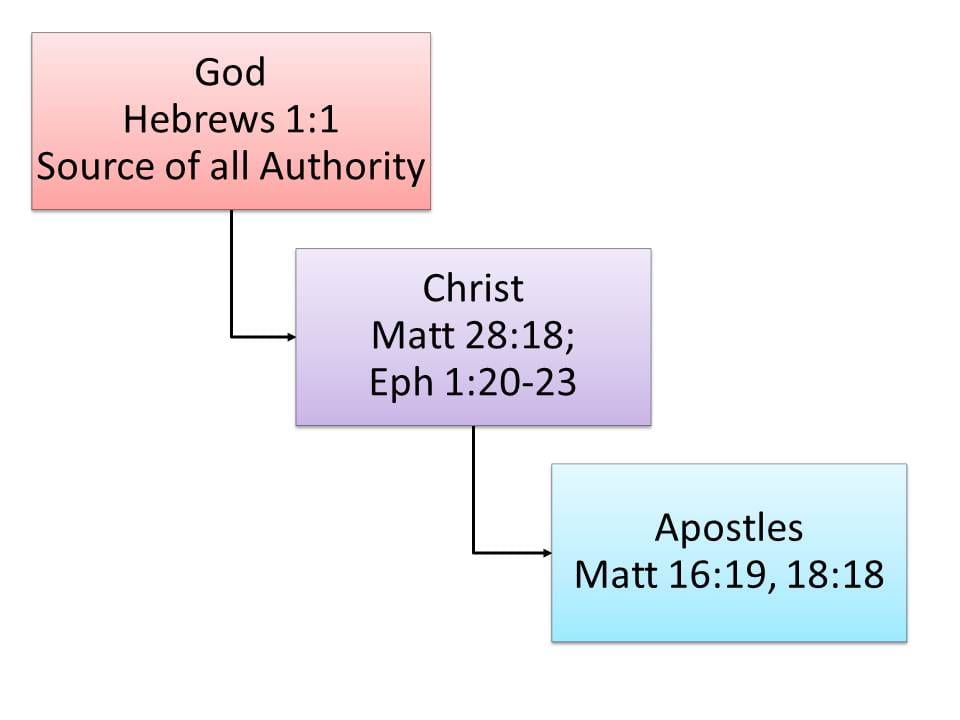
As shown above, all authority flows from the Father, through Jesus, to the apostles. The New Testament condemns anyone who departs from Christ’s teachings (2 John 7-11), follows human traditions (Matthew 15:1-9), or accepts any other spiritual authority (Galatians 1:6-9; 2 Timothy 3:16-17).
The Church and Its Rituals
Jesus Himself founded the church. In Matthew 16:18, Jesus promised to build His church. Far from being a human invention, the church is the body of Christ (Ephesians 1:22-23) and a reflection of God’s deep wisdom (Ephesians 3:10-13).
Jesus also established specific religious practices (rituals):
- On the night He was betrayed, He created a memorial meal (the Lord’s Supper) for His followers to observe (Matthew 26:26-28; 1 Corinthians 11:17-34).
- He commanded His disciples to baptize believers and teach them to obey everything He commanded (Matthew 28:19-20).
Accountability and Commandments
Jesus established rules for dealing with disorderly (unruly or non-conforming) members within the church (Matthew 18:15-20). The apostles reinforced this need for order and discipline in several letters (2 Thessalonians 3:6-15; 1 Corinthians 5:1-5).
Indeed, Jesus equated our love for Him with our obedience. In John 14:15, He said:
“If you love me, you will keep my commandments.”
A Strict Moral Code
Christ’s strict moral code contradicts the idea of a demand-free faith. For instance, Jesus held a very strict view of marriage and divorce (Matthew 5:31-32; Matthew 19:3-12).
Furthermore, the apostles warned against:
- Sexual immorality (sexual activity outside of marriage).
- Filthy language.
- Materialism (valuing physical possessions more than God).
The Bible describes these behaviors as completely inappropriate for Christians (Ephesians 5:3-12; Romans 1:18-32).
True Religion in the Bible
The Bible actually praises true religion (genuine, active faith in action). In James 1:26-27, it defines pure religion as caring for orphans and widows while keeping oneself unstained by the world.
Paul warned that a time would come when people would reject sound teaching. He said they would seek teachers who support their personal desires while maintaining an appearance of godliness (2 Timothy 3:1-9; 2 Timothy 4:1-5).
Many who reject religion also refuse to state that Jesus is the only way to salvation. Yet, Jesus Himself insisted that He is the only path to the Father (John 3:16-18; John 8:24; John 14:6-7).
As author Kevin DeYoung observed:
“If religion is characterized by doctrine, commands, rituals, and structure, then Jesus is not your go-to guy for hating religion.”
Problem 3: It Blames True Christians for the Sins of Hypocrites
Some who reject religion claim that religious people cause more suffering than good. This argument ignores the countless acts of service performed by humble Christians. While atrocities have been committed in the name of Jesus, these actions violate Christ’s commands. True Christians condemn them.
Jesus did not reject God’s law just because the Pharisees practiced it hypocritically. He corrected their errors while upholding the holiness of the Law. The problem lies with hypocritical people, not with God’s design.
The Danger of Political Alliances
Some churches align with political parties, but this does not represent all Christians. We must keep politics out of the pulpit. The church’s mission is to change hearts through the gospel, not the ballot box.
Some groups have co-opted (taken over) the name of Christ to pursue political power. This has happened throughout history, from the Holy Roman Empire to modern political debates. However, Jesus made it clear that His kingdom is not of this world.
The Error of Carnal Warfare
Similarly, wars fought in the name of Jesus do not have His approval. Opportunistic leaders have used Christ’s name to wage war, but this violates the teachings of the Prince of Peace.
Many Christians are pacifists (people who oppose war and violence). The New Testament teaches that the warfare of a Christian is spiritual, not physical (2 Corinthians 10:3-5).
It is a mistake to condemn Christ’s religion just because some have used His name to gain power or wage war. Condemning the church for the actions of hypocrites is both misleading and unfair.
Problem 4: It Can Be Used to Justify Immoral Living
The moral code of Jesus and His apostles is demanding. Yet, some use the slogan of “non-religion” to defend behaviors like sexual immorality, materialism, and vulgar language. They hide behind a selective use of “judge not.”
These movements emphasize a man-made grace where everything is acceptable. They ignore the biblical grace that calls people to repentance (sincere regret and turning away from sin) (Romans 2:4). They want the Jesus who forgives, but they forget the Jesus who commands: “Go and sin no more.” (John 5:14; John 8:11). They forget that Jesus is also the Judge who will weigh our actions (John 5:30; John 12:48; Matthew 12:36).
Doing What is Right in Our Own Eyes
This attitude is not new. Throughout history, people have rejected God’s laws so that “every man did what was right in his own eyes” (Deuteronomy 12:8; Judges 17:6). But the Bible warns:
“The way of a fool is right in his own eyes, but a wise man listens to advice.” (Proverbs 12:15)
A Hospital for Healing, Not Remaining Sick
Many say the church is a hospital for the broken. This is true; Jesus is indeed the physician for those sick with sin (Matthew 9:12). However, patients go to a hospital to get well, not to remain sick.
Jesus calls us to leave the filth of the world and live pure, holy lives (2 Peter 1:3-4; 1 Peter 4:1-5). God calls us to offer our lives as a reasonable service (sensible worship and duty) to Him (Romans 12:1). He wants us to be holy because He is holy (1 Peter 1:15).
Conclusion
Like many believers, I am deeply grieved by the hypocrisy, materialism, and scandals in the religious world. I mourn the history of violence and political abuse carried out in the name of Christ. Much of the modern “Christian” world represents a distorted faith that has left the simplicity of the New Testament.
However, we cannot reject the true religion of Christ just because some have abused it. If you truly love Jesus, you will love the religion He established. This is the faith described in the New Testament—one that reflects the glory, holiness, and righteousness of our Lord.
Private Reflection Journal
What is one thing from this study that you can apply to your life today? Jot down your thoughts below.