

Kyle Maynard’s Story
Kyle Maynard wrestled in high school and in college for the Georgia Bulldogs. He set records in weightlifting, fought in mixed martial arts, and even climbed Mt. Kilimanjaro, the highest mountain in Africa. These are amazing achievements for anyone. However, they are even more remarkable when you consider Kyle’s physical condition: he was born with congenital amputation (a condition where a person is born without limbs). Most of his arms and legs were not there at birth.
According to his biography, Kyle’s parents told him that the world was not designed to meet his needs. He would have to find ways to adapt to how the world works.
“With basically two elbows he can type up to fifty words per minute on a normal keyboard, eat and write without any adaptations, drive a vehicle that has little modification, and live on his own in a three-story townhouse in Atlanta, GA.”
Because of this mindset, Kyle learned to feed himself, shave, and take care of his daily needs on his own.

Kyle faced many difficult challenges. During his first two years of wrestling, he lost every single match. However, with an iron will and the support of his parents, he went on to win 36 varsity matches and defeat several state champions. He also bench-pressed 240 pounds 23 times, and lifted 420 pounds using leather straps and chains.
“In April of 2009, Kyle became the first quadruple amputee to step into the cage and compete as an amateur mixed martial arts fighter. Kyle’s focus is on grappling and ground fighting — he’s currently in his 7th year studying Brazilian Jiu-Jitsu and now training with Renzo Gracie black belt Paul Creighton.”
Kyle achieved great success because he took full responsibility for his life instead of giving up because of his physical limitations.
Taking Responsibility Means Giving Up Your Excuses
In Matthew 25:14-30, Jesus told the Parable of the Talents. In this story, a master went away and entrusted his servants with different amounts of money. He expected them to use that money to earn more for him while he was gone.
Although the master had different expectations for each servant, he expected all of them to make an effort. When the master returned, two of the servants had succeeded and made a profit. However, the third servant failed because he let fear hold him back. He thought he was playing it safe by burying the money, but the master was angry and punished him for being a lazy, useless servant.
This is a parable of judgment (God’s evaluation of our lives). The story is not really about managing money; it is about using what God has given us for His glory. God will judge us on how we use or waste our lives and the blessings He has provided. Two of the servants made a proactive choice, while the third made an excuse.
“So then each of us will give an account of himself to God” — Romans 14:12
What is Responsibility?
There are many ways to define this word. For our study, we can define responsibility in three ways:
- Having a duty to deal with something or having control over someone or something.
- Being accountable or answerable for the outcome of an action.
- Having the opportunity and ability to act independently and make decisions.
True responsibility means that trust is placed in you. People expect you to fulfill your obligations without needing to be told or threatened. It means accepting both the good and bad consequences of your actions, and stepping up to your duties instead of running away from them.
Accepting Responsibility is the Essence of Maturity
God has given us free will, which is the freedom to choose how we live. We are not robots programmed to follow a set path. God does not force us to obey Him or keep us from sinning.
Like the servants in the parable, we have massive freedom in how we use our resources. We are stewards (managers of God’s property) of the lives He has given us, and He will hold us accountable for what we do and what we fail to do. God has given us the driver’s seat of our own lives.
I remember when I got the keys to my first car. Those keys gave me the freedom to go wherever I wanted, whenever I wanted. I did not have to rely on anyone else for a ride, and I could finally go on dates.
However, that freedom came with a price. I was responsible for buying gas to keep the car running. I had to wash and clean it myself if I wanted it to look good. Most importantly, I was accountable for my own safety and the safety of my passengers.
One night, I almost killed myself and two friends because I was driving foolishly. That night taught me a vital lesson: when you are given the keys to freedom, you are also handed responsibility and accountability.

God has given you the keys to your life. With those keys come freedom, responsibility, and accountability. The apostle Paul wrote in 2 Timothy 3:16-17 that Scripture equips us for every good work. Because of this, we cannot blame God or make excuses that we do not know what to do.
One of the most sobering passages in the Bible is Romans 14:12:
“So then each of us will give an account of himself to God.”
We must answer to God for how we lived our lives. This includes both the choices we made and the things we failed to do. Another passage, 2 Corinthians 5:10, says:
“For we must all appear before the judgment seat of Christ, so that each one may receive what is due for what he has done in the body, whether good or evil.”
When we stand before God, we stand alone. Our parents cannot answer for us. Our preachers or church elders cannot answer for us. We cannot blame or take credit for anyone else’s choices. We will receive a reward or punishment based solely on what we have personally done.
Avoiding Spiritual Responsibility
Sadly, many people fail to accept responsibility for their own spiritual lives. Some churches are filled with members who are spiritually weak and biblically illiterate because they have never put serious effort into their growth.
Churches desperately need strong Christians who are grounded in God’s Word. We need believers who are willing to live holy lives and serve others. Too often, a tiny handful of people do all the work in a congregation, while the majority are content to sit back and let others serve.
The Trap of Perpetual Adolescence
Another common problem is that some people simply refuse to grow up. Most of us know the story of Peter Pan, the boy who lived in Neverland and never wanted to grow up. Today, our culture actually encourages this mindset. With an endless supply of entertainment, media, and distractions, it is easy to remain in a state of constant childhood.
Many young people do not want to leave their playtime behind and transition into responsible adulthood. For example, the video game industry now targets young adult men rather than children. While playing games is not inherently wrong, things like gaming, laziness, or hobbies can sometimes lead to perpetual adolescence (being stuck in a childish state forever).
As the Bible says in 1 Corinthians 13:11, there comes a time when we must put away childish things and take responsibility.
Instead of seeking responsibility, many people actively avoid it. They prefer to let others do the heavy lifting. They wait for someone else to tell them to work, choosing comfort over effort.
This passive attitude leads to adults who refuse to do hard work, expect to be served rather than to serve, and chase temporary pleasure. They miss out on the deep satisfaction of overcoming life’s challenges. As Proverbs 10:5 warns:
“He who gathers in summer is a prudent (wise) son, but he who sleeps in harvest is a son who brings shame.”
Help Others With Their Burdens
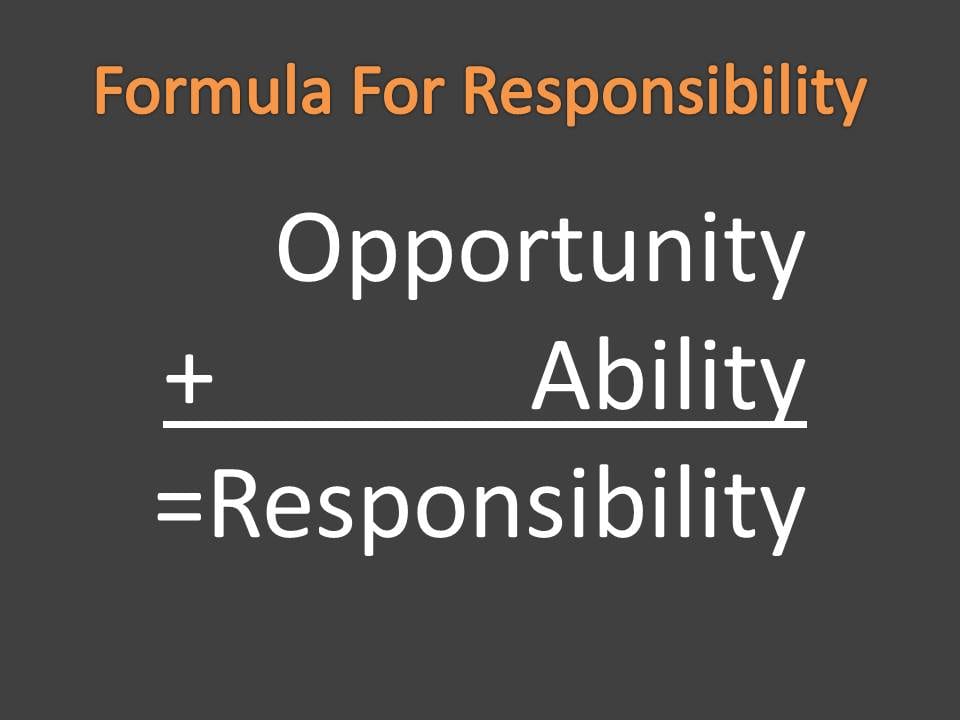
A true Christian does not sit on the sidelines; they step up to serve God and others. We should actively look for ways to help rather than waiting to be asked. In 1 John 3:16, we are told that when we see a brother in need, we must open our hearts and hands to help.
If we have the ability to help, the situation itself is our call to action. Whenever opportunity meets ability, it creates responsibility.
Be honest with yourself about what you can do. You might not have the money to help someone, but you can donate your time, strength, or skills. Often, the greatest need is not financial; people frequently just need a listening ear, a friend, or a word of encouragement.
Bear Your Own Burden
While we should help others when they are overwhelmed, every person is ultimately responsible for carrying their own load. You can read about this in Galatians 6:1-5.
Be careful: some people will gladly let you carry all of their burdens. They might try to make you do their work, demand all of your time, and make you feel guilty for not doing more. Remember that while you can support them, they must take responsibility for their own choices and lives.
Years ago, I spent several hours helping a married couple who had marital problems and struggled to raise their kids. I gave them some practical steps to improve their situation. A few weeks later, they called me in the middle of my own family time, panicking and demanding that I come over immediately.
I asked them if they had tried the advice I gave them. They admitted they had not. I told them to talk through those steps first, because I was not going to come over just to repeat myself.
I did not feel guilty about this choice. If I had gone, I would have sacrificed my own family time for people who refused to help themselves. Until they decided to make different choices, they would have to face the consequences of their actions.
Conclusion
We have countless opportunities to let God’s light shine through us, but we must actively look for them and step up. We cannot wait for someone to ask us to do what we already know is right. Choosing to live a responsible, active life will enrich you, bless the people around you, and bring glory to God.
Private Reflection Journal
What is one thing from this study that you can apply to your life today? Jot down your thoughts below.