
 Accept Responsibility for Your Failures
Think of the last time you did something wrong. Why did you do it? Here are some common excuses:
- “My brother (or friend) made me do it.”
- “Everyone else was doing it.”
- “The Devil made me do it.”
When we do something wrong, it is easy to blame someone else. We see this pattern all the way back in the Garden of Eden. When Adam and Eve ate the forbidden fruit, Adam blamed Eve for his sin. He even blamed God by pointing to “the woman you gave me.” Eve then blamed the serpent (Genesis 3).
Later in history, King Saul blamed the people for his own disobedience (1 Samuel 15). But the truth is clear: when we do something wrong, we can only blame ourselves.
You Control Your Choices
Other people might pressure you to do the wrong thing. They may tempt you to disobey your parents or God. But in the end, you choose whether to obey or disobey.
It can be difficult to make the right choice, especially when you feel embarrassed or pressured. However, you always have the power to make the right decision.
When I was in high school and college, I had a sign in my room with a quote attributed to the British Foreign Office*:
“Never excuse. Never explain. Never complain.”
When you complain or blame others, you say that they control your life. Irresponsible people always have excuses for why they couldn’t finish a task, do their chores, or keep their word. They offer long stories about what went wrong. They complain about a lack of time, resources, or how other people got in their way.
The sign served as a reminder to government officials to do their duty and keep their word. Nobody wants to hear excuses or complaints. That is why I kept it on my wall.
Be strong and accept the consequences and embarrassment when you make a mistake.
Avoid Irresponsible Responses
One of the worst reactions is the “non-apology.” This sounds like:
“I’m sorry if I did anything wrong.”
Either you did something wrong, or you didn’t. This kind of statement avoids the obligation to apologize. It shifts blame to others and makes excuses rather than owning the behavior. We must accept full responsibility for our actions and our reactions.
How to Give a Responsible Apology
A genuine, responsible apology sounds like this:
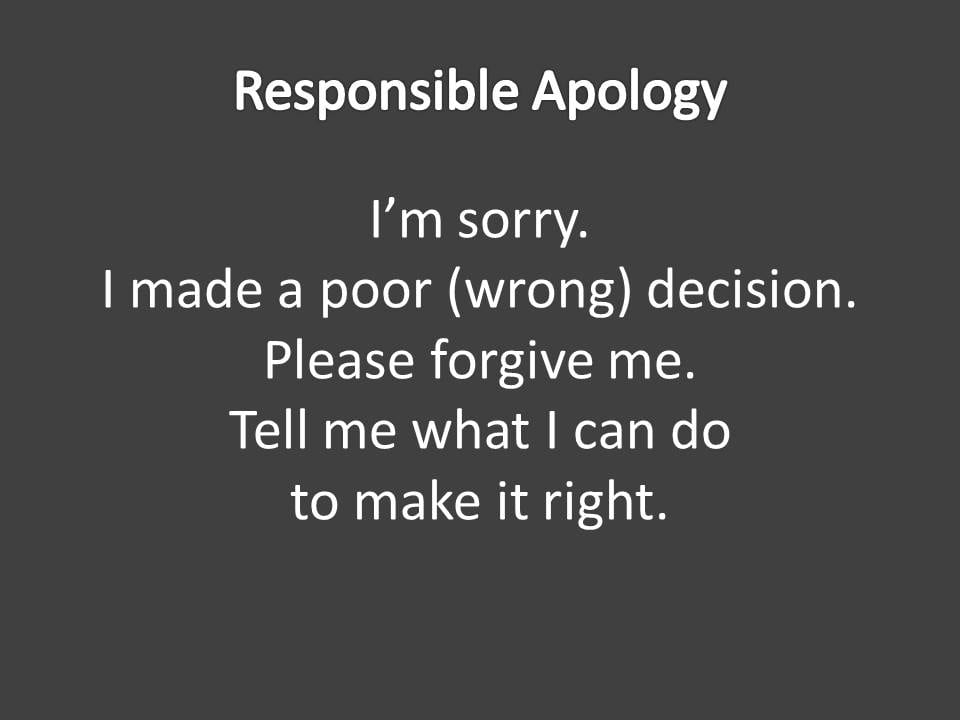
“I’m sorry. I made a wrong decision. Please forgive me and tell me what I can do to make it right.”
A real apology has four key parts:
- Acknowledge the pain: Admit that your choices hurt or inconvenienced someone else, and express sincere regret.
- Take full ownership: Accept responsibility for your action without making excuses or long explanations.
- Ask for forgiveness: Request their forgiveness directly because you need to restore the relationship.
- Offer restitution: Ask how you can correct your mistake. You might need to replace something, apologize to someone else, or repair the damage. Even if you cannot fix it, offer to do what you can and act quickly.
When you apologize sincerely, you take responsibility, bring honor to your character, and glorify God.
*I have tried to verify this quote but have had little success confirming it. Any concrete attribution would be appreciated.
Private Reflection Journal
What is one thing from this study that you can apply to your life today? Jot down your thoughts below.