
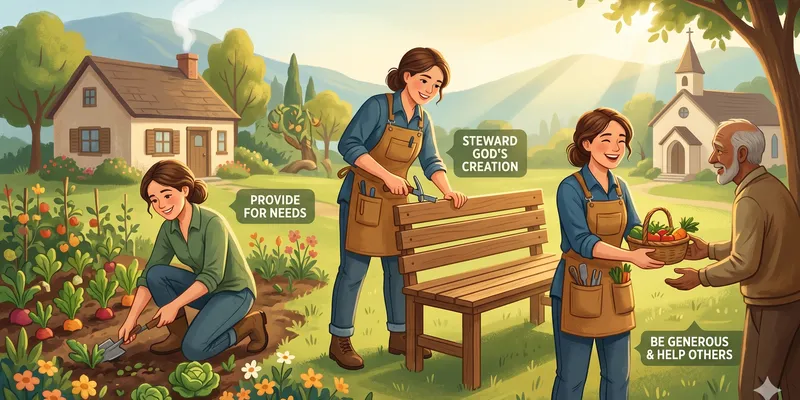
God Created Humans to Work
God set the ultimate example of work when He created the universe. During the creation week, He worked diligently to design our world, Genesis 2:1-3.
The Bible tells us:
“And on the seventh day God finished his work that he had done.”
When God created human beings, He immediately gave them a job to do.
In Genesis 2:5-15, we see that God placed man in the Garden of Eden to care for it and maintain it. Work was a natural part of human life from the very beginning. Even after the first couple sinned and were sent out of the Garden, they continued to work, though their labor became much more difficult and challenging.
The Sabbath: A Gift of Rest
Under the Old Testament law, God commanded His people to keep the Sabbath (a weekly day of rest and worship), Exodus 20:8-11. This day of rest served as a reward for their weekly labor and a special time to honor God.
As Exodus 23:12-13 shows, the Sabbath was designed to refresh both workers and animals. God never intended for us to work constantly without stopping. He wants us to balance honest labor with restful refreshment.
The Purposes of Work
Why does God want us to work? Scripture gives us three primary reasons:
1. To Provide for Our Needs
Working allows us to meet our daily physical needs. Honest labor brings personal benefits and rewards.
Here are a few wisdom principles from the book of Proverbs:
- Proverbs 12:11-14 – A person’s hard work directly benefits them.
- Proverbs 16:26 – The natural hunger we feel serves as healthy motivation to keep working.
- Proverbs 28:19 –
“Whoever works his land will have plenty of bread, but he who follows worthless pursuits will have plenty of poverty.”
We also see a beautiful example of hard work in the description of the virtuous woman in Proverbs 31:
- She works with wool and flax to create clothing (v. 13).
- She carefully prepares food for her family (v. 14-15).
- She invests her earnings to plant a vineyard (v. 16).
- She works late into the night and takes pride in her accomplishments (v. 18).
- She makes garments for her family and sells quality goods to merchants (v. 19, 24).
- She avoids laziness, never eating the “bread of idleness” (v. 27).
Because of her faith and industrious spirit, she is highly praised by her husband, her children, her community, and the Lord.
2. To Be Generous to Others
We work not just for ourselves, but to help those who cannot support themselves.
The virtuous woman in Proverbs 31:20 reached out to help the poor and needy. Similarly, the Old Testament law commanded farmers to leave the edges of their fields unharvested. This practice, known as leaving the gleanings (grain or produce left behind after harvest), allowed the poor to come and gather food for themselves.
In the New Testament, Christian work is directly connected to generosity.
The apostle Paul wrote in Ephesians 4:28:
“Let the thief no longer steal, but rather let him labor, doing honest work with his own hands, so that he may have something to share with anyone in need.”
Paul urged believers to work so they could be financially independent and have the means to bless others. He also commanded those who are wealthy to be generous and rich in good deeds, 1 Timothy 6:17-19.
We see this generous spirit in the early church as members willingly shared their resources, Acts 4:32-37. Even during a severe famine, the Macedonian churches gave joyfully and generously beyond their means to support their brothers and sisters in Judea, 2 Corinthians 8:1-5, 11-15. They used their temporary abundance to supply what others lacked.
3. To Honor God with Our Possessions
Under the Old Law, God commanded Israel to bring their tithes (a tenth of their income or agricultural produce) and firstfruits (the very first and best of the harvest) to the Lord, Deuteronomy 26:1-19. Giving the firstfruits was a step of faith. It showed complete trust that God would continue to bless their remaining crops and herds.
These offerings supported the priests and Levites who served in the tabernacle (the portable tent-sanctuary used before the temple was built), and they also helped those in need. Giving was to be done with a whole heart, recognizing God as the source of every blessing.
As Proverbs 3:9-10 states:
“Honor the Lord with your wealth and with the firstfruits of all your produce; then your barns will be filled with plenty, and your vats will be bursting with wine.”
Today, Christians are not under the Old Testament command to tithe. Instead, we are called to give generously and cheerfully from the heart.
Just as Old Testament offerings supported the physical tabernacle and temple, our gifts today serve vital purposes:
- Maintaining our place of worship
- Providing financial support for gospel preachers
- Purchasing educational materials for Bible classes
- Assisting fellow believers during times of financial hardship
Private Reflection Journal
What is one thing from this study that you can apply to your life today? Jot down your thoughts below.